Thursday, May 28, 2015

Mrs. Smucker Hacks the Machine and Saves the World

There actually are things I like about electronic devices.  Or, more accurately, services they offer:

1. Email
2. Texting
3. film-less photographs
4. Blogging
5. Amazon, where one can buy shipping envelopes and obscure batteries without driving to town

And there are things that I absolutely despise about electronic devices.

1. They have creepy, secretive, stubborn, vindictive little minds.
2. They don't like me.
3. They are utterly disposable and unfixable.

We will focus on point #3 today.

The bigger problem here, and you do not want to get me started on it, is that we rich Westerners are all about consuming cheap breakable gadgets that are cheap only because some poor soul on the other side of the world is working long hours and inhaling chemicals and twisting wires with his teeth, and earning less in a month than you do in one day.

This means, among many other things, that IN AMERICA WE CANNOT FIX THINGS.

This is how it works.

I bought a pressure washer once upon a time.  It cost maybe $60 which for me is a substantial investment in a cleaning gadget.  It had a little yellow body the size of a 4-slice toaster, an electrical cord, a place to hook up the garden hose, and a long black tube with a gun thing on the end where the water shot out so I could clean a winter's worth of dog tracks off the porch.

One day the pressure washer stopped working.  I forget the actual issue, but it couldn't serve its purpose.

So, being a frugal and sensible former Midwestern Amish farm girl, I set forth to fix it.

I assume I asked Paul, since I always do, and he must have said it was beyond his capabilities.

I hunted a long time and found an address for a place in Eugene that repairs pressure washers.  Then I hunted even longer and found the place on a side street.  I took my cute little washer into the shop, where huge muscular washers the size of file cabinets sat around on the concrete floor like a bunch of Great Danes taking a break from eating cats.

I asked the large bearded man behind the counter if he could please repair my pressure washer.

He took one look at the machine I carried and turned to me in complete disbelief.  No.  Absolutely not.  He wouldn't even take a look.  Fixing it would be far more expensive than buying another one.

I knew he thought, but did not say, "Crazy woman."

We left, sadly, while the big washers nudged each other and rolled their eyes and grinned.

I like to have things I can fix if they break.

Such as the wooden chairs from Paul's mom that are over 100 years old.  When the bar across the legs gets loose, Paul glues it back in.

When my old sewing machine began clattering, I spent several hours taking it apart and then discovered it was all due to a bent needle.  Kind of embarrassing, but oh so satisfying to fix it myself.

Things like apple peelers, hinges, jeans, and roofs are all made of understandable components.  Thus, when they malfunction, they can be fixed.

I like that.

Other things, still in perfect condition but for that one tiny hidden electronic glitch, cannot be fixed and must be disposed of.

It drives me crazier than it should.

But still.  It's not just about a calculator or Magic Bullet.

It speaks of great economic disparities and terrible stewardship of the resources God gave us.

However, despite all this, at the moment I am very happy.

Because this week I outwitted an electronic device.

Yes.

We have a printer that we use a lot, for sermons, to-do lists, photos, and much more.

Like all electronic devices, it has a mind of its own and communicates with us through a flat little screen, where one must perform obeisance in the form of pressing the right little pictures with one's finger.


If t runs out of ink and you insert a generic ink instead of the Sacred Epson Fluid, it makes nasty little beeps and makes you click through about 4 screens before it grudgingly prints.

But after printing mostly-cooperatively for a number of months, suddenly it stopped.  A nice document was turned to a vague bunch of dots every few lines.

I changed the black ink.

It didn't help.

I ran it through the maintenance procedures twice.

No change.

I put in yet another new black ink, desperately, and requested more cleaning and maintenance procedures.

Nothing.

Since this is one of the Unfixables, Paul bought another printer and set it up by his recliner where he does paperwork.  The old printer can go to Goodwill, he said.

But!!  We had all this ink we just bought!


Stubbornly, I kept begging this printer to work.  Please?  If I push "Setup"? Or 'More Functions"? Or run the cleaner once again?  Or offer incense and garlands of hibiscus??

It went bzzeeeeeep ca-dunk ca-dunk, but it didn't print.

Hey! I had tried to print the black ink only.  Maybe...

Sure enough, it printed perfectly in yellow, cyan, and magenta, otherwise known as yellow, blue, and bright pink. And in combinations thereof, such as green and purple.

Hmmm.  We could all print our documents in purple.  The day was saved.

Ben and Emily grimaced.  Seriously?  Thermo-fluid Dynamics assignments in purple?

Sigh.

I had another wonderful idea.  Maybe I could fool the printer!  I popped out the cyan (blue) ink cartridge and sneakily pushed in a black cartridge instead.

Oh my.

The printer was NOT HAPPY.

Angry thumps and noises came from its bowels, disparaging words lit up on the screen, threatening wrath and condemnation.

"HOW DO YOU KNOW, you stupid printer?" I wondered.  It was creepy.  How in the world would it know black from blue if the cartridges are the same shape?


I inspected the cartridges.  And there was a mysterious little chip on the front with a strange golden pattern.

Aha!

Gleefully, where the printer couldn't see me, I pried the little chips off the nearly-empty cyan cartridge and one of the rejected black cartridges.  Then I glued the chip from the blue onto the black.

And nonchalantly inserted it into the cyan slot.

Two bzeeeps followed, but no nasty messages.

In Microsoft Word, I changed a black document to blue, and then told it to print.

Oh the suspense.

Ca-chunk, zeeeeeeeeee, click click.

And out came the document.  In black.

YES!!!  I had both outwitted the machine and saved it from the landfill.

Sermons could now be printed again, I told the family.  And homework assignments and engineering diagrams and my speech for the Mother-Daughter tea, and checks for the warehouse employees, and grocery lists.

My children, yes, those offspring who communicate with electronics in fearless harmony, as starlings understand the wind and fly without conscious thought, they were impressed.

"Mom!  You hacked it!"  Emily said.

"HACKED it?"  Hacking is what pale brilliant 20-year-olds do in musty basements.  Moms my age do not hack.

Except maybe we do.

"That's what it's called!" Emily insisted.  "You fooled the machine.  And got around the system!  So, you hacked it!"

Really?  Little old me??

I was very happy.

Quote of the Day:
Jenny started a new job this week at Grocery Depot where Amy and Emily used to work.  I'm told this conversation took place the other day:
Donna the manager: I'm kind of worried about hiring and training two new people at one time.
Sarah Beth: Well, you won't have any trouble with Jenny.  She's like a miniature Amy.
Donna: Wow! I didn't know Amy could get any smaller!

Friday, May 22, 2015

The Wonderful Idea

I have a lot of ideas that I share with Paul, and they are sort of like horses trotting out of the corral, and he leans on the fence and watches them go, and makes non-committal comments occasionally, then answers his phone and orders tags for the 5-grain Ben is bagging tomorrow.

Other times he shocks me by randomly grabbing a particular horse, leaping on its back, and riding it as far as it will go.

Such as when we were in Kenya, driving home from school in that dusty white Peugeot, and I said offhandedly, "Maybe we should adopt Steven."

Which led through about 9 months and 50 miracles, and then Steven was really our son.

Recently we had an old machine shed at the warehouse torn down, and we were thinking about projects and salvageable materials and big lovely slabs of weathered wood, and I said, dreamily, knowing it was an idea as far off and unreachable as the moon, "I would love to have a little writing cabin by the creek."

Well.

By happy coincidence this was suggested after Paul had decided to end his teaching career, and suddenly he realized that he might actually have some TIME, that elusive commodity missing for the last 20 years, and we had all these cool old boards, and he loves to make things with wood AND--oh happy prospect--a project like this could cover at least a year's worth of Valentine's Day, Mother's Day, birthday, anniversary, and Christmas, if he played it right.

So I have been browsing Pinterest and eagerly sketching on graph paper, and Paul has been planning and measuring.

I needed a file for my ideas, and then I needed a name to write on the file.

"Writing Cabin" was kind of dull.  It needed an actual NAME, like they used to do in England, or in the Anne of Green Gables books.  Like Green Gables.  Or Whispering Winds.

I went online and discovered that there are actual websites for generating names of people and places.  Most of these are for gamers ("Ebonshield"  "Slydrift" ) but they're also for writers and people who want an actual name for a real place.  One such site promised to help you name a real house or building, which is what I wanted.  It lavishly proclaimed that it could generate over 1 trillion names!!!

All right then. I clicked.

First I needed to give the generator some clues, such as colors, foliage, natural features, and type of building.  I chose "oak" for the foliage, "creek" for the natural feature, and "cabin" for the type of building.

And clicked, imagining a long list of tasteful and imaginative names.  Gears ratcheted and motors whirred, and the result popped up before me.

Yes.  One result.  In bold letters.  The eagerly awaited name.

"OAK CREEK CABIN"

Sometimes, that is how my life goes.

So then, since there is lots of hawthorn along the creek, Paul suggested Hawthorn Cottage, with the double meaning of the plant and also suggesting Nathaniel Hawthorne, which is impressively literary of him, but Jenny said it would be confusing, and I agreed.  I asked if it would hurt his feelings if I didn't use his idea, since I worry about these things.  He said no.

I thought we should invoke the oaks, which led me to the charming but not too cutesy, I hope, Acorn Cottage.  12 hours later, I still lean toward this one.

Maybe our minds are better name generators than any braggy website.

Meanwhile, I can't explain how thrilled and amazed I am at the prospect of an actual rustic little cabin to write in, and to escape to on summer nights when the house is never silent, and for Jenny to have slumber parties in, and to use for private conversations with people who need a cup of tea and a listening ear.

Let us hope that Paul can stay on this horse despite harvest, preaching, and all the other distractions potentially calling him off the trail.

Quote of the Day:
[So there was this scary item in the news, where someone died of botulism from potato salad at a potluck.]
Me: The Poisonous Potluck.  That would be a great name for a Mennonite novel.
Jenny: Yes, except some Mennonites don't believe in calling them potlucks.  The Poisonous Carry-In doesn't sound as good.  Or The Poisonous Fellowship Meal.

Tuesday, May 12, 2015

Cats and Lilacs and Stuff I Cannot Say

Recently a young online friend named Bethany Eicher blogged about the difficulties of writing during those seasons when almost nothing in your life is ok for public consumption.

"You have to write something," I told myself. "It's been over a week since you wrote and your last posts were pathetic!"
"I can't help it," I argued. "I just can't write right now!"
"Write about the picnic you and Chris went on," I told myself. "You could make a good story out of that!"
"No." I argued. "It's too complicated. I don't feel like going to all the work."
"Write about all the beauty of Spring! All the green and the forsythia and the redbuds and the dogwoods...how it makes you think of home..."
"Naaah. Same old surface-y stuff. It'll be obvious I'm empty of words and just making stuff up!"
"Well then, write about the abscence of words and how when dark things are hiding in the back of your mind it's impossible to write..."
"Good grief. No. What is this, a broken record?"
"Ok. Fine. Do what your friend suggested and write about some tips for making your marriage better!"
"Oh please. I hate preachy blog posts. Besides, I tried twice and it just sounds lame. What do I have to say about tips for marriage anyway? Look at the big go around we had this week! And I'm not going into that; no."

I left a sympathetic comment about those times when you're left with posting pictures of lilacs and the cat because 98% of your life can't be shared.

So the next day Bethany did a "guest post" from me--with a picture of a cat and another of lilacs.

I laughed.

Well, I am down to cats and lilacs myself, so to speak. I have miracles on the brain, and disappointments, and healings, and words I finally said, and wounded places that still need oil and wine, and astonishment at God's presence over here, and wondering if he is ever going to show up over there, and that sad story "Crystal" told me, and the young man I stalked on Facebook who would be a nice match for That Lovely Daughter but no one shares my enthusiasm, especially the daughter.

However, I feel guilty even mentioning these things without explaining further, lest I be like Those People on Facebook who post mysterious updates seemingly designed to make you both sympathetic and intensely curious:

"A sad day when "Christian" people say they'll be your friend but then they let you down!!"

"Really really scared right now.  Who can I trust??"

"Ok, here goes.  Somebody come feed my cat if this doesn't turn out well."

"AAAAAAHHHHHH so excited!!!!  Got a phone call that will CHANGE MY LIFE!!"

What I am trying to say is, we who write find ourselves feeling obligated to keep up the momentum.  Also, we give you the impression, usually unintentionally, that you know all about our lives and relationships and past and cobwebby corners.

Sorry.  It's an illusion.  We don't tell that much, and you don't know that much.

But isn't this true for everyone, writers or not?

Twice recently I had friends who seem strong and capable suddenly dissolve in tears, overcome with the raw truths of their lives.

I thought, "Where did THAT come from?"

It came from the well inside each of us, that place where things bubble and swish and fill us with great emotions that consume our thoughts in the night watches, but cannot be spoken publicly.

I am all for being Real, don't get me wrong.  But I simply cannot go announcing to the world that that young-adult son made a stupid decision, and that situation from three years ago still pains me beyond bearing, and I am doubting God's goodness with how things transpired over there, and I feel unappreciated and invisible--and far too whiny and complainy--in that one role I have, and also that I am finding so many times when I felt hurt and disrespected it was ultimately my problem--for not respecting myself--and not theirs, and I am still getting my head around that.

Obviously not everyone has this much percolating at any given time, such as that nice guy named Paul Smucker who took me to church last week, and when we were driving along and I was thinking of the deacon ordination coming up and time passing and the complications of ministry and how I'd have done ordinations differently in the past if I were God, and I asked what he was thinking about, he said with some embarrassment, "Well, actually, right then I was thinking about how to get rid of mice at the warehouse."

But truly we do not know what is going on with others, and if we did, we would be a lot more kind.

The Love Chapter in 1 Corinthians talks a lot about love (of course) and then it suddenly has that verse about knowing.

12 For now we see only a reflection as in a mirror; then we shall see face to face. Now I know in part; then I shall know fully, even as I am fully known.

To me it says: I am now fully known and fully loved by God.

I think it also says: someday, if we love God, we will see Him face to face.  And we will also fully know and fully love one another.  For now, we do the best we can, all of us catching only glimpses of each other.

And now, here are a few things besides cats and lilacs that I will mention, since you have been gracious enough to read this far.

Steven had a weekend firefighter shift and he was supposed to provide Sunday dinner for the whole crew of nine.  He said they all eat as much as he does.  So at 6:00 on Mother's Day morning he gave me a potted plant with unusual orange flowers, and then he dashed out the door with a big roaster of chicken leg quarters, a jar of homemade teriyaki sauce, the means for making lots of rice, a big salad--the kind his aunts make, with twisty Fritos--and a jar of applesauce and my shaker of cinnamon.  He forgot the homemade cookies.  He picked up ice cream somewhere.

Later he texted me:
"It was super, they loved it.  It all went well."

Moms have a checklist on Mother's Day.  As each kid checks in, whether via card, plant or Facebook message, we smile with relief and tick the name off the list.

Or, I do that.  Maybe you don't.

And when the list is done, we curl up on the couch and read a James Herriot book with a happy, satisfied heart.

Emily's friend Esther wrote a somewhat satirical blog post about single people in a Mennonite setting, and how marrieds are sometimes oblivious or rude.

I and a number of others linked it on Facebook.

A hailstorm of comments ensued.

Something strange happens these days when a person tries to speak for a group.  It seems people can't accept that this person is speaking for him/herself and this group, this time.  Suddenly, everyone's hand is waving in the air and they're hollering, "But what about ME?? And MY experience??"

It's kind of like when you're teaching third graders in Sunday school and you come up with a great illustration of how feeding their cat every day is great preparation for someday going to work every day, or taking care of children, or other adult responsibilities, because he that is faithful in that which is least is faithful also in much.

So you share this illustration, feeling proud of yourself.

Immediately the air is full of hands, if they even bother to raise their hands before speaking.

"But!! I'm allergic to cats!!"

"We don't have a cat!  We have two dogs!!"

"It's my brother's job to feed the cat! Not mine!"

"I hate cats!"

So then poor Susie and Wendell sit there feeling like maybe there is something vaguely wrong with them because they fit the norm of having a cat and feeding it every morning, just like the teacher said.

And  you, feeling deflated, say to the others, "Today it's Susie and Wendell's turn to fit the example.  Another day it will be your turn."

Similarly, someone like Esther posts about the challenges of being single, and immediately the cry is raised.

"But what about us married people? We have a hard life too!!"

"Hey, I'm old and widowed!  You have no clue, you eligible cute little young thing."

"I'm single and tied down with elderly parents!  At least you aren't burdened like this!"

"At least you're a girl!  Single guys aren't allowed to admit to being lonely!"

And I want to say, "Calm down, class.  Today it is Esther's turn to speak for single Mennonite women who have a job and do not live in their parents' community.  She actually speaks for many. Let's hear what she has to say."

And: Tomorrow it may be your turn to talk.  Then we will listen to you.

This happens on Mother's Day.  There are so many exceptions to the mother-and-child "norm," and so many protests to the "Happy Mother's Day" greeting,  that you start to feel guilty if you have children and like to celebrate Mother's Day.

And then you think: seriously, there are an awful lot of moms.  Who love their families.  Why shouldn't we just celebrate them?

Tomorrow you can tell your story too.

Sunday, May 10, 2015

Letter from Harrisburg--On How Moms REALLY Influence Us

I suppose it was no accident that I heard about my grandma jumping off the train and my daughter crashing her motorbike on the same day.
When I got the text that something bad had happened to Amy, I was sitting in a church service in Iowa with Aunt Vina, last March.
I jumped up in a panic, edged past my cousin Merlin, and called Paul, my husband, who was still at Vina’s house, sick with the flu. We couldn’t phone Amy directly, because she lives in Chiang Mai, Thailand, and we communicate online, which is hard when you’re traveling in the Midwest, have sketchy Internet access and use an old flip-phone.
Paul checked for news on his smartphone.
Amy was alive, thank God, and remarkably unhurt, he told me. While riding her little green motorbike across town, she had crossed a strange shiny streak on the highway and immediately found herself on the pavement with her helmeted head wedged under a parked car while the bike skittered on without her and a flip-flop slid all the way to the curb.
The streak turned out to be a slick of spilled oil. People at a nearby store rushed to her rescue and were surprised that she didn’t need to be hospitalized. A woman poured an herbal ointment on her scraped arm, which stung like crazy. Then she went home and sent us an email, which Paul read to me.
I went back into the service but couldn’t listen to the sermon. Instead, I sent a text to Amy’s email, apologizing for not knowing about this earlier.
She replied, “I AM FINE. DO NOT FREAK OUT.”
I showed the message to my cousin, who whispered, “A little too late.”
We moms are good at obsessing. Pacifiers versus thumbs, safety versus freedom, letting them go when they’re grown.
When our children are still small, Mother’s Day is a day for mulling our mothering methods and hoping we’re doing it right.
But now, looking at my adult children and the sweep of generations, this is what I’m concluding — our influence and eventual success are not so much about techniques and systems­ but about who we are and how we live.
Vina, my one remaining aunt and the best storyteller I know, had invited two generations of local cousins to her house for Sunday dinner. I set aside my anxiety about Amy to take advantage of this rare chance to ask for details of vaguely remembered family stories.
Vina and her cousin Leona recounted the story of Grandma and her sisters jumping off the train when they lived in Oregon.
When I was a child growing up in the Midwest among cornfields, harsh winters and flat horizons, Oregon was a mythical land that my grandma spoke of with reverence and deep nostalgia.
She and her family had moved to the Amish community near Amity, when she was 19. They stayed for only three years, but it was long enough to forever equate Oregon with the Garden of Eden in Grandma’s mind.
The fruit in Oregon was so wunderbar, she would say. Apples and cherries and plums, free for the taking in your own backyard. And you could see Mount Hood. Ach my, was there anything as wunderbar pretty as Mount Hood? Grandma would take her spoon and push her mashed potatoes into a careful cone. “That’s Mount Hood,” she would grin, and then she would eat.
I remember trying unsuccessfully to imagine mountains in general and Mount Hood in particular. We could never comprehend Oregon or its wonders or its iconic status in Grandma’s memories.
Then, strangely, I ended up living in Oregon myself, years after Grandma had died. Not only that, but she and I were both 19 years old when we first arrived. She had come on the train and I flew, and as the plane descended toward Portland, a gigantic snow-covered mountain loomed off to the left, level with my window. The pilot said it’s Mount Hood, and it was almost a spiritual moment to see that mountain, come to life from Grandma’s plate and memories, before my astonished eyes.
Grandma was the third oldest of a family of 15. She was Anna, known by the Germanized Ennie. She and the two sisters nearest her age, Katie and Susan, were apparently best friends, workmates, and, at times, the determined and resourceful lifeboat that kept the family afloat.
Among their many adventures was going to Portland every week to work as maids for wealthy families, Aunt Vina recalled.
The three sisters used to get off the train at Whiteson, a village few miles from home, after their week in Portland. However, the train, heading south, would actually pass by their house before they got to Whiteson, and it seemed a shame that they couldn’t get off closer to home.
They got an idea. A mile or two north of Whiteson, the train always slowed down to go around a curve and then over a bridge. If they did it right, the girls calculated, they could jump off when the train slowed down and then walk home.
So on their next trip, they were ready. The train braked for the curve, and one by one the girls leaped off. Unfortunately, it wasn’t as easy or safe as they expected, and Susan barely made it off before the train started over the bridge.
The next time they got on the train, presumably the following Monday, the conductor sternly told them to never, ever try anything that foolish again.
They never did, to Vina’s knowledge, but their knack for adventure lasted the rest of their lives.
I decided I must find the place where this remarkable story had happened. So, on a recent Saturday, Paul and I picked up my oldest brother, Phil, in Newberg and set out. We didn’t have many clues.
A little booklet called “The Amish of Amity” told me the general area of the Amish community but not the specifics of my great-grandpa’s farm. Phil remembered that Mom took him to see the area some 20 years ago, and at that time the original farm was a golf course.
And of course, I had the clues of railroad tracks, a curve, and a bridge.
So with Paul driving, me reading directions, and Phil in the back seat, we headed south on 99W near McMinnville,­ headed for Whiteson. Our first stop was supposed to be Trestle View Lane, which would give us a good view of the old railroad trestle, which seemed like a significant clue.
Shortly before we got there, we passed a golf course. It was the only golf course for miles around, so we concluded it must be the original farm and could hardly believe we had found it so easily.
Then we took a back lane through the field across from the golf course, hoping to get closer to the tracks.
Suddenly we were on the tracks, which glide quietly right through the field. We looked south, and yes, there was a slight curve, and beyond it a bare bridge over a deep ravine with the South Yamhill River down below, and then the tracks continued to the south on a long wooden trestle.
It is a moving moment, to stand on weathered railroad ties and think of your fearless grandma, jumping off a train and then catching her breath as Susan barely makes it to safety, perhaps right over there, where the grassy slope drops into the river under the unforgiving bridge.
It happened 100 years ago, yet that quirky courage is still fresh and current.
My mom and her sister were so much like their mother, endlessly determined, tackling challenges that would intimidate any normal rational woman, delighting in doing what couldn’t be done.
My daughter hopped back on her motorbike soon after her accident and again rode all over the city, because she loves Thailand and teaching English and traveling like the locals.
While I consider myself less hardy than my mother and daughter, I do recall planning a trip to Yemen soon after the 9/11 attacks to visit my sister. “But — aren’t you afraid?” sputtered a horrified friend.
“Of course I’m afraid,” I said, “but why would I make a decision based on fear?”
That approach to life, I realize now, is the invisible chain that links me to all these intrepid women, and that is the wonderful and challenging lesson for all young moms on Mother’s Day.
Rather than focusing on detailed parenting methods, we should all be seeking to be the best people possible — the bravest, the kindest, the most grateful and joyous and thoughtful. Because daily we see more of our mothers in the mirror, and who we are is who our daughters will eventually become.

Friday, May 01, 2015

Footprints Free on Kindle

Footprints on the Ceiling is free on Kindle today and tomorrow, May 1 and 2.

Enjoy.

Find it here.


Tuesday, April 28, 2015

MOP April 28--Hunting Our History

We just might have found the place where my grandma jumped off the train.

We called both of our grandmas "Mommi" to their faces, but Dad's mom was Kansas Mommi when we spoke of her, and Mom's was Iowa Mommi.

This story is about Iowa Mommi, Anna on legal documents but always known by the Germanized "Ennie," and when she married Adam she was Adam-Ennie til she died, and long after, too--just a few months ago someone "placed" me by being told I was Adam-Ennie's granddaughter.

Mommi's dad was David Schlabach, an Amish bishop, married to Sarah.  David loved to move from one place to another all over the country, buy farm equipment and rent it out and, apparently, have children.  16 of them, my book says, 14 of whom survived to adulthood.

The family lived in Oregon from 1909 to 1912.  Oregon is a long way from other Anabaptist population centers now, and back then it must have seemed as far off as the moon.

Three years wasn't that long, but certainly long enough to equate Oregon with the Garden of Eden in Mommi's mind, for ever after.

She would have been about 19 when they came to Oregon, and 22 when they left.

In our Midwestern farmhouse she would reminisce about the fruit in Oregon.  Ooooh, it was just so wunderbar, apples and cherries growing right in your backyard, free for the taking.  Blackberries in the woods, strawberries in the fields, and everything so nice and big and delicious.

Oregon was beautiful, too, and you could see Mt. Hood.  Ach my, was there anything as wunderbar shae as Mt. Hood?  Mommi would take her spoon, push her mashed potatoes or her ice cream into a careful mound, and then swipe upwards with the back of her spoon and form the mound into a perfect cone.  "That's Mt. Hood," she would grin, and then she would eat.

We were Midwestern kids, used to hard winters and flat horizons and soybean fields and expensive fresh fruit that was often trucked in from Michigan.

I remember trying to imagine mountains in general and Mt. Hood in particular, picturing numerous upended cones, all snow-capped.  But truthfully, we couldn't comprehend Oregon or its wonders or its iconic status in Grandma's memories.

Then, strangely, I ended up living in Oregon, years after Mommi had died.  And I just now did the math for the first time ever and realized that she and I were both 19 years old when we first arrived.  Except that she came on the train and I flew, and as the plane descended toward Portland, a gigantic snow-covered mountain loomed off to the left, level with my window, more massive than any earthly object could possibly be, and the pilot said it's Mt. Hood, and it was almost a spiritual moment to see Mt. Hood, come to life from Grandma's plate and memories, before my astonished eyes.

Oh wait, I was going to tell you about Mommi's adventure with the train.  This is what happens when I get started with family stories--my train of thought gets derailed and I go off over the countryside like Tootle the Train, chasing butterflies.

Mommi was the third oldest of the family.  She used to reel off their names--Noy, Ketty, Ennie, Sussann, Dafe, Vina, all the way to the end.  In English, those six were Noah, Katie, Anna, Susan, David, and Lovina.

The three oldest girls were apparently best friends and workmates and partners in crime and at times the determined and resourceful lifeboat that kept the family afloat, such as when they picked cherries in the back yard and took them to Portland to sell.  They wouldn't sell, though, because the housewives wanted to know what kind they were, and the girls didn't know.  So they had a little consultation and decided to call them Black Pippins.  After that they sold them all.
I love this picture of  Katie, Susan, and Dave's wife. Unfortunately, my grandma isn't on this shot.
I'm amazed at how different these girls look from the Amish today.  Those oddly-shaped kapps, and big bows!
Among their many adventures was going to Portland on the train every week to work as maids. All the employers were wealthy people--a Judge Shields, for example, and someone called H. Wise Jones.  Or maybe it was H.Y.S. Jones.  They always said it so fast, says my aunt Vina--HWeissChones.

Recently I visited Vina in Iowa, and her cousin Leona, who had lived in Oregon in recent years, was also at Vina's for dinner.

They recalled the story of the train.  The three girls used to get off the train at Whiteson, a few miles from home, after their week in Portland.  However, the train, heading south, would actually pass by their house before they got to Whiteson, and it seemed a shame that they couldn't get off closer to home.

They got an idea.  A mile or two north of Whiteson, the train always slowed down to go around a curve and then over a bridge.  If they did it right, they could jump off when the train slowed down and then walk home.

So on their next trip home, they were ready.  The train slowed down for the curve, and one by one they leaped off.  Unfortunately, it wasn't as easy or safe as they expected, and Sussann barely made it off before the train started over the bridge.

The next time they got on the train, presumably the following Monday, the conductor sternly told them to NEVER EVER try anything that foolish again.

So they didn't, but their zest for life never diminished, which is why Mommi would go out by the pig shed and hoe thistles when she was 86 years old.

I'm not sure why, in all my years in Oregon, I never tried to look up where the family had lived, probably because it was an hour and a half away and I had no idea where to start looking or even what I was looking for.

Then someone gave me a little booklet called The Amish of Amity.  It tells the history of the Amish community and includes maps and directions on driving to and through the 4-mile-square area where the Amish lived, and which of their houses are still standing, and so on.

Unfortunately, it doesn't say a word about where the Schlabachs lived.

Recently my brother Phil moved to Newberg, which isn't far from Amity, and last Saturday we spent a few hours with him and decided to see if we could find the old Schlabach place and the place where the girls jumped off the train.

I didn't have much for clues.

The little booklet, as I said, told me the general area but not the specifics of their farm.

Phil remembered that Mom took him to see the area some 20 years ago, and at that time the original farm was a golf course.

And of course, I had the clues of railroad tracks, a curve, and a bridge.

So with Paul driving, me reading directions, and Phil in the back seat, we headed south on 99W near McMinnville, headed for Whiteson.  Our first stop was supposed to be Trestle View Lane, which would give us a good view of the old railroad trestle.  This seemed like a Clue.  Surely it couldn't be far away.

Shortly before we got there, we passed a golf course!  What?  Was it the same one, and how could it be so easy that we'd find it first, without even trying?

So we nosed around the countryside, stopping at the golf course and Trestle View Lane, where we could see the railroad bridge over the deep ravine of the Yamhill River, and the long wooden trestle sloping to the south.  Then we took a back lane through the field across from the golf course, hoping to get closer to the tracks to verify the geography there.
If this was the view that my grandma saw every day, minus the pickup trucks, it's no wonder
she thought Oregon was next thing to Heaven.
Suddenly, there we were, ON the tracks, since they glide quietly right through the field and aren't up on a big ridge of gravel.

We looked south, and yes, there was a slight curve, but it didn't seem like enough to make a train slow down enough to jump off.
Me and my brother Phil, with the curve in the tracks behind us.
But the other details fit, such as the bridge, which was very bare and very high, and I shuddered to think of Great-Aunt Sussann barely making it off before the train rumbled away above that deep ravine.
You really don't want to fall off that edge.
Some of the ties looked like they could be a hundred years old.

It was a Special Moment.  Not quite as amazing as seeing Mt. Hood for the first time, but still very special.

Of course, there were absolutely no doubts that Mt. Hood was the same mountain Mommi had seen, and I wasn't so positive about the tracks.

But never mind.  It was somewhere close, if not right here.

We moseyed on, down Hook and Eye Lane, past lush farmland that once belonged to Amish families, and on to the little town of Whiteson, where the two railroad tracks still come together, and where the girls probably boarded the train on many dark, rainy Monday mornings.
A--the golf course and probably the original Schlabach place. B--the site of the Leap Off the Train  C--the railroad junction at Whiteson
Then we went back to Newberg and dropped Phil off, and went home, and I hope I am wise enough not to jump off a train, but I also hope I have some of that spunk and adventure still bubbling in my veins.


The Amish cemetery.

The long trestle in the distance.  And I have no idea what kind of trees those are.

The Weirich house.

Whiteson, where two tracks merged and where the girls got off the train, except for that one time.
Quote of the Day:
Me: This post is taking me a long time.
Jenny: And you just want to make all these motions with your hands and put them into the blog post and you can't and it's so annoying!
Me: Exactly!!

Wednesday, April 22, 2015

MOP April 22--A Drama About Shopping

  Once upon a time I took a son shopping.  Afterwards, I wrote this.
I think enough years have passed that it's safe to share the story.


  Shopping: A One-Act Play

    Cast of Characters:
    Mom: short, determined Mennonite lady with purse and clipboard
    Son: tall young man with cool green sweatshirt and slow, rangy walk
    Man: 50-ish shopper
    Lady: his wife
    Door: entrance to fitting room
    Alarm: laser-activated device in fitting room

    Setting: Sears store in Gateway Mall.  Canyon River Blues jeans are on sale for $9.99

    Son: How long are we going to be here?
    Mom: As long as it takes. And you are going to have a nice, cheerful, cooperative attitude. And I am going to be sweet and patient. And we are going to find what we need and be nice to each other.

    [Mom and Son dig through piles of jeans looking for the elusive 30/32 Relaxed Fits.  Finally Mom sets a stack of jeans in Son's arms.]
    Son: Do I have to try these on?
    Mom: Yes.  Oh, but first, let's see if there's any t-shirts on the clearance rack.
    Son: [Sigh]
    [Mom marches to clearance rack.  Son follows her, shuffling his feet.]

    [Mom clicks hangers determinedly while Son waits.]

    [Meanwhile, Man leans against next rack looking bored.  Lady determinedly clicks hangers]

    Mom: Ok, hold these.  Now, where's a fitting room?
    [They start to walk away.]
    Man to Son: Get used to it.  It doesn't change any after you're married.
    Mom to Man: Please tell him it won't kill him.
    Man to Son: Actually, yes, it will.

    [Mom and Son find fitting room in back of store next to hundreds of male undergarments on display racks.  Door is open.  No one is around.]

    Mom: Ok, try these on one by one and show them to me.
    Son: Oh great.
    Mom: Go on.
    Alarm: DWEE dee.
    Son: Gaaaaah! What did I do?
    Mom: Don't worry about it.
    Door closes.
    Alarm: DWEE dee.
    Door opens.
    Son: Are you sure this is ok?
    Mom: Yes.
    Door closes.
    Alarm: DWEE dee.
    Door opens.
    Son: Am I gonna get in trouble?
    Mom: No! If anyone comes, I'll explain.
    Door closes.  One minute passes.
    Alarm: DWEE dee.
    Door opens.
    Son:  IS THERE A CAMERA IN HERE??
    Mom: NO!  TRY ON THOSE CLOTHES!!

    [Son tries on garments, one by one.  Mom waits among the Jockeys.  Alarm continues to sound.  One by one Son and Mom decide on keepers.  Mom calls home and tells husband to make sure Daughter practices piano.]

    [Son finally finishes and comes out.]
    Alarm: DWEE dee.

    [Mom gathers things.  Son looks at display racks.]

    Son: Mike* mumble mumble.
    Mom: Did you say Mike needs underwear?
    Son: MOM!!
    [Son turns 360 degrees to see if anyone was within earshot of such blasphemy.]
    Mom, in hushed tones: Do you need some?
    Son: Yes.
    Mom: $26!!  Mercy me, I'm not getting these.

    [Mom and Son walk to shoe department.  Son holds garments as though they were soiled diapers while Mom tries on shoes.  Finally they buy everything and leave.]

    In car:
    Son: So, are you going to buy me something to eat?
    Mom:  Why?
    Son: Because I had to wait for you for a long time while you tried on shoes, I think I deserve something.
    Mom: Do you realize how much I just spent on clothes for you?!!
    Son mumbles and sighs.

    Son: Can we go to Walmart and get, you know. . .??
    Mom: We don't have time.  That's something I can pick up for you some other time if you tell me what you want.  You like the leggy things, right?
    Son [writhing in embarrassment]: It's hard to explain!
    [Mom has sudden inspiration for how she can be compensated for all the evening's frustrations]
    Mom, thoughtfully: You know, I bet if I tried I could sew some for you.
    Son: [terrible strangled gasp and shriek]
    Mom: hee hee hee


*a pseudonym

Thursday, April 16, 2015

MOP April 16--Fire Starter Tutorial

[Reminder: April is our Month of Posting.  You can read Emily's posts at The Girl in the Red Rubber Boots and Jenny's at Dreaming of Dragonflies.]

Years ago, when we lived in the Cold North and relied on a wood stove to keep us alive, little Matthew once asked something profound like, "Why is it that the fire starts for the dad but not for the mom?"

He had good reason for asking.  I had a hard enough time resurrecting a fire that had burned too low, but starting one from scratch required clouds of wadded newspapers, multiple matches, even more prayers, soot on my forehead, and many Lamaze-type puffs on the reluctant flame.

Paul of course had that Man Magic that also made the car start the first time and that drove it right to the top of the icy hill without spinning out.

Yes.  Well.

If only I would have known about Fire Starters back then.  Granted, I couldn't have made them with dryer lint in the years we didn't have a dryer, but I'm guessing shredded paper or cotton rags would have worked as well.

These little lovelies work.  They ignite with one match, even when it's windy.  Then they burn, igniting all the kindling and bark and eventually the big chunks of driftwood that you've piled carefully around them.

This is how you make them.

1. Save your dryer lint for a while.  I had an ice cream bucket pressed down, shaken together, and running over for this batch, and it was way too much.


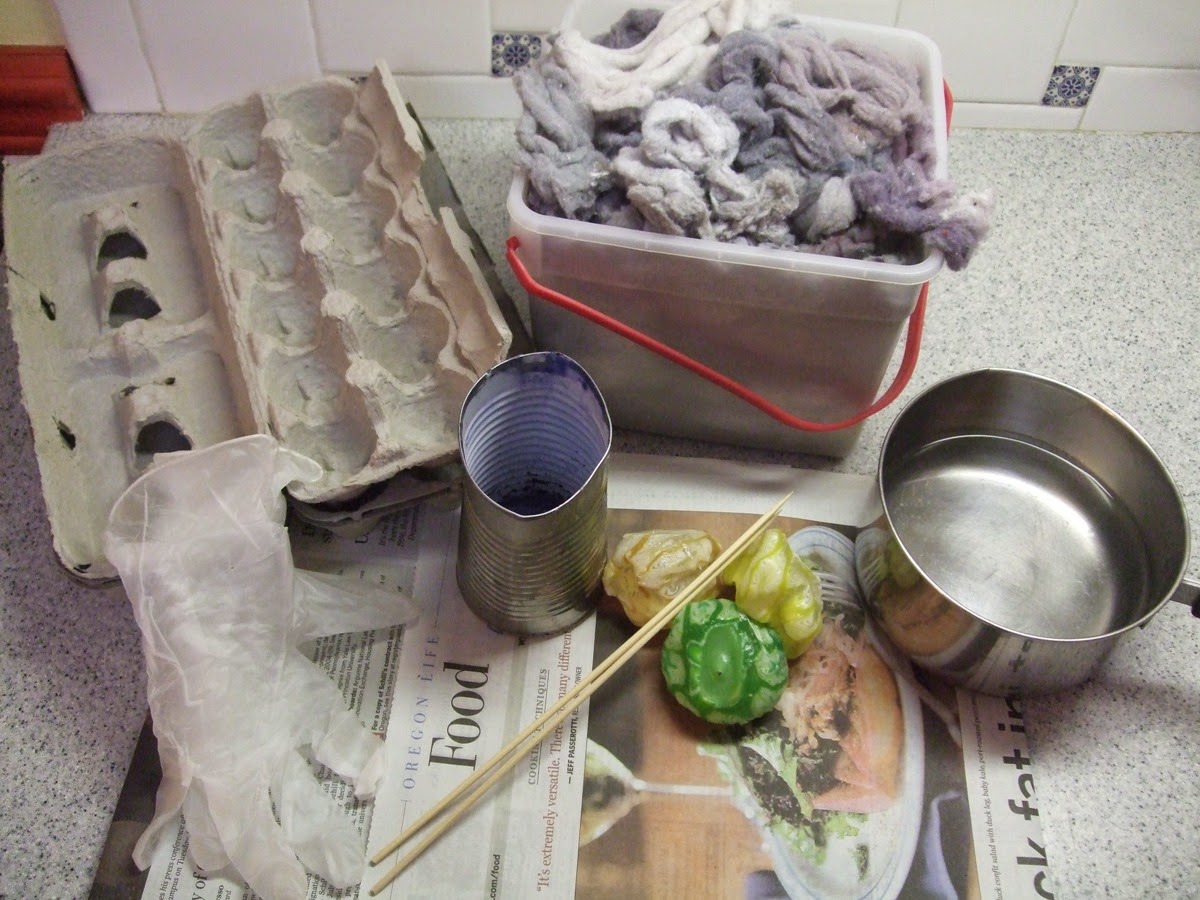
2. Gather up:
the dryer lint
old newspapers
cardboard egg cartons
disposable rubber gloves
a skewer for stirring
a tin can
a small pan of water
old candles and stubs

A word on the old candles: Last year I found some pretty egg-shaped candles at a garage sale.  I put them in the attic in my box of Easter decorations.

We had a long hot summer.

I got out the Easter decorations right before Easter this year, and behold, the beautiful candles.


3. To melt the wax, put some chunks of wax in the tin can.  Put the tin can in the pan of water.  Heat the water on the stove.

DO NOT EVER heat the can directly on the burner.  At a critical point the wax will erupt in flames.

We pause here for Story Time with Aunt Dorcas:

I once bought a large bag of old candles at a church rummage sale.  An older lady asked me what I plan to do with them.  I said they're for an art project for my husband's students.
She got a look on her face that spoke of terrible memories.  "Please please don't let them heat the container of wax directly on the stove," she said.  "When I was about ten, my mother was making jelly and back them we would put melted paraffin on the jar to seal it.  We had the pan of wax on the wood cookstove and I was supposed to watch it.  Then I needed to get something in the pantry, and we would save our newspapers in a stack in the pantry, and when I walked by, the comics were on top, so I stopped to read them and lost track of time.  Suddenly I remembered the wax.  Just as I came back to the kitchen the wax exploded and the flames shot up to the ceiling.  I was frozen to the spot.  I couldn't move.  Someone grabbed me and pulled me outside, and in minutes the house went up in flames.  My eyebrows were singed but I was alive.  But we lost everything.  So PLEASE be careful."

I promised I would, and now I've warned you too.

4. Stir the wax now and then with the skewer.  I don't know if this hurries it up or not, but some of us like to poke around in soft wax.


5. When the wax is melted, turn the burner off and pull on the rubber gloves.
A picture, in case you don't know how to put on rubber gloves.

6. Take a big handful of lint and put it on the newspaper.


7. Pour on a circle of wax.  Glop it around with your hands.  Repeat until you can pick up a wad of it and it mostly holds together.  It doesn't have to be saturated.


8. Press an egg-size glob into each cup of the egg carton.


 9. Cut or tear the egg carton apart.  Keep the individual fire starters in a Ziploc bag with your camping supplies. Use one little cup to start your fire.


You will love these.

I was going to demonstrate with a lit match, etc. but it's hard to do this safely while taking the picture yourself.

When we go camping now, Paul uses these things all the time.  Which means they're even better than Man Magic.
At Bible Memory Camp last fall.  Paul builds the breakfast fire while Tanner watches.
Just make sure you pack matches too.  We will refrain from telling that story those stories, but when I am an old woman I will also have my share of cautionary tales to tell.

Sunday, April 12, 2015

Letter from Harrisburg--On Passing On the Faith

LETTER FROM HARRISBURG
Warm flame of faith starts with the smallest spark

By Dorcas Smucker
For The Register-Guard
APRIL 12, 2015

Let’s pray for my cat,” Sophie said one Sunday in a worried little voice. “She’s going to have kittens soon and I’m afraid she’s going to have them in the woods where I can’t find them and it’ll be raining and stuff.”

I added to my list on the back of the church bulletin — “Sophie-cat-kittens-woods-rain?”

“But you do know,” I said, “that God made cat moms to be smart about finding a warm, dry spot to have their babies, right?”

Yes, she knew that. But she still looked worried. What good was a cat mom’s warm spot if Sophie couldn’t find it? So we prayed about it.

We also prayed that Logan’s cow would soon have her calf and it would all go OK. And for McKenzie’s smashed finger and Weston’s smashed toe, and for Annika’s sick dad, and Abby’s grandma with the bad heart, and also for Annika’s family, needing a house to move into soon.

I agreed to teach this Sunday school class because I love this age, and after a year of teaching adult women, I needed something less intense, requiring less study.

It was a different kind of intensity, I found out. Ten-year-old boys have an astonishing ability to both talk and move, all the time. Every subject requires a clever comment, usually involving hunting. Or hitting.

For some reason, the girls are quieter, except for whispered comments that I’m not supposed to hear.

While I could sometimes fill the time with stories, I found I couldn’t get by with studying less. Ten-year-olds pounce if you don’t know what you’re talking about, like the time I tried to explain the lineage of the Old Testament royalty by assigning identities — lining up Ahab and Jezebel the wicked king and queen, then Ahaziah their son, Athaliah the super-wicked woman who usurped the throne, and Joash the child snatched to safety by his aunt Jehosheba.

Soon I was so confused that the kids had to align the family tree themselves.

We study a series of booklets called quarterlies with lessons designed to take the students through the entire Bible in about five years’ time.

This means I teach not only the happy, easy stories of creation, David and Goliath, Jesus’ birth, and feeding the 5,000, but also stories of obscure kings, bloody battles, and judgment for sin, all in King James version.

I try not to think too much of the heavy responsibility of passing on the faith. It seems an impossible job for a 50-something minister’s wife with a long and sometimes anguished journey imparting the truth, like a sandwich in a paper sack, to squirrely 10-year-olds.

Can I really give them something that will guide them through their future moral dilemmas, inevitable griefs and crises of conscience? That will comfort in sorrow and turn them toward wisdom and away from foolishness? That will make them a benefit and blessing to the world they’ll be part of?

I’d like to teach the Mennonite particulars as well, which are obviously needed, based on the emphasis on solving problems by punching someone.

And all in a half-hour on a Sunday morning.

Of course it’s impossible. But somehow it happened with me growing up; the adults in my life contributing a story here, a prayer, an unexpected kindness, and one day I was grown up with not only a vague faith in God’s existence, but a living flame that filled and illuminated all of life.

“With man this is impossible,” Jesus once said. “But with God all things are possible.”

So I tell stories, move the most talkative kid to the seat beside me, jot down the prayer requests, hope for a miracle, and distill the lesson into one basic thought that applies to them, for real, right now.

“God is with you, all the time.”

“Always tell the truth.”

“Suffering is better than sinning.”

“Do the right thing, even if you’re afraid.”

They lose their place in the Scripture passage, ask for another story from when I was little, dig in purses for Chapstick, and elbow the next kid because they need his pen.

I keep on.

I also laugh a lot, such as the other Sunday, when Tyler was reading from Second Kings about the prophet Elijah.

“He was a hairy man, and girt with a girdle of leather about his lions.”

“Loins,” I corrected.

“Oh,” said Tyler, and added, “I wondered.”

And last year, when one of the boys was reading aloud about Jesus’ conversation with Nicodemus. “Shall a man enter the second time into” — he stopped suddenly. “ ‘his mother’s WOMB? And be BORN?’ Is this rated R?”

I dissolved in laughter and reached for a pen.

The boy’s neighbor nudged him. “She’s writing it down.”

You bet I was.

Logan’s cow had a beautiful all-black Holstein calf. The toe and finger are healing. Annika’s family is still looking for a house to rent. The grandma is going in for tests on her heart. Sophie is still worried about her cat.

How strange is God’s Kingdom, where an old-fashioned mom with bifocals talking about ancient prophets and praying for that young girl’s still-pregnant cat just might be a little part of the miraculous spark that slowly grows into a flame of faith, warm and glowing and alive.