Monday, October 12, 2015

Bible Memory Camp 2015--Chapter One


First, some definitions.

Bible Memory Camp: an annual project in which we hand out cards printed with 50 Bible verses to the 9-to-14-year-olds at church.  If they memorize them and recite them to their parents, they get to go on a 3-day trip.

Camp: a loose term that can mean actual camping, with tents and campfires and hauling water, or staying in a house with actual beds and showers, or something in between, such as staying in yurts.

Yurt: a round, wood-framed, canvas-covered building based on dwellings in Mongolia and featured at a number of Oregon campgrounds.  They provide more structure and shelter than tents, and a lot less than motorhomes or houses, thus providing the true camping experience without the complete despair of a cold rain on a leaky tent with homesick 10-year-olds.
The outside of a yurt.
The inside of a yurt.

Our big red and white van, the Verse Contest, Treasure Hunts, the Sand Sculpture Contest, and Way Too Much Food Sent By The Moms: Unchanging camp traditions.

Paul and I have been involved in Bible Memory Camp for 20 years.  For a number of years, Arlen and Sharon Krabill were involved.  The last few years, we organized it, with various people helping.

Last year, Paul said, "Someone else needs to be in charge of this."  So he told the congregration we'd like to take two younger couples along and train them in. Was anyone interested?

Ben and Ruth Swartzendruber volunteered, and also Preston and Heather Kropf.

The Sponsors, still smiling at the end of camp
Ben thought, and we agreed, that this sort of interaction between church leadership and the kids from church has been invaluable.  So, in the future, they might invite a pastor/deacon couple to go along each time.

Which means there's a chance we'll do this again, but for now this was officially our Last Bible Memory Camp.
Weston and Jadrien in back. Then Tyler, Tanner, Trevin, Logan, Cody,
Brittney, Eunice, Ashton, and McKenzie. Annika in front.
It was wonderful.

Well, most of it was wonderful.

Paul stayed in a yurt with the boys, and I was in another with the girls.  The other couples had tents at another campsite. The first night, I climbed awkwardly up into the top bunk and unzipped my sleeping bag.  Did the girls seem extra expectant and quiet, in retrospect?  Maybe so.  Because down in my sleeping bag I found something long, tubular, brown, cold, alive-ish, and awful awful awful.  Not a snake, praise be to God, but awfully awfully snakelike.

Shudders and horrors, gasps and exclamations.

It was a long coiled end of one of those awful long brown tubular seaweed things.

And the culprit was Ashton, one of those lucky girls who isn't scared of anything.

She still teases me about it, sneaking up behind me after church and murmuring, "How about some seaweeeeeddd??"

And the next day, while I was still jumpy, McKenzie came up behind me on the beach and twined a long cold seaweed around my ankles.  GAAAAHHHHH!!

She laughed and laughed.

Both seaweed incidents involved this kind of seaweed.  Logan was dragging all this
along to use in his sand sculpture.  He reminded me of the prisoners
dragging the ship in the opening scene of Les Miserables.*
This was much more voluntary, and happy.
This was the first time we rented a community yurt in addition to the yurts we stayed in.  It was the best idea yet, as we could make food there, stash all the food without losing it to raccoons, and have a place to hang out together after dark.
Jadrian and Logan, the Camo Cap Campers
One night Ruth introduced a game where each team had to stack plastic cups using only a rubber band and string.

Trevin, Tanner, and Eunice

Tyler and Cody, with Ruth looking on.
 This post is getting way too long.  I'll post more pictures tomorrow.

But first, the Quote of the Day:
"Guys!  Act normal! It's the park ranger!"
--Logan

*Disclaimer: this is not an endorsement of Les Mis, which I watched on a plane once, about the only time I watch movies clear through, and it was pretty intense. Especially if you don't watch movies much. Excellent story, though.

That's Annika dragging the stick in the sand.
I think this shot just shines with the Fun and Joy of the Coast.

Sunday, October 11, 2015

Today's LFH: On Finding Ways to Communicate

LETTER FROM HARRISBURG
It’s about communicating love, no matter what the technology or platform


By Dorcas Smucker
For The Register-Guard
OCT. 11, 2015

 We were in the middle of making 50 quarts of applesauce when I suddenly remembered it was time to talk to Amy. I left kids on the porch washing and quartering apples, pots of apples hissing on the stove, and the Squeezo applesauce-extractor in mid-crank as I dashed to the computer.

Communication trumps canning, after all.

Every Saturday at 5 p.m. I sit down at the desktop computer in the office and open a program called Skype.

I type in my name and password. My list of contacts appears on the left, and I look for a green check mark by our oldest daughter’s name telling me she’s also signed in.

A click on the little video camera icon, a short wait and there is Amy, just waking up on the other side of the world in Chiang Mai, Thailand. I see her arranging herself and her cup of coffee against a green pillow in front of the curtains that I sewed for her a year ago.

She looks healthy. And happy. Praise God.

And then we talk.

Amy always wants to know what’s happening here. Is Jenny in choir again and how are Steven’s EMT courses going? Is harvest over and has JoNell had her baby?

I hear the tropical birds trilling outside her open windows, and a dog barks. She tells me about tutoring university students and about the funny neighbor who puts sweaters on her dog when the temperature drops to a chilling 68 degrees.

After an hour, she needs to get ready for church and I need to go make supper.

“Bye.” “Love you!” “Good talking to you!” “You too!”

Click.

“How has technology changed your life?” an email asked me recently.

My first thought was, “Communication.”

We were Amish when I was little, which means you can’t pick up the phone to call your relatives, so Mom would seat us around the dining room table, pass out papers and pencils, and tell us to write letters to Grandma.

I saw one of these specimens, years later. “Dear Grandma, How are you? I am fine. Are you very busy these days?”

As teenagers, we talked on the phone with our friends, which never had quite the charm of the girls in magazines lying on their chenille bedspreads chatting on their Princess phones, because we had exactly one phone, right in the middle of the house, and it was a party line to boot, so the neighbors could listen in too.

My parents never transitioned to technology and always preferred paper and ink letters. Writing, addressing, and mailing a letter seemed like a huge bother in comparison to email, especially when we had small children, so it was hard to stay in touch.

We even bought a fax machine and installed it in Mom and Dad’s basement, hoping to make communication one step easier. I wrote a detailed list of instructions and pasted little numbers and arrows to various buttons on the machine. They never grew comfortable with it.

“If you have a message to give, it’s your job to figure out how to make sure it’s understood,” we were told in a cross-cultural communication class while working with Native Americans in Canada. “this includes learning another language, if need be. You can’t expect them to learn your language.”

When your children are at home or your parents live nearby, communication can include hugs, big ginger molasses cookies, and help with raking leaves.

When they’re far away, communication is mostly words.

I love my family, and love is all about relationships, and relationships fade and even die without words. So, I need to continually figure out how to keep those crucial, life-giving words flowing back and forth between us, not only in a language they can understand, but in a medium they can easily use.

It’s my task to make communication a priority. It’s not mine to dictate how it has to happen.

My dad and I still write letters to each other, but otherwise the days of weekly paper letters are long gone, and talking on the phone is out of fashion with young people as well.

I need to adapt to the culture and learn their language and customs.

First I learned to email. Then, a few years ago, I learned to text. Before I discovered backspacing, I would type “oops” whenever I made a mistake, wildly amusing my daughters.

On Sunday afternoons I sometimes Skype with our son Matt. He shows me the latest project in his Washington, D.C., apartment, such as a wooden rack for his weights, and tells me about his work at the Navy Yard while I analyze the room behind him (messy), his beard (handsome), and the green smoothie he’s sipping (impressive).

At Matt’s urging, I bought an outdated iPhone from a Craigslist ad. “It’s more intuitive,” he said, choosing his words carefully. “It might work better with how your mind works.”

He was right. Slowly, swipe by swipe, I learned. I’ve even downloaded a few apps.

My sister in Oman introduced me to WhatsApp, an online messaging system that’s a few steps easier than email and works better than texting for communicating overseas.

“Plipp!” chirps my phone on the kitchen counter, and there is a picture of Rebecca’s tiled patio, ringed in greenery that must be hard to keep alive in the 120-degree heat.

Another day, the phone beeped and no words appeared, only a line and a triangle. “Oh! It’s an audio message!” I clicked the triangle and my sister’s voice, in our traditional Amish dialect of Pennsylvania German, came out of my iPhone in a bizarre bending of time, space and communication.

In the next week, I’ll probably text my high school daughter about picking up milk after school, Skype with the older kids, write a longhand letter to my dad, and have a long philosophical discussion as all of us wash the dishes after supper.

I’ll call friends my age, send Facebook messages, comment on a niece’s Instagram photo, and text a nephew about coming for Sunday dinner — words and always more words, pulling us together.

In this strange modern world of endless ways to communicate but increasingly isolated and lonely people, I feel an urgency to reach out, to connect, to include, to speak and listen, even if it means the applesauce scorches or the cleaning waits.

Words and sentences and paragraphs, again and again. Written, tapped, and spoken. Cut apart into electrons and mysteriously reassembled on another continent. No matter the method, it always comes back to the words that form the communication that makes the connections that keep alive the relationship, the friendship, the family, the love.

Tuesday, September 22, 2015

Ideas for Uses for Stuff

I am a Yoder by birth, which means I  like to save, keep, rescue, and repurpose things that most people would throw away.  Right now I need some ideas.  I have some objects that seem loaded with Potential and Possibilities but the Good Uses are all hidden behind a foggy window in my head and I need someone to wipe the glass.

1. I found this fabric at a funny secondhand store in an old metal barn on the coast near Bandon, one of those quirky places run by a man with a big mustache who was relaxing out front on an old bench seat from a van.

It's a denim fabric, about two yards, with simple orange and blue stripes.  It was only a dollar and had Etsy and Pinterest and Instagram all over it, so I bought it.


But now: what would be the best use of it, and would justify that momentous no-turning-back First Cut that always terrifies me, since I am scared of commitment?

2. This is a skirt hanger made of sturdy metal bars and flimsy pink clothespins.  The pink clothespins died one by one, but the bars remain.  And I think, surely there's a creative use for this.

I tried hanging it in the kitchen for dish towels, but it got in everybody's way.

I could still use it for a skirt hanger if I used regular clothespins, but I have enough nicer hangers that I'd rather use.

I will toss this if I don't find a use for it soon, as even my Yoder repurposing has its limits.


What do you think?

3. This was another $1 find that I snatched up like only veteran garage salers can home in with bat-like radar and grab. It's an old toolbox, obviously homemade, with lots of scratches, personality, and signs of wear.

But.


Do I fill it with flowers?  Put it up on the wall for teacups?  Take quart jars of lemonade out to the threshers next summer??

Would it have a useful and decorative purpose in my writing cabin?

Help me out here.

4. I saved the last Laughing Cow cheese box because it is just so cute.  However, I didn't tell my daughters because they would have had a fit.


But just tonight I found this on Pinterest.  Ta da!


Sunday, September 20, 2015

Cottage Beginnings

Things are happening with my writing cabin!

I am a bit like an excited duck chasing a June bug about this, flapping my wings and quacking, so if you find this annoying, please continue your walk around the park and pay me no mind.

But yes, actual things are happening, like measuring and buying and pounding stakes where the corners will be.

If you are a bit ADD, and you have a husband who has a lot more great ideas than time, it can be a long step from Maybe We Should to Real Things Actually Happening.

I have old friends far away.  Sometimes when we communicate, we say, wouldn't it be fun to get together and chat over tea?

Yes, it would.  But we both know what it would take to coordinate this.

So this is like the old friend actually showing up at the door.

The cabin will be across the road by Muddy Creek in an area that is covered with water at times during the winter.  During the big flood of I think 1996 that area was filled up almost to the road.  So I want the cabin way up above such dangers.

So the other day Paul got a surveyor's scope and ruler and beamed and calibrated and marked, from the Official Elevation Marker at Leroy and Anita's next door, over to the signpost, and then across the road.
Here are Paul and Jenny, measuring and marking.
The ice cream lid has a purpose. Really.
To set things on, or something.
The cabin will have to be up on very high posts, we realized.  But better a bit stilted looking than washed away.

I've been on Pinterest, scouting for ideas, off and on, by searching for cabins and cottages and small houses.  I got some good ideas but the featured buildings never seemed quite what I was looking for.

A Facebook friend asked me if I'm going to utilize Treehouse Masters.  I had no idea who that was, but it turns out to be a Pacific-Northwest-based crew who designs and builds tree houses, and who has their own TV show.

And then I realized I had been searching all the wrong things on Pinterest.  I plugged in "tree house" and before me bloomed a thousand ideas that were exactly what I wanted.

Like this.  [Read more here]


"Is this the same idea as the she-shed that is all the rage here?" asked another Facebook friend.

My snooty answer: I hope I am as high and dry above this world's swirling fads as this cottage will be above the next flood. I've dreamed of something like this for a long time.

Meanwhile, we continue to discuss names.  Dear me, it was easier to pick names for the children.

I still like Acorn Cottage but the children think it's a strange choice, and others have pointed out the obvious and inevitable jump to Nut House.

Ben goes to college with one of those people whose name seems to be entirely comprised of surnames--something like Dorington Chase Wilkins.  Ben thought "Dorington" would be a great name for my cabin.

I think: will it take too much explaining? And is it too egotistical?

The other day Jenny sat down at the computer and shrieked:

Quote of the Day:
"MOTHER!!  You are NOT naming it OATMEAL COTTAGE!!"

It's no wonder some of us moms go around perpetually confused.  What was she talking about?

Well! There was a little tab at the bottom of the screen, and it SAID, "Oatmeal Cottage."  SEE?

Oh, child.

Earlier that day I had looked up a Trim Healthy Mama recipe, and then I had "minus-ed" the page, or that's what I call it, but I'm sure normal people call it something better, when you click the little dash in the little box third from the end at the upper right.

So only the first two words of the recipe showed in the tab at the bottom.

The recipe was for Oatmeal Cottage Cheese Pancakes.

Meanwhile, I need an uncomplicated name that conveys rest, oak trees, creativity, water, and such things.

But not oatmeal.

*****
This weekend we were down to two children at home.  Two!  I dropped a few chicken thighs in a tiny little crock pot this morning to make honey mustard chicken for lunch, and it was easily enough for the four of us.

I thought: maybe the kids will all leave home about the time I get my cabin, and I won't even need it!

And I also thought, "What if there's nothing magic about this cabin and it won't make me a prolific and good writer?"

But then I decided I was just feeling guilty for being so blessed.

One of my faraway friends, Dorcas Stutzman, said, regarding the building of a cabin, "For some reason this takes me all the way back to our giggling fits in Jonathan and Cynthia's trailer house."

And I said, "If you come visit, we can sit in the cabin and have more giggling fits, if we still know how."

My friend Sharon testifies that I still know how.

Maybe the writing cabin will be a place where nebulous ideas and wishes become reality.

Friday, September 18, 2015

Cousins and Friends

Last week Paul's niece, Leah, sent me a CD with photos from the Wilton Smucker reunion in June.

I was struck by how similar Jenny and her cousin Allison look in this shot.

I think they were more tired than sad, despite those woebegone faces.


Actually, they looked alike in other pictures from that weekend too.


Here they're sitting between Steven and Grandpa Yoder.
 Jenny was born less than two months before Allison, and they have been like two peas in a pod ever since they were little.  At 16, they are best of friends.

Allison's eyes are blue while Jenny's are brown.  Allison has blonde hair; Jenny's is red.  Allison's features are a bit finer.

But they walk alike, laugh alike, and carry themselves the same way--and they have for years.  They are very similar in size and shape.  When Jenny decided she wanted a "cape" dress, Allison sewed her one from her own pattern and it fit Jenny perfectly.

Here are two shots I took at the reunion.  Allison and Jenny are on the left, and they're not posing for the pictures.  They just DO this.


I found the reunion pictures intriguing enough that I sent them to the rest of the family.  Matt reminded me of how the two girls hit it off in Poland when Allison's family lived there, and we went to visit, in 2004.  I think that was the first time we had noticed their remarkable similarities, and John noted that they even squealed alike, about the same things.


That Sunday morning they tried to look as alike as possible, from navy-blue dresses to French braids.

 I'm not sure why I'm so intrigued with similarities in cousins--maybe because I didn't have any girl cousins my age.

The truth is, I might have had cousins who were a lot like me.  After all, I had over 50 first cousins.  But we were at the young end of the family tree and our oldest cousin, Sylvia, was 50 years older than the youngest Yoder cousin, my sister Margaret, who was good buddies with Sylvia's grandchildren.  When I was 16, the freindschaft wasn't likely to notice if 40-year-old Barbara had been like me when she was my age.

This was at another Smucker reunion, maybe 10 years ago.
So it just makes me happy that the time and the genes were right for these two to not only be cousins, but to be the same age and so very much alike. . . but still just different enough to keep their friendship interesting.

Playing dress-up, long ago.
If you have a cousin who is also your best friend, you are blessed.

Quote of the Day:
"That guy can land-plane in a bit straighter rows than I can."
--Emily, who has learned to observe crops and fields as we're driving along, like a true farmer


Sunday, September 13, 2015

Column: The Hot Summer and Weariness of Soul

LETTER FROM HARRISBURG
From this summer of heavy burdens, we emerge stronger


By Dorcas Smucker
For The Register-Guard
SEPT. 13, 2015

About seven years ago I directed a Christmas play called “Why the Chimes Rang.” It began as a good idea for a school program but turned into a bad-dream project that muddled on and on. Every aspect of it, from the singing to the costumes to the behavior at rehearsals, steadily degenerated into chaos as time went on.

That’s how it’s seared into my memory, at least, which is why I haven’t directed a play since.

One of the characters was a young mother who was hungry and lost on a winter night. The actress was supposed to come down the church aisle, unsteady and desperate, clutching her baby in her shawl as the winter winds blew the snow down on the village.

She had one line to say: “Oh, I am so weary and cold.”

Thankfully I had a sense of humor, and the girl who played this part was not easily discouraged, because for some reason she could not recite that line.

“Oh I am so tired and hungry!” she would say before collapsing into the snowbank, a pile of quilt batting from the sewing circle, covered with a white sheet.

“No, no.”

Back up the aisle I sent her. A slow turn, and toward the front again, into the wind: “I am so weary and tired!”

“No! WEARY and COLD.”

“Oh, I am so cold and hungry!”

I’m not sure that she ever got it right, even on the night of the program. I should have let her ad lib. Who would have noticed?

Sometimes, in certain seasons of life, it feels like we’re all weary and cold, fighting our way into the winter wind. Our shawl isn’t nearly enough protection, and we are about to collapse into the snowbank with the baby in our arms.

At such times, life is just a lot of hard slogging, on and on, one step after another. We grow weary in body, which makes us extra weary and cold in spirit as well. It seems we will never reach the front of the church, and for sure we won’t hear the miraculous chimes when they ring in the steeple on Christmas Eve.

Health issues, difficult relationships, financial stresses, caregiving — all of these can seem like trials that will never end.

This hot, dry summer, paradoxically, has been a season of wintry weariness of soul.

Just by definition, summer in farming country is exhausting: long days on a combine, seed-cleaning machines running around the clock, ripe peaches dropping from trees and needing to be canned today, hungry animals, thirsty gardens, and never quite enough energy to reach around.

With its record dryness and heat, this summer seemed especially endless and difficult. The grass died, the lilac leaves — normally hardy through the heat of August — started curling in July, and the potted flowers on the porch wilted as soon as my back was turned.

The calves’ pasture turned brown and we supplemented with sacks of feed. The waiting grass fields became ripe not only for harvest but also for any stray spark that would ignite and destroy them. We turned on sprinklers to keep the pasture grass and flower beds alive, but the well kept running dry.

With extra responsibilities, such as taking in my dad for six weeks, two bouts of bronchitis and weeks of recovery that made a normal day’s work feel like climbing Mount Hood, I found it the most challenging summer in years. The rest of the family, busy with jobs, harvest and summer classes, was unable to pick up the slack.

Daily life became a hard climb uphill, day after day.

I sensed that I was not the only one short on rest, facing relentless demands, and losing the sense of joy that normally comes with summer.

For my family, summer meant sacking seed at night and sleeping restlessly in the heat and noise of the day; studying for tests for summer college courses late at night; stocking shelves while friends were swimming in the river; and fixing worn-out belts and motors high in a dusty warehouse in motionless heat.

Harvest ended, but the heat continued. We watched, helpless and horrified, as fires burned all over the Northwest. We waited and prayed for rain. The smoke burned our eyes and made us feel surrounded by a fog of poison.

I’ve found in summers past that young people with long hours of alone time on combines and in deserted warehouses end up with too much time to think and no outside voices to counter the inner noise. Regret, addictions, depression — whatever the weakness, it shows up here. Sometimes it’s just a weird outlook on life, and they start having arguments in their heads with "all the stupid people on NPR" or with Rush Limbaugh or "that opinionated sports show host."

Then they think, “Wait. I am arguing with people on the radio.”

It’s the season when people apologize. I first noticed this years ago, when a young friend was driving combine and then wrote me a note explaining that she’s afraid she left the wrong impression, but really she meant this and not that, and she feels very badly about her mistake.

Combine syndrome, I named it, that strange summer struggle of the soul. I tried to encourage my children and their friends, “It’s just a hard season, right now, and a tough trail. Be gentle with yourself.”

The day I found myself lecturing a Hollywood celebrity, I knew I had a bad case of combine syndrome of my own. It was one of those silly stories that takes over the news feeds, something I would ignore in saner times, but there I was, forming a speech in my head to set them straight.

I laughed at myself, which is what you learn to do at my age, especially if the choice is down to laughing or crying. I also went back to reading my Bible more, my anchor of sanity in the crazy times. I recommended it to the combine-driving and seed-sacking and exhausted people in my life as well, even if it’s only an encouraging verse tacked above the bagger. “... be strong and do not give up, for your work will be rewarded.” Or this one from Galatians: “Let us not become weary in doing good, for at the proper time we will reap a harvest if we do not give up.”

“And,” I said, “You need to talk with real people with real voices who speak real words to you.”

I took my own advice one morning, cooking oatmeal for my dad and then escaping to Jake’s Café in Harrisburg to meet my friend Gina for breakfast. Those two hours were like a large Iced Kicker from Dutch Bros. on a 100-degree day on an un-air-conditioned tractor.

At least I knew this, among all the hot days and the dry straw swirling and the threat of fire — the season eventually ends. I’ve been here before, and I know. It doesn’t last forever.

This was my survival message to myself and all my weary loved ones: “One day when you least expect it the farmer will tell you you’re combining the last field today, and you’ll have time in the afternoon to go swimming, or you can sit up late with friends on a Sunday night because you won’t have class the next day.

“The day will come when the sackers won’t be working night shift anymore, the blueberries will all be in the freezer, the farmer won’t need you to do flail-chopping until next week. Your mind will think normal thoughts again, the confusion will pass, the guys on the radio will be only an occasional noise in the background.”

Eventually, a cloudy day turned into showers and then an actual rain. The brittle lilacs got a drink at last, the lawn turned a timid green overnight, and the air cleared of that lingering smoke.

Even when it seems they’ll last forever, hard journeys do eventually finish, when the time is right. You reach the front of the church and remember your line, or at least get it close enough, and the long slow walk is done at last, and the chimes ring out in the ancient belfry.

As you sit on the pew and rest, you know that it was scary and hard and it seemed it would never end, but it finally did, and you are stronger, better, wiser, and braver for what you’ve just been through.

Wednesday, September 02, 2015

On Rebuke and Humility

Many years ago, when I was young and a bit full of myself, [don't say it!] I took it on myself to correct Henry Schrock on a few points of his sermon.

He had mentioned First Corinthians 11 when he meant First Corinthians 13, for one thing.  And then there was some point of doctrine that I questioned him on also.  I don't remember what it was, but I remember my sister laughing at me afterward and saying, "Only you, Dorcas."

Henry's response was to listen carefully with his characteristically bowed head, to smile genially, and to take me a lot more seriously than I deserved.

I think of this now because I have not always been so fortunate in the years since.

There was the visiting preacher who had a bluff-and-bluster sermon about evolution, making it clear that anyone who believed in evolution was just stupid.

I spoke to him afterwards.  It might be more effective, I suggested, to just compare the two philosophies side by side, and consider both seriously but explain why creation makes more sense to you.  Because if you're going to play this game, "they" can make "us" look stupid too.

"But evolution IS stupid!" he said, visibly upset. And that was the end of that conversation.

Then there was the guy who had the same approach to Calvinism vs. Arminianism, and who had the same reaction to my gently-worded challenge.

And the guy who felt that all depression was caused by sin, and none of us need professional help.

I might have burst into tears when I spoke to him, having just lost a nephew to suicide.  His response was utterly devoid of compassion or sense.  He did not appreciate me or my question.

I am making Mennonite ministers look really bad here, so please note that our repertoire of guest preachers includes dozens who were Godly, sensible, and easy to be entreated.

I'm making a point here, eventually.

I don't go around correcting ministers all the time, either.  But if I have a question, I'll ask if the time seems right, with a more diplomatic spirit than I had back when I spoke to Henry Schrock.

None of the men I confronted said that I, as a woman, had no right to question them, although they probably thought that.  I'm guessing that anyone younger, female, or less ordained was disqualified from doing anything but heartily agreeing.

This can do crazy things to your mind.  Like: Oh dear, I'm just too forward.  Maybe I should have complimented him on something before I asked about that.  Maybe I'm just too full of my own opinion. If a well-known important person thinks I'm an idiot, maybe I am. Maybe I should have had Paul ask him instead . . . even though Paul would have wondered why I'm getting him involved if I was the one with the question.

Anyone in any position with a bit of power can fall into this trap, not just ministers. Parents, professors, anyone In Charge of Anything.  I once had a very secular psychology professor who claimed that the blind spot in the center of your iris and the blind spot when you're driving were the same thing, and when I asked her about it after class she smiled like a Rottweiler and tore me apart like one too.

"How dare you question me?" this attitude says.  "After all, I'm all these things that you are not."

And so you're left feeling bad.  About yourself, about them, about your voicelessness in something that really should not have become that big a deal.

Of course there's a right and a wrong way to speak to someone. 1 Timothy 5:1 says, "Rebuke not an elder, but intreat him as a father, and the younger men as brethren."  I'd say my approach was always "intreating," but if someone didn't want to hear it, they'd probably disagree.

I was driving home from Portland the other night and listening to a radio program, an interview with Dr. Henry Cloud.  He was talking about just this sort of thing, and how it affects relationships, and said something I'd never thought of.

The Bible, especially Proverbs, talks a lot about maturity and wisdom.  We tend to think the mature, wise person is the one who has it all together and does everything right.  But Proverbs doesn't say that.

Proverbs says, instead, that the mark of the wise person is that they listen to a rebuke.  They are humble and gentle when corrected.  Maybe even if they're older and more powerful.

The immature and foolish person will respond by being defensive, angry, and hostile, says Dr. Cloud.

"Whoever corrects a mocker [fool] invites insults. Whoever rebukes the evil person incurs abuse. Do not rebuke mockers or they will hate you; rebuke the wise and they will love you. Instruct the wise and they will be wiser still; teach the righteous and they will add to their learning. –Proverbs 9:7-9 (NIV)"

Interesting, isn't it?

It seems a bit harsh to label a Mennonite preacher a mocker or fool, but it's also silly to think that his denomination and position might make him immune.  I'm married to a Mennonite minister who is getting older by the day.  Thankfully he is wise and humble, but he is not immune to pride because of his ordination or age.

We all face rebuke and correction, in a lot of areas besides what we say up front, as in all my examples here.  I suggest that we respond like Henry did back in 1978, and listen with an open heart and a patient smile, and make sure we understand.  Even if the rebuker is a sassy teenager who is way too full of herself. And even if it was an inadvertent and insignificant error like citing the wrong chapter in First Corinthians.

I think of him with gratitude and respect, all these years later.

James 3:17 But the wisdom that is from above is first pure, then peaceable, gentle, and easy to be intreated, full of mercy and good fruits, without partiality, and without hypocrisy.

Sunday, August 23, 2015

Some Summer Happenings

Here in Oregon the smoke is thick as winter fog.  Like fog, it makes the world seem silent and a bit ominous.  The sun shines through and spreads a strange orange glow on the landscape, and the it looks like a glowing red ball as it sets.


Our eyes burn, and our sinuses ache, and we cough, and the air seems almost poisonous.

The smoke blew in from further east, we are told.  We're also told that some 90 fires are burning all over the Northwest.  The stories and pictures are just terrifying.

It all has an apocalyptic feel, and we are praying and hoping for rain.

Three firefighters have died, and it hits me hard, because Steven is learning to be a firefighter and EMT.  "No, Mom, they're not going to send me to fight wildfires," he says.  "I'm not certified for that."

But they're taking people from local fire departments, and prisoners, and the National Guard.  So he and his classmates might be next.

One of Steven's first assignments, once he was qualified to go on calls, was to rescue a cat out of a tree.

Yes, just that cliche, but it totally warmed my heart to hear him tell, grinning, how he climbed the ladder 20 feet into the tree and rescued the cat and brought it down.

He is a Rescuer at heart, and it's right that rescuing should be his life work.

But firefighting is more than rescuing cats, and one of these times he will be the guy in the yellow suit, heading straight for the flames with 50 pounds of hose on his shoulder.

May God surround him with protecting angels when that day comes, and may He send an angel or two to keep me calm as well.

*     *     *
This has been a busy busy summer.

Dad was here for most of it.
We went to Detering Orchards and Dad got to pick up windfalls.
He was very happy.
We looked up the spot where Grandma jumped off the train.
Dad liked to watch the action over at "the plant," as he calls it.
Here he watches Keith push Leonard Baker's seed into a pile.
My brother Marcus, in the middle, brought Dad to Oregon, along with his wife Anna.
Phil, on the right, came for a visit.
So we posed for a sibling picture. "Put your arms around each other for goodness sake!"
said the photographer.  So we did.
*     *     *
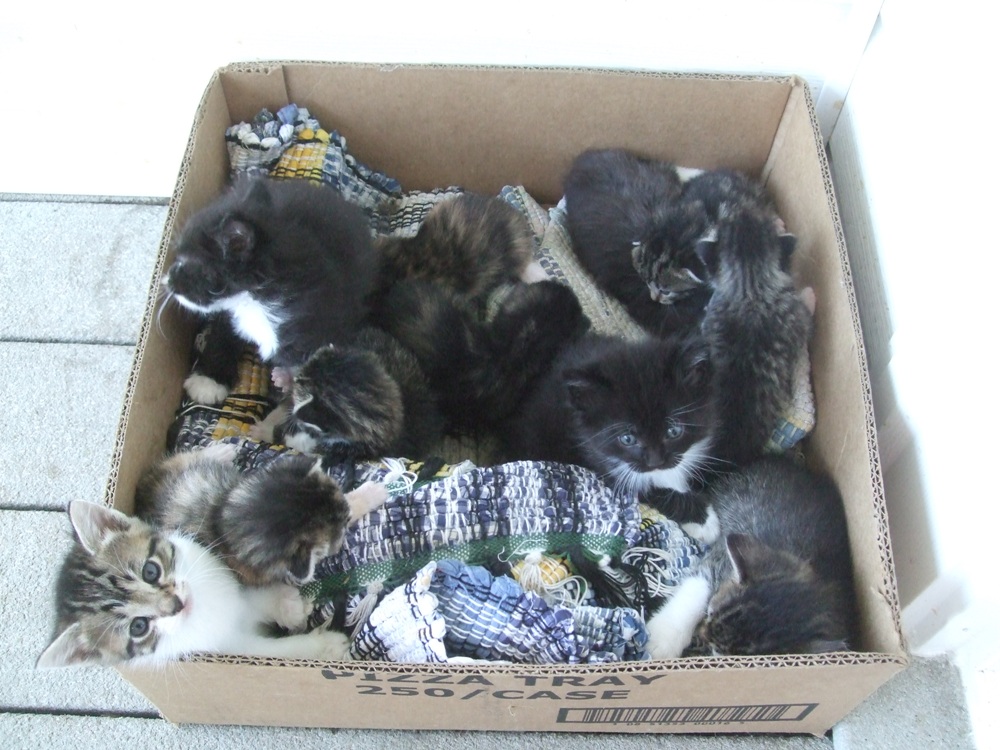
Two mama cats had lots of kittens.  One cat was a good mom, loving, attentive, calm, practical.  The other cat was really an odd mama, obsessive and oblivious by turns.

Jenny put the cats' water in an old pie tin instead of a sour cream tub so the kitties could drink more easily.  Well.  The strange mama has this bizarre habit of leaping straight up and about three feet north whenever we open the door, no matter if she's asleep, eating, whatever.

One day she was lying on the porch, nursing her babies.  I opened the door and she levitated off the floor, scattering kitties in all directions.  One of them landed right in the pie tin of water.

What kind of mom does this??? Seriously!  I exclaimed to Steven, "That cat is so weird!" and he said,

Quote of the Day:
"That's what happens when you have kids too young."

Oh Steven, we love you.

Two batches of kittens in one box.
It has been a hot summer.  The cats start melting at about 85 degrees.
And yes, for all the Animal People who are right now reaching for their phones to call me because I must not know about Spaying, we are giving kittens away to Good Homes and will take Steps to Prevent such a Population Explosion in the future.  I just wish the cats would ask Paul before they start dating, like the daughters do.  It would at least give us fair warning.

*     *     *
Yesterday we went to a wedding and like I do at weddings, I watched people and whispered observations to the daughter beside me.

I love to watch people, and tell stories about them, and figure out how they're connected to everyone else I know.

I also like to imitate them, and laugh about their quirks.  Because some people, oh my, they just have all these odd delicious quirks and they always do these same bizarre things that they've done for the last 40 years, and it is so much fun to discuss this.

And if you are talking with someone who is equally fascinated by people, it is just so much more fun than observing it yourself and making notes about it in your little notebook.

So we were sitting there watching people file out, bench by bench, hugging and hand-shaking the bride and groom, and that One Guy with a reputation for Being Like That filed out, and I whispered something about it to Jenny, with a snicker.  And then I realized that he might have a family member sitting close by who could have heard what I said, and suddenly I felt Horrible and Mocking and Unkind.

Since then I've been wondering about these things, and what are the proper boundaries, and how do you enjoy observing the endless variety of personal quirks without descending into belittling and nastiness?

On the one hand, I think you should be allowed to say some things about people, in the privacy of your home, that you would not say to their face.

I also think that if people don't want to be spoken of in That Way, they should refrain from doing Those Things.

And I don't know if I could survive as a pastor's wife if Paul and I couldn't have honest conversations about people.

But I also felt like the moment at the wedding was a Holy Spirit nudge that my heart was feeling like I was way superior to That One Guy and my amusement was far too condescending.  Maybe that's the key thing, and maybe it's ok to enjoy other's oddities and strangenesses if I let people get just as much amusement out of mine, recognizing that I have plenty to choose from.

*     *     *
My last post was about a busy day, which was part of a terribly busy week.  Then, suddenly, Pauline Scheffel's funeral was over, and so was VBS, and Matt was back in Washington, D.C.

So Paul and I went to the coast for a few days and stayed in a nice ocean-front hotel, thanks to the generous school board and their end-of-year gift.

I walked on the beach a lot and it was rest for my soul.  I watched the sun set and I watched the sanderlings, who are the happiest birds ever, run along the shore with their zippy little legs.  They like to peck the microscopic creatures the wave leaves behind, so they run along in a group, always at the top edge that the wave reaches on the sand, and they peck and run and have good times with each other.

In fact, they are a lot like Pauline who passed away last week--small in size but it doesn't bother them in the least, moving rapidly and getting a lot done without being nervous or frantic, just very happy to keep busy doing what God made them to do.

We also went out on a whale-watching expedition because there's a pod of some 200 whales that summer close to Newport, and Paul thought I really needed to go out on the ocean for the first time.

He bought me some Dramamine the day before, since I get carsick and airsick, and surely I would get seasick as well.

The Dramamine was a 24-hour variety, and it bragged that it was "less drowsy."

Well.  I took half a pill and spent the next 28 hours falling asleep pretty much every time I sat down.

But first we got on the boat, which motored out of the bay, where the fishermen were unloading tuna, and then out past the jetties, a rough ride in itself, and then it hit the 5 and 6 foot swells, plowing up and plunging down like a bull at a rodeo.

"Just watch the horizon!" said the cheerful lady at the microphone.  I have a feeling she also wrote the "less-drowsy" label for the Dramamine and is also the person who tells pregnant women to drink ginger tea to take care of their morning sickness.

I leaned back against Paul and closed my eyes.  "We're having some ocean motion!" said the microphone lady cheerfully.  She said "ocean motion" several times, like it was very clever.

We did not see whales.

The ride back was with rather than against the wind so I could open my eyes and take in the demo on the stern, where Mrs. Cheerful had some kids drag plankton out of the ocean in a cool little net with a cup on the end.  She was always recruiting Helpers, since the boat was full of children on a field trip with OMSI.  I even got to be a Helper and hold the strainer while she poured the water through.

So it was kind of a disappointing trip, all around, but I didn't throw up, and I can now say I've been on the ocean, and it is nice to have a husband who wants me to have new adventures.
Here we are just past the bridge, and I am still smiling.

Thursday, August 13, 2015

Mrs. Smucker's Busy Day

My cup overflowed today.

No, I'm afraid it wasn't my cup runneth-ing over with J-O-Y but rather the one in my head overflowing with stuff.

I often say I have a cup in my head that holds information about what I need to remember, who I need to call, what I need to take along, stuff like that.  This cup has about a half-cup capacity.

Anything that spills over gets forgotten.

This week is Vacation Bible School, and Matt is coming for a visit, and a dear older lady from church passed away.

This morning my phone rang.  Should we warn the funeral-goers about the traffic from the Country Music Festival?

I called someone who should know.

They texted back: yes.  So I put it on the prayer chain, a process that involves calling a number and then beeping through four or five options, and then recording the message, which involves about three takes because I always flounder near the end or someone walks into the room, hollering.

Another person called.  Could I set out the lunch for the family before the funeral tomorrow, if they buy the food?  Yes I could.

Another person called.  Did I realize they and we were in charge of the VBS picnic on Saturday, since we're on the missions committee?

No, I hadn't realized.  Yes, I can pick up food for up to 200 people at Costco, since I'd rather do that than set up tables and chairs.

I was trying to figure out how to pick up Matt at the Amtrak station at 3:30, go to Costco, and also get to the viewing by 6 pm.

Meanwhile I was trying to cut out and sew a skort for Jenny's friend Brenna who is going to a Baptist college next week and needs below-knee feminine athletic attire and I had told her I'd make her something.

Another person called.  Could I put on the prayer chain that they desperately need cookies for VBS?

So I did.

Paul's mom called.  Could she go to the viewing with us?  I said I'm not sure, with picking up Matt and stuff.  She decided to go with her daughter Lois.

Then I drove over to Horse Creek Farms to replenish our supply of fresh vegetables.

And washed another load of Dad's bedding, since Paul and I flew with him to Minnesota last week, and left him there, returning Friday evening, and now I'm washing his massive stack of blankets.

I texted Jenny to pick up lunch meat from the deli at work.

Ben came home from his class at OSU. We discussed possible weekend plans, such as hiking to Horse Rock, when Matt is here. Hey!  Maybe he could go get Matt at the station!  He said he would. Yippee!

I got meatballs out of the freezer for supper and butter out of the fridge to make cookies.

A guy named Derek Morgan called.  He had a telemarketer accent and said he is Emily Smucker's boyfriend and went to college with her, and he is worried about her because she hasn't been in da class.

I said, "Tristan, is this you?!" because it sounded like Cousin Darrell's son trying on a voice.

"How's that?  What did you say?"

I hung up.  He called back with more of the same.

I laughed at him and hung up again.

Emily was driving tractor.  I texted her about these calls and she found it funny because the guys in college who fell in love with her were always named Derek, but this didn't seem to be one of them.

Ben called.  The Bolt bus was at the station but Matt wasn't there.

Frantic calls followed.

I had gotten the date wrong.  Matt is coming tomorrow.

I texted the other kids so they'd know.  Steven said he won't be able to get off to come home this weekend at all.  He is a very dedicated firefighter/student but it made me sad he couldn't come.

I frantically sewed the skort some more.

And I decided not to go to the viewing after all since I'll see the family over lunch tomorrow.

I set sprinklers and kept overloading the pump, so I had to go out to the pumphouse and re-set the pump, which puts pressure in the new pressure tank, which looks like a Minion [weird little movie character].

Paul said he can go to Costco for me! What a relief.  So I made such a grocery list as you need for up to 200 people, such as 125 hamburger buns and 6 big bags of chips and 200 ice cream bars.  And he went and bought Much Stuff, and delivered it right to church and put the frozen stuff in the freezer, God bless him.

The clinic called and said I can pick up some samples of medication to tide me over until my order comes from Canada.

I put rice in the cooker and then drove to Junction City and fetched the medicine.

I fed the calves.

I made sweet-n-sour-meatballs for supper.  The meatballs burned because I was busy listening to Emily who was wondering if a young man from CouchSurfer.com could stay with us for a few weeks while he works at Detering Orchards.  We decided "no."

I hung up laundry, and fed the cats, and texted Brenna about the skort, and washed dishes, and took the rings off the applesauce we canned yesterday.

There was more, but I don't remember it.  My day felt like Too Much, but it would have been So Much More if Ben and Paul hadn't gone to town for me.

Some people thrive on things coming at them from all directions.  Like Paul, for instance, who comes alive when his phone is always ringing and he has 15 decisions to make and is always going going going.

I have never done well with this.  I did better back when I still had my full mind, but now it is not fun.

And yet, it keeps happening, no matter how much I say No, which makes me suspect that I have a deep lesson to learn here, like maybe I have made an idol out of time alone and rest, since they look so impossible and appealing just now.

Yesterday was much the same as today, plus we were canning the first batch of applesauce.  To save my sanity I decided not to attend the Oregon Christian Writers Summer Conference Awards Ceremony last evening.  It was in Portland, and I was a finalist in the Published Article category.  I haven't heard yet if I won or not.  So I might be a real Award-Winning Author, but some Award-Winning Authors have to wash applesauce kettles.

So this is why I haven't been writing much, or blogging, or working on new projects.

Writers like Jan Karon, I am told, write in solitude, in pretty rooms, for hours a day.  I've always had the sense that writing isn't supposed to be my main occupation, and that real life, overwhelming as it can be, is what gives me something worthwhile to say, now and then.

On our anniversary, which was Monday, I sat down and hastily typed this on Facebook before I went to bed:

31 years ago today we got married. Of course we were impossibly young and naive, but we went into it believing that divorce was not an option. Ruth Bell Graham once said, "We never considered divorce. Murder, occasionally, but never divorce." So yes we've had tough times but thankfully neither of us changed our minds and here we are. I don't think you appreciate the gift of a strong faithful loving sacrificing man until you've been married for years and have seen the ditches littered with abandoned and neglected families. The hardest and best lesson I've learned: that only Jesus is Enough. And only Jesus can fill the deep-down hunger for security and affirmation and being treasured. Once you get that, then anything your husband does for you is icing on the cake. If you don't get that, then all your husband's efforts will fall short of being Enough, and you will feel a constant vague disappointment in the back rooms of your soul.

To my complete surprise it touched a nerve and got a lot of Facebook-style response--likes and shares and comments.

I told Ben about this.  "I just don't get it.  I can sweat for HOURS over a column and just get this lukewarm response, then I dash this out in five MINUTES and it goes bananas!"

He said, "Yes, but it took you a lot longer than five minutes to learn the things you wrote about there."

That is very true.

So hopefully in these overwhelming days I am learning something worthwhile as well.

Sunday, August 09, 2015

Letter from Harrisburg: On Farming


Letter from Harrisburg

Essence  of farming  will live on


“It reminds me of the Dust Bowl of the ’30s,” my dad said, looking out the car window as I drove toward Harrisburg on one of this summer’s many hot, dry days.
In a bare field to the west, a tractor and plow stirred up an expanding cloud of dust, as though the plow were dragging a brown tornado laid on its side.
“How did you make it through those days?” I asked.
“Oh, we were OK,” he said. “Our part of Oklahoma was about 50 miles east of the worst of the Dust Bowl. We had a good supply of water underground. And a windmill. So we could water the garden, and the livestock had plenty of water. We managed all right. But further to the west they plowed up the shortgrass prairie and then it dried out and the wind came and carried off the soil. Tons and tons of it. It was terrible.”
Dad, who is 98 years old, lives in Minnesota but is spending the summer with us. Oregon’s grass-seed harvest is fascinating to him. He stands outside in his blue jacket and gray trilby hat and watches the equipment at work in the fields — windrowers cutting and raking the grass, combines eating up the neatly piled rows and augering the seed into farm trucks, and then a convoy of tractors and balers roaring in and baling the loose straw left behind.
“The bales are huge,” Dad marvels. “Not like we used to have. And these are just the right size to set on a truck. They stack them just so and it fills up the truck nice and even.”
“Farmer talk,” we call it, and there’s a lot of it at our house, even though we don’t farm any land ­ourselves.
Dad talks about Oklahoma in the ’20s and ’30s — farming with horses and learning to survive when wheat brought only 25 cents a bushel.
My husband cleans and processes grass seed and talks about germination tests and which lots of ryegrass are shipping out today and which farmer is finishing his fescue first.
Our daughter Emily comes home from working for a farmer a few miles south of us, driving an air-conditioned combine or tractor, and tells stories about her day. “The combine plugged up today,” she will say. “I turned it off of course, and then I had to take a big wrench and turn the header to unplug it because it’s an older ­combine so it doesn’t have a switch to reverse the header.”
Her brother Ben and I look at each other.
“Emily is talking farmer-talk?” he whispers, bending his eyebrows.
“Yes. Bizarre.” I mouth back.
After all, Emily is a college student who enjoys vintage fashion and writing computer code and discussing literature. She is also on her third summer of working for local farmers, so she can now discuss flail-chopping and fescue harvesting almost as easily as minimalism and multicultural communication.
And it all makes me reminisce about farming in Minnesota in the 1970s with a John Deere 720, disking fields on spring days, picking rocks and stacking hay bales that even a high school girl like me could handle, but just barely.
Farming is a diverse occupation, differing vastly in methods, equipment and crops from one part of the country to another and from one generation to the next. My dad talking about horses and sorghum is like a different language and culture from Emily’s harvesting ryegrass seed in Oregon on a John Deere ­combine.
“I used to find horseshoes when I was land planing last year,” Emily told us. “They would get hung up on the blade and make this big groove in my nice smooth dirt, and I’d have to stop the tractor and go back and pull it off.
“I guess a horse would throw a shoe and it would get plowed under and then gradually work its way back up again,” she guessed.
“Ask Grandpa,” I suggested.
“You didn’t have to put shoes on the work horses,” Dad said. “The buggy horses, yes, because the roads were hard on their feet. But the fields were softer.”
“Maybe that field was a pasture for the horses at one time,” Emily concluded.
Then we went silent for a little, thinking about horseshoes and land planes, what these flat brown fields have seen and how much farming has changed, from horses to sputtering narrow-nosed Farmall tractors to massive modern tractors guided by GPS.
“Our neighbors have one,” says Cousin Trish, “the kids can sit in there and read or play on an iPad, and the tractor goes along by itself. The only time they need to help it is on the corners.”
And yet, no matter the time or place, farming is about the same elemental things. Working the soil, dropping the seed, watching the weather. Fighting weeds, feeding stock, fixing equipment. Holding the head of grain in your hand, feeling its weight, deciding when to cut the first swath and then harvesting the loads of grain or seed or corn. And always, the miracle of life and growth and nourishment in that little dry kernel.
It’s also about character, wisdom, thinking of the future, and the dangers of ambition over caring for the soil and for each other.
“Do you think modern farmers are spoiled?” I asked my dad, referring to the physical work of driving a combine versus pitching wheat sheaves into a threshing machine.
“To some extent, yes,” he admitted. “But I’m more troubled by greed. The big farmers take over and think they have to have more acreage. They could do with 500 but they go for 1,000 or 1,500. What would happen if we had a crash like ’29? I don’t know. And I don’t see how a young man could ever get started with farming, the way the big farmers outbid the small ones.”
He believes in careful stewardship of the land. “A lot of the farmers left in the dry years,” he said. “The Okies, you know. The ones who stayed took better care of the land, so it wouldn’t blow so much. They didn’t do too badly then.”
“The ones who just grew one thing, like wheat or cotton, they went under in the dry years. But we diversified. Grain sorghum, sweet sorghum, milo maize. We’d harvest the grain from the sorghum and then put the stalks in the silo. It worked very well.”
I thought of the increasing number of filbert orchards planted along Powerline Road. Apparently Willamette Valley grass-seed ­farmers are choosing to vary their crops as well.
Local author Dan Armstrong researches agricultural logistics and encourages Oregon farmers to diversify, not only in case of a financial crisis but to encourage locally grown food sources in addition to seed crops. He works with small farmers seeking to grow food crops and market them in this area. He gave me a packet of quinoa seeds and told me how to grow them, a gesture that told me he is practical as well as theoretical.
He and my dad would get along well.
My husband’s extended family gathered in the front yard of Uncle James and Aunt Orpha’s house on a windy evening in July and ate grilled hamburgers and potato salad and cake.
As we ate and visited, two tractors towing equipment roared by and entered the field across the road. Up close, farm machinery is always much bigger than you thought. “My goodness,” said Aunt Nadine. “We sure didn’t farm like this when I was young.”
We didn’t when I was young, either. And yet, fundamentally, we did, and so did my dad, and so does the cousin with the latest New Holland combine the size of your house, and so did that farmer whose horse kept dropping his shoes for Emily to catch on the land-planer a hundred years later.
Dirt sifted through carefully analyzing fingers, prayers for rain or sunshine, life and hope in a million tiny seeds, food on the dinner table — the soul-deep essence of farming always will be the same. Farmers always will speak farmer-talk, the summer sun will be hot on their shoulders, and the tiny green shoot pushing through the soil will forever seem a miracle.