Friday, February 15, 2019

How to Write and Publish—4—Short Pieces, Self-Publishing


Writing, as explained in the three previous posts, is the process of getting ideas out of your head and translating them into a readable form. Putting your musings on paper is a huge step, but communication really happens when someone else reads what you wrote.

Publishing is the process of getting that writing out to where others can read it. If it’s scary to take your ideas and put them into a document for the first time, it’s absolutely terrifying to put that writing out before the eyes of others.

This is all part of using the voice God gave you, of listening to that persistent voice in your ear or thumb in your back, and of sharing your unique message.

The publishing process varies with the length and style of writing, its intended audience, and whether it’s distributed by yourself or someone else.

Today we’ll talk about publishing short pieces of writing and doing it yourself. “Short” is article length, maybe a few thousand words.

Today’s writers have landed in a propitious moment as communication has switched from paper to digital, from a laborious and difficult process to a few clicks, and from only a few gatekeepers in the industry to everyone potentially being their own publisher.

Here are a few ideas for spreading your work:


To one person, or a few
To many people
Paper and ink
Individual letters
Photocopied form letters,
Newsletters, booklets, tracts,
brochures
Electronically
Email
Group emails


Blog posts
Facebook posts

Never underestimate the value and validity of a letter. I know people who wouldn’t consider themselves writers at all, yet they pour their hearts and stories into personal letters that are a joy to read.


My dad's letters always begin with, "Dear Ones in the West,"
HOW TO: If you’re too young to remember letters in the mail, you might want to learn that art from a grandma.

As a child and teenager, I had lots of penpals. It was a magical process—getting a letter in the mail and answering it. Depending on the receiver’s personality and the type of relationship we had, I could insert all kinds of witticisms and craziness in my letters to them, knowing they would understand. 

In between pen pals and blogging came a strange little newspaper called The Eye that I produced sporadically during my years as a teacher and a few years into married life. It served no real purpose except as a creative outlet, and I was lucky to have friends who acted like they were happy to receive it. Production involved several evenings of typing, cutting, pasting, and photocopying.


I had forgotten that poem, which has since been relevant to many situations, 
not only school board meetings.
---
"Entreating with the Lord
At a meeting with the board
I have found to be the standard and procedure.
And the long and dull discussions
On the weather, life, and Russians,
Have relevance to school things: very meager."


I dug out my old Eyes to get a picture and may have gotten a tiny bit distracted.

HOW TO
: I’m not sure anyone should try to replicate The Eye, but you have permission to be as creative as you want with paper and ink or online.


One writer who combines writing and illustrations is Striped Pineapple.


As a young mom on the mission field, I wrote monthly form letters on our primitive computer and mailed them out to a list of family, friends, and supporters. The letters often took a week or more to arrive, and a reply might come back weeks after that, but all the people on our list made us feel supported during long winters and tough times.

The feedback from those letters helped me improve my writing and prepare me for a larger audience later on, although I was unaware of this at the time of course. 

Sometimes I wrote a story and everyone misunderstood it. Or they got exactly what I was saying. It all helped me communicate better.

HOW TO: Form letters are still the communication of choice for ministries and missionaries, but there’s no reason you can’t send out form letters on your own, just for fun. Type one up, print it off, send it to friends, and see what happens.

Blogging was a natural transition once I was introduced to the internet. I was still in charge of the process, but everything about publishing this way was so easy and free. No paper, no stamps, no photocopying—and I could reach hundreds or thousands of people with the same amount of effort.

Wikipedia says:
A blog is a discussion or informational website published on the World Wide Web consisting of discrete, often informal diary-style text entries. Posts are typically displayed in reverse chronological order, so that the most recent post appears first, at the top of the web page.

HOW TO: If you want to get started blogging, go to Blogger.com or Wordpress.com and follow the instructions. If I can do it, so can you. My children will verify this. You can adjust your settings to restrict comments, if a public discussion makes you uncomfortable.

Eventually I switched to email for much of my personal communication, but I didn’t get into mass emails until after I had a newspaper column. I would copy the column and email it to my list of maybe 300 people every month.

An email list is a rich resource when you start publishing. I have friends who invite people to sign up for regular updates, devotionals, or articles. I send a notice to my email list when I have a new book coming out or a book signing coming up.

We’ll talk later about finding a publisher for your book. One of the words you’ll hear over and over in the publishing world is “platform.” Even a beginning author is expected to have an audience and a platform, which is unfair and unrealistic, in my opinion, but meanwhile a list of email subscribers can be a good foundation for your platform.

HOW TO: To develop an email list, send a letter out to everyone in your current address book letting them know what you’d like to send out regularly and giving them the option of signing up. Also, invite them to forward the email to others.

You can send them updates, articles, or fun meandering letters, like my Georgia friend Rhonda Strite does.

I think her letters are dispersed to people she chooses, but her blog is open to all, and it gives you a good taste of her writing. Here it is. 

Make sure you always use the “blind carbon copy” feature for group emails.

In recent years, I’ve done less blogging and 
more posting on Facebook, usually quoted conversations or 4-paragraph cogitations that seem too short for a blog post. Some people like to do longer posts on Facebook.

Again, you are your own publisher and you can post whatever you want.

HOW TO: go to Facebook.com. Sign up for an account. Do a search for people you know, and invite them to be your friends. If they like your posts, they might "share" them with others.

When you publish your work in any of these ways, people will read it. If your words resonate with them, some of them will let you know. Their responses will tell you whether or not you communicated clearly what you wanted to say. There’s no shame in finding out that everyone misunderstood you. That’s how you learn.

Be brave. Write. Find a way to share your work. Learn a lot. Keep writing.

Post 5: Edits and critiques.
Post 6: Publishing short pieces via a publisher.

Thursday, February 14, 2019

How to Write and Publish--3--Organize and Begin


Step 3a is to gather and organize your notes.

Pull together the bits of paper, the notebooks, the documents on your computer.

Think hard—did you write about this subject in a journal, letters to your sister, or sermon notes? Include those on your pile as well, if you can.

If you’re writing a life story, whether it’s your own or someone’s else’s, you’ll want every document you can scrape up. Old letters, diaries, pictures, cards, report cards, and so on.

I inherited my grandpa Adam’s financial record book. Even the notes about eggs and cream tell me about him.

A list of farm products the family sold.

Writing a children’s book or a devotional on forgiveness will be a different process from writing someone’s story, but in every case, the more jotted ideas you begin with, the easier the process will be.

Usually when I begin work on an article or speech, some notes are on paper and some on computer documents. However, when I prepared a few talks on marriage for a retreat this past year, I decided to put all my points and illustrations on bits of paper. Then I sat on the floor and placed the notes in piles all around me, with one pile of papers for each main point of my outline.

It worked amazingly well.

Our son Matt who works for the Navy is in charge of transitioning certain systems from paper to digital, much like the medical community has been doing for a number of years. Sometimes he is in charge of meetings where others with similar tasks get together from various points of the country to make sure they’re all doing this the same so that their systems can communicate.

Oddly and a bit ironically, he’s found that the best way to conduct these paper-to-digital workshops is not with Powerpoints and videos, but with Sharpies and Post-It notes. Everyone writes their questions and issues on Post-its, and Matt groups them by subject. Then they figure out solutions.

There is Matt organizing information and explaining things. And people are listening.
I am so proud of him.
He has always been good at explaining things so I can understand them without making me feel stupid.
He is sitting on his right leg. It is not as amputated as it appears.

So despite the benefits of fancy programs that let you cut, paste, and manipulate, there’s something about handwritten notes that helps you organize ideas.

Try it.

Step 3b is to start writing.

Most of us, at this point, agonize before the glowing computer screen. How should I begin? Beginnings are so crucial We slowly tap out one line.

“In 1990, my husband and I moved our little family to a reservation in Ontario.”

No no, too dry and chronological. Delete.

“I held my baby close as the Cessna 206 roared across the lake. Behind me, lumber for school desks was stacked to the ceiling. In front of me, the steering wheel thingamajig moved toward me as the pilot pulled the matching majiggy on his side. Beside the lumber, my two older children were strapped into one seat. I barely had room to turn my head to check on them.”

Sigh. I’m cramming too much into one paragraph. Maybe I need more backstory.

Actually, I need to quit worrying about how to begin.

The place you start writing won't necessarily be the place your story or book eventually begins, if that makes sense.

Much later, you can figure out the words that will draw people into your story.

At this point, you need to plunge into the middle of the pool and start swimming. 

This is what works for me at this point: take a pile of notes and dive in. Expand on ideas. Turn the jotted words into complete sentences. Add more sentences to explain it better.

Take another jotted note. Write out the idea or event in a full paragraph. This might remind you of something else that’s not in your notes, but it fits. Write that down too.
Don’t worry about beginnings and structure. The most important thing at this stage is to write like a maniac. Words words words. Pile them up.

This stage of writing is like building a sand castle on the beach: first you need a big pile of sand. So you shovel and scoop and mound it up high. Next, you run to the ocean for buckets of water to dump over it.

When the mound of sand is ready, the careful work begins. You pat here and carefully cut away there. You shape turrets and windows. You gather shells to make a pretty driveway, and put seagull feathers on top for flags. It turns into a beautiful castle, and you step back and admire it.
from Wikimedia
That’s how it is with writing. First you shovel and scoop a big pile of words. This gives you lots of material to work with. Then you slow down and start crafting. This first, then that. Cut this out and move it up here. An embellishment here. Less of this, more of that. Experiment with beginnings and endings. Read it from beginning to end a dozen times. Look at it from different angles.

Eventually, you’ll step back and admire your creation.

That idea tucked away in your mind has become something real.

I hope you are as proud of yourself as you ought to be.

 Next: How do I share my work with others?


Tuesday, February 12, 2019

How to Write and Publish--2--Jotting Down Ideas

The idea has been niggling at the back of your mind for a long time, and you’ve decided to do something with it.

Now what?

The process of getting your imagined story or message into tangible, readable form begins with jotting down ideas. It's a rough process, and you'll need to find what works for you.

It's also scary. Possibly for the first time, carefully-protected pictures and concepts in your mind are seeing the light of day.

This is not the time for well-crafted sentences and artful descriptions. It’s not for pondering word choices or designing book covers or contacting editors.

It's only for putting thoughts into words, on paper or on your computer.

This sort of note-jotting takes two forms:
1. The Brain Dump
2. The as-they-come-to-mind notes

First the Brain Dump. This is where you sit down and get those ideas out of your head as fast as possible, in abbreviated form. Sometimes I think of it as vomiting. While it might not be that gross, many times it’s not a pretty process.

Here are some methods:
On a laptop, in a Word document.
In a pretty notebook with a nice pen.
In a cheap notebook with a cheap pencil.
On the backs of old envelopes.
On 3x5 note cards.

You can write in lists, boxes, charts, or mind maps. Even sketches. Whatever works for you.

While you don't want to write long, detailed sentences at this stage, you do need to use enough words so that when you sit down a month from now to write it all out in detail, you’ll know what you were talking about.

Let's say I decide to write a book about our years on a Native American reservation in Canada. My initial notes might look something like this:

Weagamow Lake
1990-93
Gokum
Tina’s house
School kids
Church
Matt’s surgery
The yellow house
The neighbor kids
WINTER
Flying
The winter road
Nursing station

Those are the big topics. Then I might take each one and add a few more specific incidents and details. It still won't be anything fancy.

Gokum—laundry—not knocking—did she actually understand English?—smoking beaver—Matt’s questions
Tina’s house—20x24—1 year—the tin tub—curtain doorways--
School kids—Halfadays—Kanakakeesics—when Kesa graduated—David Winter—Jacob and Nita
Church—Gary playing guitar--Sunday evening singing--Cree/English sermons
Matt’s surgery—Meckel’s diverticulum—ambulance plane
The yellow house—running water!!—Kans gave it up for us—by the lake--
The neighbor kids—James n BamBam—the swings—the hockey rink—Stye—the water hole--
WINTER—45 below—winter road
Flying—NYP pilots—kids barfing—flying to Windigo—lake vs ice vs airport--
The winter road—the Christmas trip with Mark Boss—over the lake—through the woods—

As I proceed on to the next steps, I’m going to keep coming back to jotting notes. These will be the as-they-come-to-mind variety. In the middle of writing a long, detailed chapter on the winter road, I might realize I never mentioned fishing, but obviously that won't belong in a chapter about driving to Windigo on the ice road. So I'll grab a note card and write down Round Lake—fishing—canoe—walleye—jackfish.

I can deal with that card later, either dropping it into a file or copying it into my notebook, adding it to the brain-dump list of topics I want to cover. If I don’t write it down, I will likely forget to include it entirely until the book is finished and off to the printers.

I might also recall a very specific detail such as the time Jacob Meekis told me happily that there are lots of snakes under the rocks in front of our house, and how he grinned with his fat cheeks when he told me that, completely unaware of how much I feared snakes. 

So I might write that story and quote in a little more detail and file it away to help me out when I write about the children in the neighborhood.

But generally, it's best to leave the detailed stories for later.

[By the way, this is very off-topic, but when you do this exercise lots of stories come to mind...I never saw a single snake in our three years in Weagamow. It is a miracle. I’m sure there were hundreds of garter snakes around. For some reason God had special mercy on me and I appreciate it.]

If you’re like me and have many projects going at once, you’ll get ideas for an article on marriage while you’re in the middle of writing a blog post about saving money, or maybe you'll have a chance conversation on the subject. Grab a paper, jot down the idea about marriage, set it aside, and continue with the blog post.


I jotted these notes when a friend was talking about surviving a difficult marriage.
It went into my "speeches" file.
Here are two quotes I recalled that I might include in a Pennsylvania Dutch video.
One was my old landlady, Noah Fannie, saying, "But I got a man!" after she had related
the difficulties of her life, like it all worked out fine in the end.
The other quote is from my mom who, when we left a few dirty dishes, always said we
are "saving some for seeds."


My files for the above notes.
In my writing, I quote people a lot. I’ve learned to immediately write down what people say, even if it means leaping up from the dinner table amid the family’s groans to grab a pen and paper. Sometimes I think, “Oh, I’ll remember. It was so clever,” but when I go to write it, I might recall the gist of it but it’ll be in my words and not theirs.

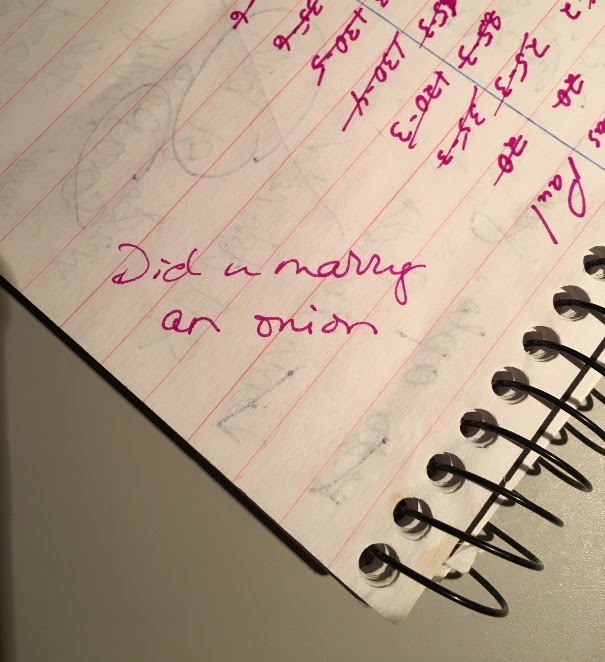
I’ve also learned to write down who said it, and why, because sometimes I end up with notes like this:


"Did you marry an onion??" What on earth was that all about, and who said it?? I’ll never know.

I can tell we were playing a game, but that's the only clue I have.


I tend to have quotes on bits of paper in pockets, purses, and piles of paper. Eventually I gather them into file folders.

Obviously, if you’re jotting down ideas for one article or devotional, you will have far fewer notes than if you want to write a whole book, or half a dozen books. But the process is still the same.


Once your jumbled thoughts have been dumped onto the page, the next step is to group your notes and start fleshing these ideas into sentences, paragraphs, and chapters. We’ll talk about that another day.

For today, pour a cup of tea, gather your courage, and pour those messy, disorganized thoughts and ideas out of your brain and into a spiral notebook. From now on, always keep a pen and paper near at hand for the ideas that come in the middle of a walk or meal or sermon.

Tomorrow: turning notes into actual writing.


Obviously, I scratch notes and quotes on whatever paper is within reach.
This one says, "I put my interested face on but in my head I was like this is literally like the dumbest thing ever."
I didn't cite the source here either but figured I'd remember, which I do.

Sunday, February 10, 2019

How to Write and Publish: 1-- The Persistent Idea


“I have an idea for a book, but I have no idea how to get started.”

“I’ve written some stories. How do I get them published?”

“Somebody should write my grandma’s story. She’s had an amazing life.”

“Everything that happens to me, I think of in terms of stories and devotionals, but I don’t actually sit down and write them.”

In the last month, I’ve had at least five people ask me for advice about writing and publishing. I’d like to do a few blog posts about the process of getting an idea in your head to printed words that others can read.
Today, I want to talk about that idea that keeps squirming in the back of your brain. Maybe it’s a message of encouragement for young moms.

Or poetry.

Maybe it’s insights from Scripture that strike you in your morning devotions.

It might be a little girl you knew who was so much like Junie B. Jones that you know she merits a book of her own.

The idea keeps coming back. You get busy with other things and tell yourself you’re not a writer. You tell the idea to go away. It keeps returning.

For me, it’s like a divine thumb in my back, gently nudging. I can ignore it for days or weeks, but it doesn’t go away. It’s still there when the world quiets down for a bit, or when I’m falling asleep, pushing me in a certain direction. “You have something to say. You need to say it.”

I want to say two things about this:

1.       You need to listen to that idea, examine it, take it seriously. Quit ignoring the nudge. Maybe you’re not a writer, speaker, or poet. That doesn’t disqualify you from having a voice and a message.

2.       It’s risky to take that idea out of your imagination and turn it into something tangible. As long as it’s tucked away in your mind, it’s astonishing, profound, rich, and beautiful. No one but you can see it, but in your heart you know it’s amazing.

However, if you take it out of your imagination and try to put it into actual words, it might be like a big round glowing soap bubble that pops and becomes only a slimy little spot on the ground, or a beautiful dress you order online that turns out to be way too small and shabbily stitched from cheap scratchy material.

I grew up in the Midwest surrounded by cornfields. I used to read about mountains, visualize them, wonder what they were really like. I imagined a beautiful scene of snowcapped peaks with their tops in the clouds and forests at their feet.

One day when I was maybe nine years old I decided to draw the picture I saw in my mind. I took a pencil and white paper, sketching tall mountains, clouds, forests.

The result was cruelly disappointing—my mountains looked like a set of weird flat cones with donuts around the tips.

Would I have been better off keeping the picture in my mind and not even trying to put it on paper? Maybe. But there is something courageous about taking that idea and attempting to bring it into light and space, in tangible form.

Despite that failure, I never lost my curiosity about mountains. About ten years later, I moved to Oregon and was struck with wonder at the size and majesty of Mt. Hood and all the other snow-capped, cloud-covered peaks. I never get tired of seeing them. I no longer try to draw mountains, but I take lots of pictures.

I’m proud of 9-year-old me for attempting to draw that picture.

The funny story in your imagination might seem trite when it’s written out. You might write your grandma’s story and discover that no one else is interested in it.

The deep insights into Scripture might seem silly when you type them up.

That, of course, is the risk.

And yet, there is that nudging thumb in your back.

Here is a secret: most great ideas look limp and a bit ridiculous when you first put them on paper. The difference between beginning and experienced writers is that beginners expect the process to be simple and those with experience know that it’s a long road and a lot of hard work to make the words resemble the original idea, but they also know it can be done.

If an idea keeps coming back to you, you need to listen to it. You have something to say, and you should take the dangerous step of saying it out loud.

Thursday, January 24, 2019

Katz un Hund un Gehss

This is a long, sisterly, Deitsch conversation involving animals and quite a few mentions of our brother Fred.


For more Deitsch conversations, subscribe to my Youtube channel here.

Sunday, January 20, 2019

Mrs. Smucker Considers the Possibilities

"Did it really take up that much time?" someone asked me about writing for the Register-Guard every month.
"No...." I said. "I mean, maybe four or five hours, and then the time I spent emailing it out after it appeared in print, answering responses, and putting it on social media."
"Maybe it took more brain space than time," they said.
"Yes!" That was it exactly.

I have two bullet journals going for 2019. My friend and honorary niece Dolly Smucker gave me one. I use it for all the general goings-on of my life--schedule, sewing, cleaning, travel, books to read.

I've always made lists, but I think the index is the significant key in keeping my brain on track.

The other journal was a Christmas gift from Steven, and I use it only for my writing goals. Suddenly a tsunami of ideas is rushing into that free space where my column used to be. Fiction! Tuesday Teas in the Sparrow Nest! Writing workshops! A better website!

My list of goals and projects is up to 28.

Here are a few things I'm pondering or pursuing. I'm open to your ideas and suggestions on any of these, or others I haven't considered.

1. Fiction. I joined a Christian fiction writing group in Springfield. There are five of us. Two of the five already have 3-book deals from publishers, so they are good at what they do. But they are ok with me being a floundering beginner. One other member of the group is also transitioning from newspaper writing to fiction.

Obviously I'm not a beginner with writing in general, and it's so interesting to discover which skills work with both fiction and non. Someone told me it's like you learn to cook American food and then you switch to Japanese. You know how to grill hamburgers, bake bread, mash potatoes, and make a good white sauce. Then you switch to Japanese cooking and it's all different foods, yet it's still about feeding hungry people, chopping vegetables, using a stove, and getting three different dishes to the table at the same time.

I've written about five chapters of a novel, but I'm telling myself it's a throwaway novel, just to free up my creativity. So I won't have a book ready for a publisher for a long time.

2. Mentoring. This past week I spoke to or heard from four different people who have great ideas for a book or story but don't know where or how to begin. I don't have time to coach them all. I'm wondering: what do they really need, and how can I make it happen without doing it all myself?

3. Non-fiction on parenting. Now that our kids have reached adulthood and still like to talk to us, I'm tempted to write a book on parenting adults, since parenting books are always written by people whose kids were relatively easy and trouble-free.

Someone in my life said, "No no--you need to write about parenting younger kids and talk about everything that went wrong."

I have an increasing "burden," as my mom used to say, for young moms. Mothering little children is always a challenging job, but it seems to me that every generation has a harder task. We had pressure from our peers, to some degree, and also from career-oriented mothering magazines that made you feel silly and useless for staying at home. So I deliberately quit reading those magazines.

But the current generation has thousands of beautiful hyper-achieving moms at their fingertips. They also have an online community that will rip them to shreds for choosing to vaccinate, or not, or for letting the kids have lollipops.

Most of my reading and speaking demographic is older women, which is wonderful, but I've been wondering how to tap into that younger generation. I don't see them as a market, necessarily. It's more that I'd like to be a voice to them that I needed at their stage.

At the annual library fundraiser sale in December a young mom came to my table. She said her grandma introduced her to my books, and she follows me on Instagram. I was so happy. Then when I spoke at the seniors' group at First Baptist in Eugene on January 10th, two young moms showed up!


So I will see where God leads me with this "passion," as they like to say in counseling circles. It means pretty much the same as Mom's "burden."

4-28: Other ideas include having people in for tea in my Sparrow Nest, getting a real website, and redoing one of my e-books. And I want to pick up where I left off on my Pennsylvania German videos. 

So many possibilities.

Again, I'll listen to all your suggestions.

Friday, December 14, 2018

Letter from Harrisburg: Goodbye


Letters from Harrisburg: Thank you for the shared experiences
By Dorcas Smucker For The Register-Guard
Posted Dec 9, 2018 at 5:00 AM
Updated Dec 10, 2018 at 7:14 AM


You would think that being a little Amish farm girl was poor preparation for writing for a large newspaper 50 years later. But it was that very limitation that began the discipline of choosing words in my mind and placing them onto the paper, one by one.

Being Amish, we couldn’t pick up the phone and call our grandmothers, so my mother seated us around the dining room table on a regular basis, gave us lined paper and pencils, and told us to write to either Kansas Mommi or Iowa Mommi, or maybe Aunt Vina or another relative.

It didn’t matter if we felt like it or not, or if we were inspired with great ideas. It was time to write, so we knew we couldn’t go play until the task was done. I happened to see one of these letters, years later. “Dear Aunt Vina, How are you? I am fine. Are you very busy these days?”

It turned out to be great training for writing “Letters from Harrisburg” for the Register-Guard for the past nearly 19 years. Month after month, as the deadline approached, one word after another formed in my head and oozed down to my fingertips and onto the keyboard.

You also wouldn’t expect a Mennonite mom and minister’s wife from a farmhouse in Harrisburg’s grass fields to write for a paper in Eugene. For that I credit my friend Ilva Hertzler and a risk-taking editor.

Ilva had mentored me during our years of teaching in the northern reaches of Ontario, Canada. “You need to write for a bigger audience,” she would say whenever I sent out my monthly form letter to a growing list of interested friends and family.

“But I live way out in the bush, and I have little children,” I would protest. Ilva’s gentle, nudging voice was undeterred. “I still think you need to pursue this.”

We moved from Ontario to Oregon in 1994. Hoping to earn a bit of money from home, I tried to break into writing for the Christian magazine market but was mostly unsuccessful.

One day I noticed a Write On feature in the Sunday edition of The Register-Guard. Anyone in the community could submit an essay, and the editors chose one for publication each week.

Impulsively, I sat down and wrote about living beside Interstate 5 and all the people who came in off the freeway and asked for help.

Before church the following Sunday, I walked out the driveway in my dress and heels, pulled the newspaper from the box and leafed through it.

There it was!! My article! With my name! Thrilled, I raced back to the house and showed it to Paul and the children.

A day or two later, I clipped the article out of the paper and sent it to Ilva. “See?” I said, “I’m finally doing what you said!”

Two weeks later, the phone rang. “This is Grant Podelco, the features editor at the Register Guard. You got some fan mail, all the way from Canada!”

Ilva had not only written an appreciative letter, but she had also suggested that the paper would do well to use this writer more often.

Podelco, who was new at the Guard and searching for new material, pursued her idea. “Would you consider writing a column once a month?” he asked me.

Yes. I would love to.

“I think we’ll call it ‘Letter from Harrisburg’,” Podelco went on. He had no way of knowing that that title looped back and connected to all the letters I wrote as a child, a teenager — to a long list of pen pals — and then as an adult, turning life in the Canadian bush into paragraphs on paper.

The first column appeared in March of 2000.

Podelco worked at the Guard for less than two years, but it was enough time for me to find my footing before I was handed off to a new editor.

At the beginning, my joy at this opportunity was interspersed with panic: What could I possibly say to the readers in Eugene? They seemed different from me in every possible way — lifestyle, religion, worldview, education, entertainment, everything.

I wrote what I knew, since I had no other options, and was astonished at the responses. “This reminds me of my life,” people said. Or “My grandma, my dog, my teenager.” “My fears, my kids, my love for the Oregon Coast.”

This has been the best and greatest gift and lesson for me: We are all human beings, and stories have the power to connect us. Our differences are actually tiny, our shared experiences endless, and our similarities significant and enormous.

At first, our five children ranged from 13-year-old Matt to 11-month-old Jenny. Steven joined us via adoption five years later. I wrote about Legos, slumber parties, sibling rivalry, choir concerts and learning to drive. I shared the woes of trying to feed a houseful of teenagers and of telling them goodbye when they left for road trips, college and work overseas.

“Do your children mind that you write about them?” I was often asked. The kids were surprisingly nonchalant about having their names in the paper regularly, but I learned to have them vet the column if they were mentioned in it, before I sent it in. We tweaked this arrangement at times, such as the time I called Jenny at school. “Listen, I have a deadline at noon and there’s one paragraph about you. I need to know if it’s OK.”

I read it to her over the phone.

“No, Mom, I don’t think so.”

“What’s it worth to you?” I asked, desperate.

“Five bucks.”

“Deal!”

I made my deadline.

As the children grew older and left home, there were fewer stories to tell about them. Instead, I wrote about aging parents, chickens, the gray days of winter and my vast fabric collection.

Still, readers responded: “This sounds just like me and my life.”

Every three years or so, I collected the “Letters from Harrisburg” into a book. Six of these books have been published.

Today, my oldest child is 32 years old and the youngest is 19. I’ve had a growing sense that this crazy and beautiful stage of my life is coming to an end, both in mothering and in writing.

It’s time for other types of writing, new avenues of service and different adventures, so this will be my final Letter from Harrisburg.

I am indebted to so many: my husband and children, first of all. On deadline days, they knew better than to open the office door unless there was smoke or blood. My friend Ilva, who advocated for me. The Register-Guard, for giving me a chance and keeping me on board. The four editors at the RG who worked with me and seldom altered the manuscript.

Most of all, I am grateful to the many readers who followed the column and let me know that my words spoke to them, and they understood.

One of my favorite responses was from a woman who found me at the authors’ table at the Lane County Fair. “I’m a single, childless, Buddhist,” she said, “and I connect with your writing.” She looked puzzled, as though she wasn’t sure how this could be.

Who can understand these mysterious winds that cycle through our lives, or the impossibility of these random people, one after another, following an inner nudge that opened a door for me at exactly the right time? How is it that words form stories that unite us in a common experience, and we find we are more alike at heart than we ever imagined?


We are part of a story bigger than ourselves, and I am blessed, grateful and endlessly surprised.


Dorcas Smucker is a writer from Oregon. To order her books, go here  http://dorcassmucker.blogspot.com/p/books.html or email her at dorcassmucker@gmail.com
To read the Register-Guard feature and photos about her retirement, click here: https://www.registerguard.com/entertainmentlife/20181208/i-feel-so-blessed-dorcas-smucker-retires-letters-from-harrisburg-after-18-years