Saturday, October 17, 2015

The Cabin Gets a Name

Paul's great-aunt Berneice didn't have a name until she was 4 years old.  They always called her "Babe," and somehow never got around to giving her an actual name.  Then one day the parents had to fill out some legal documents in town and had to fill in their children's names.

Well.  What do we call Babe?  They decided on Berneice, and, as I recall the story, came home from town and informed her of this.  She was quite pleased.

We had been calling our project The Cabin and The Writing Cabin and the Acorn House and similar things while I waited on The Right Name.

Various readers weighed in.  "Don't choose Acorn Cottage!  It'll become The Nut House!"  "DO choose Acorn Cottage!  The Nut House is a fun name!"

And it was my decision to make, and even something this small can be terrifying when the final word is yours.

I made lists of synonyms for house:
cabin
cottage
hut
nook
castle
abode
place
hutch
shanty
manor
hideout
shack
shed
den
burrow
roost
shelter

And I listed natural features:
creek
stream
woods
hawthorn
oaks
grass
valley

And words for "quiet":
hush
peace
stillness
tranquil

Someone suggested using the word "Selah," in the sense of "pause and think," which I thought was a great idea, especially since it would tie in well with some of my favorite verses, in Psalm 84, that I hope to accomplish with my writing:
Blessed are those who dwell in your house;
    they are ever praising you. Selah.
Blessed are those whose strength is in you,
    whose hearts are set on pilgrimage.
As they pass through the Valley of Baka,
    they make it a place of springs;
    the autumn rains also cover it with pools.[d]
They go from strength to strength,
    till each appears before God in Zion.
"Baka" means "balsam" and represents weeping or bitter.  I really like the idea of going through a bitter time and turning it into a place of springs for whoever comes after me.

Also, the part about the autumn rains covering the area with pools seemed appropriate for our location.

But nothing came together, name-wise, or felt Right.

It crossed my mind that I had forgotten to pray about this.  So I prayed about it, but I didn't ask for a sign, only for wisdom, not wanting to be a wicked and adulterous generation. [Matthew 16:4].

The next day Ben was flying in from points afar, and I needed to pick him up in Portland.  I decided to leave early and eat supper with my brother Phil in Newberg, so I fixed a cooler of homemade food, as a good sister ought to, with chicken soup and fresh tomatoes and Mom's "goommera salaut" [cucumber salad] as best as I could replicate it.  As I was leaving, I grabbed a few cd's to play on the way, and for much of the drive on I-5 a cd of hymns was playing, but I didn't listen much, because when I am alone I like to Think.

Among other pressing matters, I thought about a name as I drove, and realized that one name I hadn't considered was "nest."  Hmmm.  Well, what kind of nest would it be?  Eagle? Raven? Robin?

Hey!  Sparrow!

Yes!  A quiet place for an obscure little brown bird who isn't anything to brag about but the Father still watches over it!  Yes yes yes!

The Sparrow Nest.

I said it to myself, and I liked it, and Right Then I came back to reality and the hymn that was playing in the car at that exact second--"His eye is on the sparrow, and I know he watches me."

How could it be anything but a Sign?

Later, some of the family thought it should be "Sparrow's" and not just "Sparrow," and Paul said cautiously that sparrows don't nest in the oaks by the creek, and someone mentioned Captain Jack Sparrow of Pirates of the Caribbean.

But I said The Sparrow Nest just feels right.

Later I realized that it still goes perfectly with Psalm 84.  Verse 3, just before the above quote, says:

Even the sparrow has found a home,
    and the swallow a nest for herself,
    where she may have her young—
a place near your altar,
    Lord Almighty, my King and my God.

Lovely, isn't it?

I'm happy to have this settled.

But maybe we don't need to mention to Great-aunt Berneice how much time and complication this naming process involved.

Meanwhile, like a nest accumulating straw by straw, this cabin is becoming reality.  Paul is doing most of the work, so it has to fit in between preaching, principaling, and grass seeding.  But it IS happening, little by little.

Yesterday they poured the 8-foot concrete posts that should keep it above the 100-year flood plain.


And the cabin isn't the only thing that's up high and out of reach.  I told Paul he is setting the bar so high that pretty soon husbands everywhere are going to resent him.

Quote of the Day:
"If you put "the" in, it changes it."
--Cousin Simone, who wasn't sure about Sparrow vs. Sparrow's

Tuesday, October 13, 2015

Bible Memory Camp 2015--Chapter 2

At Ben Swartzendruber’s suggestion, we went to Bandon for Bible Memory Camp, down on the southern Oregon Coast.

Paul and I hadn't been there since our honeymoon.

It’s a lovely area, a bit warmer than points north, I’m told, and while the miles of uninterrupted beach further north are lovely, the Bandon beach with its random massive rocks is beautiful as well.

The rocks are great places for kids to climb on, and for the boys to have a seaweed battle.
 

Ben brought his boat and we brought crab rings.  The kids took turns spending hours and hours out on the boat, crabbing.
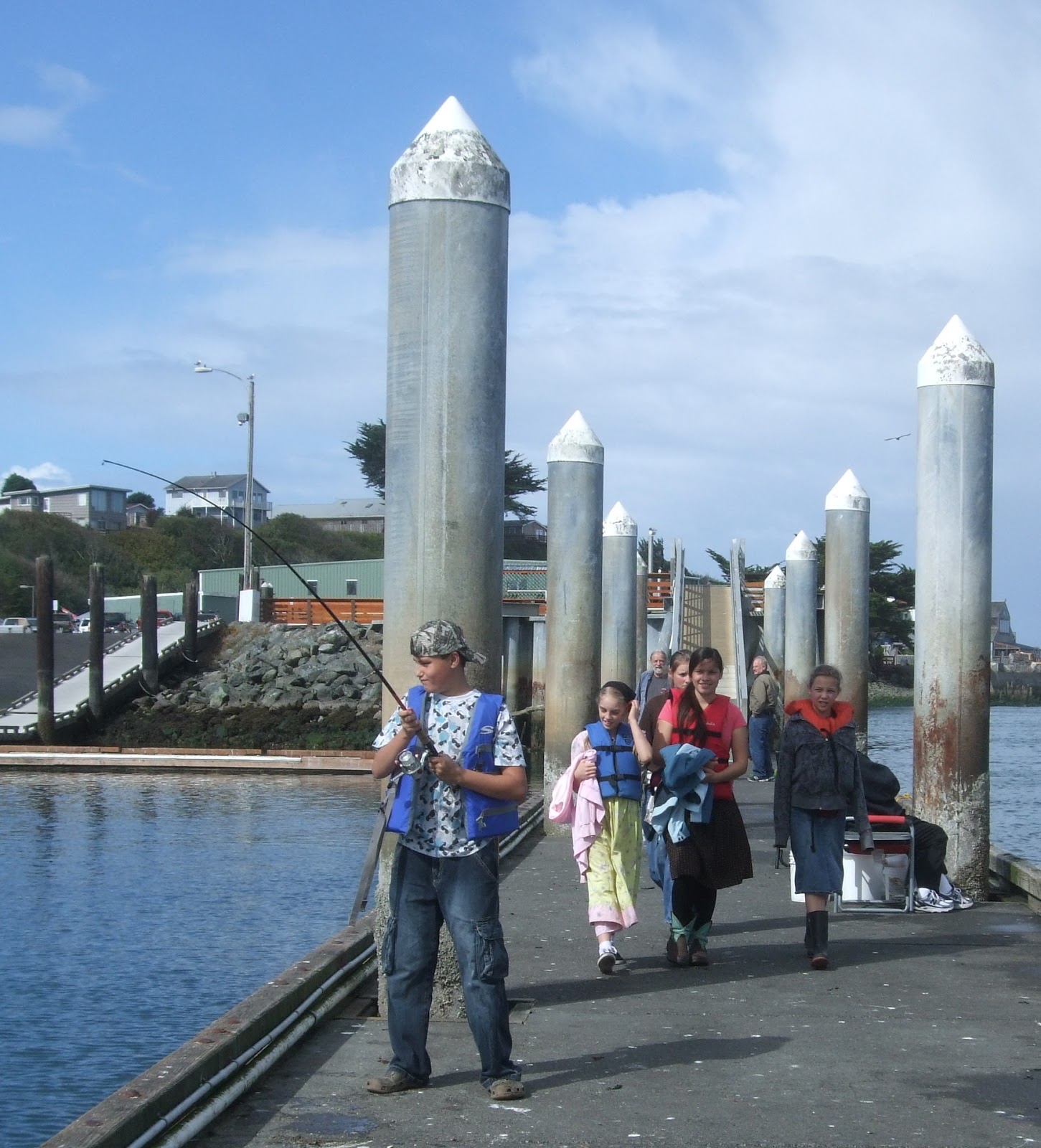
We also did some crabbing and fishing from the dock.
Jadrien, Annika, Eunice, McKenzie

On the last day, we ate lots of crab.
Mrs. Smucker eating crab, daintily.

We had one injury that involved blood, when Weston grabbed a crab the wrong way and it pinched his finger.

We also had one hurt feeling, when one of the guys connived, Thelma-like, to have "Andrew" sweep out the yurt at the end of our stay.  I didn’t know about this until I was walking to the restroom and suddenly a voice came out of a tree above me, bird-like, and it was "Andrew," who had retreated there to regain his equilibrium and told me what had happened.  I sympathized and told him that God will bless him for serving, which probably didn’t help much.

I can’t remember if I talked to “Thelma” about it or not.

With this age, it’s always hard to know when you assume they can handle it and when you need to intervene.
The guys did a lot of grilling, drove boats and vans, and conversed.

We also had one scare.  They boys were playing hide-and-seek on the beach, darting around the big rocks and running far down that enormous beach where even a Smucker’s voice carries only a few hundred feet and then is lost in the wind and waves.

The sun was setting and it was time to go.  We stopped the game, started rounding up children, and took inventory. Tanner was missing.

Tanner is a slow-moving, slow-talking, slow-grinning sort of guy.  We looked behind logs and around rocks, up the beach and down the beach.  We called, but our voices didn’t reach far enough to rouse a well-hidden kid.

Where in the world was he?

The boys went scampering back down the beach where they’d been playing before, maybe half a mile away.  We saw them skittering and darting around, playing a new game, and finally one of us went down to fetch them, and there was Tanner.

Weston had remembered seeing Tanner crossing a dune, heading away from the beach, but hadn’t divulged this to us when we were all frantically looking.  So when the boys went back to where they had played before, Weston knew where to look.  But right about that time Tanner showed up.  So they started playing another game.

I asked Tanner later if he’d fallen asleep.  “Nooo, not quite,” he said.  “But just about.  I lay back in the grass for a long time and nobody found me.  But then I saw the sun was settin’ and I thought I’d better come back.”

Well, I guess he won the game, for sure.


 Riding in a van full of boys is exhausting even if you don't have to drive, or say or do anything.  Just the constant NOISE.
In our Reliable Old Van: Cody and Logan in back.
Tanner and Jadrien in front
Boys communicate with a lot of noises in between words.  I kept track for about 20 minutes.

Ksshht--1
Pbbbbbt--1
tshhhh--4
Pssssshhhhht--2
ERRRRR--2
WEEEEEE--2
zhoop!-1
errk--1
DUDE!-2
whoa!-2

But then I noticed that, depending on the subject, all these sounds and more would be uttered many times, at high volume, and with wild gestures, within about 2 minutes.  These subjects included:
1. A high-speed police/motorcycle chase through Brownsville and Harrisburg the day before
2. A chiropractor fixing someone's back
3. Dirt biking
One sand sculpture.
It was a wonderful camp.  Annika and Trevin won the verse contest.  People were fun and kind and helpful.  The weather was amazing.  A bunch of adolescent girls made me feel included.  And at night, in my top bunk, I could look out the skylight and see stars.

It doesn't get better than that.

Quote of the Day:
I forget who, talking about pets, I think: Their names are Flint and Weston.
Me: That's like guns!
Ashton: Uh, that's Smith and Wesson.
Me: Oh yeah...


Logan and Tyler on the jetty


Boys being boys.

Some of us went to a wild animal park.
This cat was about as cooperative as your average housecat.

Ashton, Brittney, Eunice in the "valley of dry bones" 

Girls, waiting.
These people will do a great job with camp in the coming years.
[Ruth: "And then he threw a frisbee and it hit me right here!"]
[just kidding]

The Bandon bayfront has all kinds of benches, sculptures, and fun things to do.
Loading up: why does it always take so much Stuff?
But we used it all.
Except we had too much food.

It's been a fun ride.

The beautiful Bandon beach.

The Campers, 2015
Goodbye, beach and Bandon and Bible Memory Camp.  It was good to be here.


Monday, October 12, 2015

Bible Memory Camp 2015--Chapter One


First, some definitions.

Bible Memory Camp: an annual project in which we hand out cards printed with 50 Bible verses to the 9-to-14-year-olds at church.  If they memorize them and recite them to their parents, they get to go on a 3-day trip.

Camp: a loose term that can mean actual camping, with tents and campfires and hauling water, or staying in a house with actual beds and showers, or something in between, such as staying in yurts.

Yurt: a round, wood-framed, canvas-covered building based on dwellings in Mongolia and featured at a number of Oregon campgrounds.  They provide more structure and shelter than tents, and a lot less than motorhomes or houses, thus providing the true camping experience without the complete despair of a cold rain on a leaky tent with homesick 10-year-olds.
The outside of a yurt.
The inside of a yurt.

Our big red and white van, the Verse Contest, Treasure Hunts, the Sand Sculpture Contest, and Way Too Much Food Sent By The Moms: Unchanging camp traditions.

Paul and I have been involved in Bible Memory Camp for 20 years.  For a number of years, Arlen and Sharon Krabill were involved.  The last few years, we organized it, with various people helping.

Last year, Paul said, "Someone else needs to be in charge of this."  So he told the congregration we'd like to take two younger couples along and train them in. Was anyone interested?

Ben and Ruth Swartzendruber volunteered, and also Preston and Heather Kropf.

The Sponsors, still smiling at the end of camp
Ben thought, and we agreed, that this sort of interaction between church leadership and the kids from church has been invaluable.  So, in the future, they might invite a pastor/deacon couple to go along each time.

Which means there's a chance we'll do this again, but for now this was officially our Last Bible Memory Camp.
Weston and Jadrien in back. Then Tyler, Tanner, Trevin, Logan, Cody,
Brittney, Eunice, Ashton, and McKenzie. Annika in front.
It was wonderful.

Well, most of it was wonderful.

Paul stayed in a yurt with the boys, and I was in another with the girls.  The other couples had tents at another campsite. The first night, I climbed awkwardly up into the top bunk and unzipped my sleeping bag.  Did the girls seem extra expectant and quiet, in retrospect?  Maybe so.  Because down in my sleeping bag I found something long, tubular, brown, cold, alive-ish, and awful awful awful.  Not a snake, praise be to God, but awfully awfully snakelike.

Shudders and horrors, gasps and exclamations.

It was a long coiled end of one of those awful long brown tubular seaweed things.

And the culprit was Ashton, one of those lucky girls who isn't scared of anything.

She still teases me about it, sneaking up behind me after church and murmuring, "How about some seaweeeeeddd??"

And the next day, while I was still jumpy, McKenzie came up behind me on the beach and twined a long cold seaweed around my ankles.  GAAAAHHHHH!!

She laughed and laughed.

Both seaweed incidents involved this kind of seaweed.  Logan was dragging all this
along to use in his sand sculpture.  He reminded me of the prisoners
dragging the ship in the opening scene of Les Miserables.*
This was much more voluntary, and happy.
This was the first time we rented a community yurt in addition to the yurts we stayed in.  It was the best idea yet, as we could make food there, stash all the food without losing it to raccoons, and have a place to hang out together after dark.
Jadrian and Logan, the Camo Cap Campers
One night Ruth introduced a game where each team had to stack plastic cups using only a rubber band and string.

Trevin, Tanner, and Eunice

Tyler and Cody, with Ruth looking on.
 This post is getting way too long.  I'll post more pictures tomorrow.

But first, the Quote of the Day:
"Guys!  Act normal! It's the park ranger!"
--Logan

*Disclaimer: this is not an endorsement of Les Mis, which I watched on a plane once, about the only time I watch movies clear through, and it was pretty intense. Especially if you don't watch movies much. Excellent story, though.

That's Annika dragging the stick in the sand.
I think this shot just shines with the Fun and Joy of the Coast.

Sunday, October 11, 2015

Today's LFH: On Finding Ways to Communicate

LETTER FROM HARRISBURG
It’s about communicating love, no matter what the technology or platform


By Dorcas Smucker
For The Register-Guard
OCT. 11, 2015

 We were in the middle of making 50 quarts of applesauce when I suddenly remembered it was time to talk to Amy. I left kids on the porch washing and quartering apples, pots of apples hissing on the stove, and the Squeezo applesauce-extractor in mid-crank as I dashed to the computer.

Communication trumps canning, after all.

Every Saturday at 5 p.m. I sit down at the desktop computer in the office and open a program called Skype.

I type in my name and password. My list of contacts appears on the left, and I look for a green check mark by our oldest daughter’s name telling me she’s also signed in.

A click on the little video camera icon, a short wait and there is Amy, just waking up on the other side of the world in Chiang Mai, Thailand. I see her arranging herself and her cup of coffee against a green pillow in front of the curtains that I sewed for her a year ago.

She looks healthy. And happy. Praise God.

And then we talk.

Amy always wants to know what’s happening here. Is Jenny in choir again and how are Steven’s EMT courses going? Is harvest over and has JoNell had her baby?

I hear the tropical birds trilling outside her open windows, and a dog barks. She tells me about tutoring university students and about the funny neighbor who puts sweaters on her dog when the temperature drops to a chilling 68 degrees.

After an hour, she needs to get ready for church and I need to go make supper.

“Bye.” “Love you!” “Good talking to you!” “You too!”

Click.

“How has technology changed your life?” an email asked me recently.

My first thought was, “Communication.”

We were Amish when I was little, which means you can’t pick up the phone to call your relatives, so Mom would seat us around the dining room table, pass out papers and pencils, and tell us to write letters to Grandma.

I saw one of these specimens, years later. “Dear Grandma, How are you? I am fine. Are you very busy these days?”

As teenagers, we talked on the phone with our friends, which never had quite the charm of the girls in magazines lying on their chenille bedspreads chatting on their Princess phones, because we had exactly one phone, right in the middle of the house, and it was a party line to boot, so the neighbors could listen in too.

My parents never transitioned to technology and always preferred paper and ink letters. Writing, addressing, and mailing a letter seemed like a huge bother in comparison to email, especially when we had small children, so it was hard to stay in touch.

We even bought a fax machine and installed it in Mom and Dad’s basement, hoping to make communication one step easier. I wrote a detailed list of instructions and pasted little numbers and arrows to various buttons on the machine. They never grew comfortable with it.

“If you have a message to give, it’s your job to figure out how to make sure it’s understood,” we were told in a cross-cultural communication class while working with Native Americans in Canada. “this includes learning another language, if need be. You can’t expect them to learn your language.”

When your children are at home or your parents live nearby, communication can include hugs, big ginger molasses cookies, and help with raking leaves.

When they’re far away, communication is mostly words.

I love my family, and love is all about relationships, and relationships fade and even die without words. So, I need to continually figure out how to keep those crucial, life-giving words flowing back and forth between us, not only in a language they can understand, but in a medium they can easily use.

It’s my task to make communication a priority. It’s not mine to dictate how it has to happen.

My dad and I still write letters to each other, but otherwise the days of weekly paper letters are long gone, and talking on the phone is out of fashion with young people as well.

I need to adapt to the culture and learn their language and customs.

First I learned to email. Then, a few years ago, I learned to text. Before I discovered backspacing, I would type “oops” whenever I made a mistake, wildly amusing my daughters.

On Sunday afternoons I sometimes Skype with our son Matt. He shows me the latest project in his Washington, D.C., apartment, such as a wooden rack for his weights, and tells me about his work at the Navy Yard while I analyze the room behind him (messy), his beard (handsome), and the green smoothie he’s sipping (impressive).

At Matt’s urging, I bought an outdated iPhone from a Craigslist ad. “It’s more intuitive,” he said, choosing his words carefully. “It might work better with how your mind works.”

He was right. Slowly, swipe by swipe, I learned. I’ve even downloaded a few apps.

My sister in Oman introduced me to WhatsApp, an online messaging system that’s a few steps easier than email and works better than texting for communicating overseas.

“Plipp!” chirps my phone on the kitchen counter, and there is a picture of Rebecca’s tiled patio, ringed in greenery that must be hard to keep alive in the 120-degree heat.

Another day, the phone beeped and no words appeared, only a line and a triangle. “Oh! It’s an audio message!” I clicked the triangle and my sister’s voice, in our traditional Amish dialect of Pennsylvania German, came out of my iPhone in a bizarre bending of time, space and communication.

In the next week, I’ll probably text my high school daughter about picking up milk after school, Skype with the older kids, write a longhand letter to my dad, and have a long philosophical discussion as all of us wash the dishes after supper.

I’ll call friends my age, send Facebook messages, comment on a niece’s Instagram photo, and text a nephew about coming for Sunday dinner — words and always more words, pulling us together.

In this strange modern world of endless ways to communicate but increasingly isolated and lonely people, I feel an urgency to reach out, to connect, to include, to speak and listen, even if it means the applesauce scorches or the cleaning waits.

Words and sentences and paragraphs, again and again. Written, tapped, and spoken. Cut apart into electrons and mysteriously reassembled on another continent. No matter the method, it always comes back to the words that form the communication that makes the connections that keep alive the relationship, the friendship, the family, the love.

Tuesday, September 22, 2015

Ideas for Uses for Stuff

I am a Yoder by birth, which means I  like to save, keep, rescue, and repurpose things that most people would throw away.  Right now I need some ideas.  I have some objects that seem loaded with Potential and Possibilities but the Good Uses are all hidden behind a foggy window in my head and I need someone to wipe the glass.

1. I found this fabric at a funny secondhand store in an old metal barn on the coast near Bandon, one of those quirky places run by a man with a big mustache who was relaxing out front on an old bench seat from a van.

It's a denim fabric, about two yards, with simple orange and blue stripes.  It was only a dollar and had Etsy and Pinterest and Instagram all over it, so I bought it.


But now: what would be the best use of it, and would justify that momentous no-turning-back First Cut that always terrifies me, since I am scared of commitment?

2. This is a skirt hanger made of sturdy metal bars and flimsy pink clothespins.  The pink clothespins died one by one, but the bars remain.  And I think, surely there's a creative use for this.

I tried hanging it in the kitchen for dish towels, but it got in everybody's way.

I could still use it for a skirt hanger if I used regular clothespins, but I have enough nicer hangers that I'd rather use.

I will toss this if I don't find a use for it soon, as even my Yoder repurposing has its limits.


What do you think?

3. This was another $1 find that I snatched up like only veteran garage salers can home in with bat-like radar and grab. It's an old toolbox, obviously homemade, with lots of scratches, personality, and signs of wear.

But.


Do I fill it with flowers?  Put it up on the wall for teacups?  Take quart jars of lemonade out to the threshers next summer??

Would it have a useful and decorative purpose in my writing cabin?

Help me out here.

4. I saved the last Laughing Cow cheese box because it is just so cute.  However, I didn't tell my daughters because they would have had a fit.


But just tonight I found this on Pinterest.  Ta da!


Sunday, September 20, 2015

Cottage Beginnings

Things are happening with my writing cabin!

I am a bit like an excited duck chasing a June bug about this, flapping my wings and quacking, so if you find this annoying, please continue your walk around the park and pay me no mind.

But yes, actual things are happening, like measuring and buying and pounding stakes where the corners will be.

If you are a bit ADD, and you have a husband who has a lot more great ideas than time, it can be a long step from Maybe We Should to Real Things Actually Happening.

I have old friends far away.  Sometimes when we communicate, we say, wouldn't it be fun to get together and chat over tea?

Yes, it would.  But we both know what it would take to coordinate this.

So this is like the old friend actually showing up at the door.

The cabin will be across the road by Muddy Creek in an area that is covered with water at times during the winter.  During the big flood of I think 1996 that area was filled up almost to the road.  So I want the cabin way up above such dangers.

So the other day Paul got a surveyor's scope and ruler and beamed and calibrated and marked, from the Official Elevation Marker at Leroy and Anita's next door, over to the signpost, and then across the road.
Here are Paul and Jenny, measuring and marking.
The ice cream lid has a purpose. Really.
To set things on, or something.
The cabin will have to be up on very high posts, we realized.  But better a bit stilted looking than washed away.

I've been on Pinterest, scouting for ideas, off and on, by searching for cabins and cottages and small houses.  I got some good ideas but the featured buildings never seemed quite what I was looking for.

A Facebook friend asked me if I'm going to utilize Treehouse Masters.  I had no idea who that was, but it turns out to be a Pacific-Northwest-based crew who designs and builds tree houses, and who has their own TV show.

And then I realized I had been searching all the wrong things on Pinterest.  I plugged in "tree house" and before me bloomed a thousand ideas that were exactly what I wanted.

Like this.  [Read more here]


"Is this the same idea as the she-shed that is all the rage here?" asked another Facebook friend.

My snooty answer: I hope I am as high and dry above this world's swirling fads as this cottage will be above the next flood. I've dreamed of something like this for a long time.

Meanwhile, we continue to discuss names.  Dear me, it was easier to pick names for the children.

I still like Acorn Cottage but the children think it's a strange choice, and others have pointed out the obvious and inevitable jump to Nut House.

Ben goes to college with one of those people whose name seems to be entirely comprised of surnames--something like Dorington Chase Wilkins.  Ben thought "Dorington" would be a great name for my cabin.

I think: will it take too much explaining? And is it too egotistical?

The other day Jenny sat down at the computer and shrieked:

Quote of the Day:
"MOTHER!!  You are NOT naming it OATMEAL COTTAGE!!"

It's no wonder some of us moms go around perpetually confused.  What was she talking about?

Well! There was a little tab at the bottom of the screen, and it SAID, "Oatmeal Cottage."  SEE?

Oh, child.

Earlier that day I had looked up a Trim Healthy Mama recipe, and then I had "minus-ed" the page, or that's what I call it, but I'm sure normal people call it something better, when you click the little dash in the little box third from the end at the upper right.

So only the first two words of the recipe showed in the tab at the bottom.

The recipe was for Oatmeal Cottage Cheese Pancakes.

Meanwhile, I need an uncomplicated name that conveys rest, oak trees, creativity, water, and such things.

But not oatmeal.

*****
This weekend we were down to two children at home.  Two!  I dropped a few chicken thighs in a tiny little crock pot this morning to make honey mustard chicken for lunch, and it was easily enough for the four of us.

I thought: maybe the kids will all leave home about the time I get my cabin, and I won't even need it!

And I also thought, "What if there's nothing magic about this cabin and it won't make me a prolific and good writer?"

But then I decided I was just feeling guilty for being so blessed.

One of my faraway friends, Dorcas Stutzman, said, regarding the building of a cabin, "For some reason this takes me all the way back to our giggling fits in Jonathan and Cynthia's trailer house."

And I said, "If you come visit, we can sit in the cabin and have more giggling fits, if we still know how."

My friend Sharon testifies that I still know how.

Maybe the writing cabin will be a place where nebulous ideas and wishes become reality.

Friday, September 18, 2015

Cousins and Friends

Last week Paul's niece, Leah, sent me a CD with photos from the Wilton Smucker reunion in June.

I was struck by how similar Jenny and her cousin Allison look in this shot.

I think they were more tired than sad, despite those woebegone faces.


Actually, they looked alike in other pictures from that weekend too.


Here they're sitting between Steven and Grandpa Yoder.
 Jenny was born less than two months before Allison, and they have been like two peas in a pod ever since they were little.  At 16, they are best of friends.

Allison's eyes are blue while Jenny's are brown.  Allison has blonde hair; Jenny's is red.  Allison's features are a bit finer.

But they walk alike, laugh alike, and carry themselves the same way--and they have for years.  They are very similar in size and shape.  When Jenny decided she wanted a "cape" dress, Allison sewed her one from her own pattern and it fit Jenny perfectly.

Here are two shots I took at the reunion.  Allison and Jenny are on the left, and they're not posing for the pictures.  They just DO this.


I found the reunion pictures intriguing enough that I sent them to the rest of the family.  Matt reminded me of how the two girls hit it off in Poland when Allison's family lived there, and we went to visit, in 2004.  I think that was the first time we had noticed their remarkable similarities, and John noted that they even squealed alike, about the same things.


That Sunday morning they tried to look as alike as possible, from navy-blue dresses to French braids.

 I'm not sure why I'm so intrigued with similarities in cousins--maybe because I didn't have any girl cousins my age.

The truth is, I might have had cousins who were a lot like me.  After all, I had over 50 first cousins.  But we were at the young end of the family tree and our oldest cousin, Sylvia, was 50 years older than the youngest Yoder cousin, my sister Margaret, who was good buddies with Sylvia's grandchildren.  When I was 16, the freindschaft wasn't likely to notice if 40-year-old Barbara had been like me when she was my age.

This was at another Smucker reunion, maybe 10 years ago.
So it just makes me happy that the time and the genes were right for these two to not only be cousins, but to be the same age and so very much alike. . . but still just different enough to keep their friendship interesting.

Playing dress-up, long ago.
If you have a cousin who is also your best friend, you are blessed.

Quote of the Day:
"That guy can land-plane in a bit straighter rows than I can."
--Emily, who has learned to observe crops and fields as we're driving along, like a true farmer


Sunday, September 13, 2015

Column: The Hot Summer and Weariness of Soul

LETTER FROM HARRISBURG
From this summer of heavy burdens, we emerge stronger


By Dorcas Smucker
For The Register-Guard
SEPT. 13, 2015

About seven years ago I directed a Christmas play called “Why the Chimes Rang.” It began as a good idea for a school program but turned into a bad-dream project that muddled on and on. Every aspect of it, from the singing to the costumes to the behavior at rehearsals, steadily degenerated into chaos as time went on.

That’s how it’s seared into my memory, at least, which is why I haven’t directed a play since.

One of the characters was a young mother who was hungry and lost on a winter night. The actress was supposed to come down the church aisle, unsteady and desperate, clutching her baby in her shawl as the winter winds blew the snow down on the village.

She had one line to say: “Oh, I am so weary and cold.”

Thankfully I had a sense of humor, and the girl who played this part was not easily discouraged, because for some reason she could not recite that line.

“Oh I am so tired and hungry!” she would say before collapsing into the snowbank, a pile of quilt batting from the sewing circle, covered with a white sheet.

“No, no.”

Back up the aisle I sent her. A slow turn, and toward the front again, into the wind: “I am so weary and tired!”

“No! WEARY and COLD.”

“Oh, I am so cold and hungry!”

I’m not sure that she ever got it right, even on the night of the program. I should have let her ad lib. Who would have noticed?

Sometimes, in certain seasons of life, it feels like we’re all weary and cold, fighting our way into the winter wind. Our shawl isn’t nearly enough protection, and we are about to collapse into the snowbank with the baby in our arms.

At such times, life is just a lot of hard slogging, on and on, one step after another. We grow weary in body, which makes us extra weary and cold in spirit as well. It seems we will never reach the front of the church, and for sure we won’t hear the miraculous chimes when they ring in the steeple on Christmas Eve.

Health issues, difficult relationships, financial stresses, caregiving — all of these can seem like trials that will never end.

This hot, dry summer, paradoxically, has been a season of wintry weariness of soul.

Just by definition, summer in farming country is exhausting: long days on a combine, seed-cleaning machines running around the clock, ripe peaches dropping from trees and needing to be canned today, hungry animals, thirsty gardens, and never quite enough energy to reach around.

With its record dryness and heat, this summer seemed especially endless and difficult. The grass died, the lilac leaves — normally hardy through the heat of August — started curling in July, and the potted flowers on the porch wilted as soon as my back was turned.

The calves’ pasture turned brown and we supplemented with sacks of feed. The waiting grass fields became ripe not only for harvest but also for any stray spark that would ignite and destroy them. We turned on sprinklers to keep the pasture grass and flower beds alive, but the well kept running dry.

With extra responsibilities, such as taking in my dad for six weeks, two bouts of bronchitis and weeks of recovery that made a normal day’s work feel like climbing Mount Hood, I found it the most challenging summer in years. The rest of the family, busy with jobs, harvest and summer classes, was unable to pick up the slack.

Daily life became a hard climb uphill, day after day.

I sensed that I was not the only one short on rest, facing relentless demands, and losing the sense of joy that normally comes with summer.

For my family, summer meant sacking seed at night and sleeping restlessly in the heat and noise of the day; studying for tests for summer college courses late at night; stocking shelves while friends were swimming in the river; and fixing worn-out belts and motors high in a dusty warehouse in motionless heat.

Harvest ended, but the heat continued. We watched, helpless and horrified, as fires burned all over the Northwest. We waited and prayed for rain. The smoke burned our eyes and made us feel surrounded by a fog of poison.

I’ve found in summers past that young people with long hours of alone time on combines and in deserted warehouses end up with too much time to think and no outside voices to counter the inner noise. Regret, addictions, depression — whatever the weakness, it shows up here. Sometimes it’s just a weird outlook on life, and they start having arguments in their heads with "all the stupid people on NPR" or with Rush Limbaugh or "that opinionated sports show host."

Then they think, “Wait. I am arguing with people on the radio.”

It’s the season when people apologize. I first noticed this years ago, when a young friend was driving combine and then wrote me a note explaining that she’s afraid she left the wrong impression, but really she meant this and not that, and she feels very badly about her mistake.

Combine syndrome, I named it, that strange summer struggle of the soul. I tried to encourage my children and their friends, “It’s just a hard season, right now, and a tough trail. Be gentle with yourself.”

The day I found myself lecturing a Hollywood celebrity, I knew I had a bad case of combine syndrome of my own. It was one of those silly stories that takes over the news feeds, something I would ignore in saner times, but there I was, forming a speech in my head to set them straight.

I laughed at myself, which is what you learn to do at my age, especially if the choice is down to laughing or crying. I also went back to reading my Bible more, my anchor of sanity in the crazy times. I recommended it to the combine-driving and seed-sacking and exhausted people in my life as well, even if it’s only an encouraging verse tacked above the bagger. “... be strong and do not give up, for your work will be rewarded.” Or this one from Galatians: “Let us not become weary in doing good, for at the proper time we will reap a harvest if we do not give up.”

“And,” I said, “You need to talk with real people with real voices who speak real words to you.”

I took my own advice one morning, cooking oatmeal for my dad and then escaping to Jake’s Café in Harrisburg to meet my friend Gina for breakfast. Those two hours were like a large Iced Kicker from Dutch Bros. on a 100-degree day on an un-air-conditioned tractor.

At least I knew this, among all the hot days and the dry straw swirling and the threat of fire — the season eventually ends. I’ve been here before, and I know. It doesn’t last forever.

This was my survival message to myself and all my weary loved ones: “One day when you least expect it the farmer will tell you you’re combining the last field today, and you’ll have time in the afternoon to go swimming, or you can sit up late with friends on a Sunday night because you won’t have class the next day.

“The day will come when the sackers won’t be working night shift anymore, the blueberries will all be in the freezer, the farmer won’t need you to do flail-chopping until next week. Your mind will think normal thoughts again, the confusion will pass, the guys on the radio will be only an occasional noise in the background.”

Eventually, a cloudy day turned into showers and then an actual rain. The brittle lilacs got a drink at last, the lawn turned a timid green overnight, and the air cleared of that lingering smoke.

Even when it seems they’ll last forever, hard journeys do eventually finish, when the time is right. You reach the front of the church and remember your line, or at least get it close enough, and the long slow walk is done at last, and the chimes ring out in the ancient belfry.

As you sit on the pew and rest, you know that it was scary and hard and it seemed it would never end, but it finally did, and you are stronger, better, wiser, and braver for what you’ve just been through.

Wednesday, September 02, 2015

On Rebuke and Humility

Many years ago, when I was young and a bit full of myself, [don't say it!] I took it on myself to correct Henry Schrock on a few points of his sermon.

He had mentioned First Corinthians 11 when he meant First Corinthians 13, for one thing.  And then there was some point of doctrine that I questioned him on also.  I don't remember what it was, but I remember my sister laughing at me afterward and saying, "Only you, Dorcas."

Henry's response was to listen carefully with his characteristically bowed head, to smile genially, and to take me a lot more seriously than I deserved.

I think of this now because I have not always been so fortunate in the years since.

There was the visiting preacher who had a bluff-and-bluster sermon about evolution, making it clear that anyone who believed in evolution was just stupid.

I spoke to him afterwards.  It might be more effective, I suggested, to just compare the two philosophies side by side, and consider both seriously but explain why creation makes more sense to you.  Because if you're going to play this game, "they" can make "us" look stupid too.

"But evolution IS stupid!" he said, visibly upset. And that was the end of that conversation.

Then there was the guy who had the same approach to Calvinism vs. Arminianism, and who had the same reaction to my gently-worded challenge.

And the guy who felt that all depression was caused by sin, and none of us need professional help.

I might have burst into tears when I spoke to him, having just lost a nephew to suicide.  His response was utterly devoid of compassion or sense.  He did not appreciate me or my question.

I am making Mennonite ministers look really bad here, so please note that our repertoire of guest preachers includes dozens who were Godly, sensible, and easy to be entreated.

I'm making a point here, eventually.

I don't go around correcting ministers all the time, either.  But if I have a question, I'll ask if the time seems right, with a more diplomatic spirit than I had back when I spoke to Henry Schrock.

None of the men I confronted said that I, as a woman, had no right to question them, although they probably thought that.  I'm guessing that anyone younger, female, or less ordained was disqualified from doing anything but heartily agreeing.

This can do crazy things to your mind.  Like: Oh dear, I'm just too forward.  Maybe I should have complimented him on something before I asked about that.  Maybe I'm just too full of my own opinion. If a well-known important person thinks I'm an idiot, maybe I am. Maybe I should have had Paul ask him instead . . . even though Paul would have wondered why I'm getting him involved if I was the one with the question.

Anyone in any position with a bit of power can fall into this trap, not just ministers. Parents, professors, anyone In Charge of Anything.  I once had a very secular psychology professor who claimed that the blind spot in the center of your iris and the blind spot when you're driving were the same thing, and when I asked her about it after class she smiled like a Rottweiler and tore me apart like one too.

"How dare you question me?" this attitude says.  "After all, I'm all these things that you are not."

And so you're left feeling bad.  About yourself, about them, about your voicelessness in something that really should not have become that big a deal.

Of course there's a right and a wrong way to speak to someone. 1 Timothy 5:1 says, "Rebuke not an elder, but intreat him as a father, and the younger men as brethren."  I'd say my approach was always "intreating," but if someone didn't want to hear it, they'd probably disagree.

I was driving home from Portland the other night and listening to a radio program, an interview with Dr. Henry Cloud.  He was talking about just this sort of thing, and how it affects relationships, and said something I'd never thought of.

The Bible, especially Proverbs, talks a lot about maturity and wisdom.  We tend to think the mature, wise person is the one who has it all together and does everything right.  But Proverbs doesn't say that.

Proverbs says, instead, that the mark of the wise person is that they listen to a rebuke.  They are humble and gentle when corrected.  Maybe even if they're older and more powerful.

The immature and foolish person will respond by being defensive, angry, and hostile, says Dr. Cloud.

"Whoever corrects a mocker [fool] invites insults. Whoever rebukes the evil person incurs abuse. Do not rebuke mockers or they will hate you; rebuke the wise and they will love you. Instruct the wise and they will be wiser still; teach the righteous and they will add to their learning. –Proverbs 9:7-9 (NIV)"

Interesting, isn't it?

It seems a bit harsh to label a Mennonite preacher a mocker or fool, but it's also silly to think that his denomination and position might make him immune.  I'm married to a Mennonite minister who is getting older by the day.  Thankfully he is wise and humble, but he is not immune to pride because of his ordination or age.

We all face rebuke and correction, in a lot of areas besides what we say up front, as in all my examples here.  I suggest that we respond like Henry did back in 1978, and listen with an open heart and a patient smile, and make sure we understand.  Even if the rebuker is a sassy teenager who is way too full of herself. And even if it was an inadvertent and insignificant error like citing the wrong chapter in First Corinthians.

I think of him with gratitude and respect, all these years later.

James 3:17 But the wisdom that is from above is first pure, then peaceable, gentle, and easy to be intreated, full of mercy and good fruits, without partiality, and without hypocrisy.