Friday, April 10, 2020

ABC Post 4--Thirty Little Fingers--Review and Giveaway

Update: We have a winner! Connie Stoll!
Please contact me at dorcassmucker@gmail.com with your mailing address.
Thanks to everyone who entered the drawing. If you didn't win, I encourage you to write to Sheila and invest in a copy of your own.

This is supposed to be a book review of Sheila Petre's Thirty Little Fingers, and a giveaway.


But first I'm going to go down a rabbit trail.

If you are Plain, be it an Amish woman in a white kapp and a long dress, or a Mennonite man in jeans and a plaid shirt, people who are not Plain will often expect you to be A Certain Way. Sort of other-worldly, serene, holy, unfailingly gentle, and superhumanly good.

If you act like a normal human being, they are surprised. They might be delighted, disappointed, or something in between, but they will definitely be surprised.

By acting like a normal human, I mean getting tired and grumpy, laughing loudly, feeling impatience or envy, or buying bread instead of making your own.

I've run into this myself a hundred times when I meet The Reading Public--people have told me they're surprised that, for example, I would get impatient with my children. Some expressed shock and disappointment. Others were glad, such as the woman who told me she's an atheist, and she decided if a Mennonite woman can get annoyed at her children, then there's hope for her.

I happened to be reading Amazon reviews of an ex-Amish tell-all book one time--a bad idea, just so you know--and a reviewer said something like: "This book can't be true. The author says her mother called her a brat. An Amish woman would never do that! They are gentle, kind people!"

You see what I mean.

So. Let me just say, lest you were not aware of this: Plain people are just people. They have the same range of emotions as anyone else. They have good days, bad days, and plenty of days that are a mixture of both, just like you.

I have known Amish women who were catty and manipulative, Mennonite men who were kind and empathetic, and a whole lot of Amish and Beachy and Mennonite people who did the best they could with what they were given, and some days they handled life quite successfully and other days they really blew it.

There are proper Amish folks who quietly abuse drugs, alcohol, and their children, and others who sacrifice every single day to make life better for everyone around them.

So let's toss those Amish novels in the recycle bin and lay to rest any lingering notion that Plain people are so different, at heart, from the rest of the world.

Which brings us to Sheila Petre.

You would assume she was Amish, at first glance, if you weren't raised in the culture and thus you can't pick out the subtle distinctions. But her book will convince you, like few pieces of writing out there, that you and she really are not so different after all. In lifestyle, somewhat. In the deep humanity of your soul, not at all.

At the same time, Sheila swims against the American cultural stream as a wife and mom who embraces both roles and rejoices at another pregnancy. But so do many women who might wear jeans but have said No to the culture's bizarre expectations of how a woman should work, look, dress, eat, mother, and spend her time.

Sheila is smart and funny and honest. She's also dedicated and sacrificial, but not in a dreamy, angelic way. More like she loves God and her family, and this is how she has chosen to be.

Sheila wants to reach a wider audience than only young moms, but I feel like that's the group that really needs to read Thirty Little Fingers. I'm convinced they will laugh and cry with gratitude that someone understands them, at last.

Read on for Sheila's post and ordering information.

GIVEAWAYS:
Sheila will give away three copies of Thirty Little Fingers. One winner will be chosen from comments on this post, another from commenters on Facebook [look up Dorcas Smucker], and a third from Instagram [@dorcassmucker].

US addresses only, please.

Giveaway ends Monday, April 13, at 9 a.m. Pacific time.

I'll let Sheila speak for herself now.
---

Once upon a time, I thought I would grow up to be an old maid.

If I grew up at all. I was born a Lehman in Maryland; my mom was a Swartzendruber from Oregon. My sisters and I, one fine sisterly morning in the early 2000’s, decided to predict each other’s futures. Sheila, they said, is the type to die a tragic early death. Then they looked at each other, repentant, and revised their prophecy, lest it be fulfilled. Maybe, they amended, she’ll be instead a reclusive letter-writer.

I’m a letter-writer; they got that. As for reclusive, I’d rather hole up in my house, barefoot, with my own family, than put my sweater on and mingle with others, virus or no virus. I’ve been compulsively writing letters for over twenty years now, like some people keep buying shoes, hoping that perhaps this time I can perfectly capture a few steps of my journey and showcase them to another in a way that pleases us both.

So I’m a letter-writer, but I never achieved old-maidenhood. A man named Michael Petre intervened.
No nineteen-year-old girl can resist a handsome welder who falls in love with her by reading her poetry, before he knows what she looks like (or what sort of sisters she has). We married on a rainy April morning in 2006 and I’ve been bearing his babies and singing his praises in my letters to friends ever since.

(Here we are, during the years I was writing the words that would become Thirty Little Fingers. Yes, the photo cropping is strategic; only one person in our marriage has maintained a consistent waist size through going-on-fourteen-years and it’s not me. I would share a photo of my children, but they are adorable, and I’d rather not encourage kidnappers.)

Together we’ve weathered eight births, seven new in-laws, five new books, three new-for-us vehicles, two complete pea crop failures, a brother’s death, the purchase of a house and a business, a chimney fire, the onset of a pandemic coinciding with the onset of teen parenting, two Muslim exchange students, three seasons of postpartum depression, five road trips across America, countless moments of coming utterly to the end of ourselves, facedown upon the mercy of God…

…Does it seem a lot? Make a list of what you have weathered. Most of my acquaintances could easily construct a more arduous list than ours.

And here is how I know: Not a one of us is alone. Ever since I began writing letters, and increasingly after I moved into a house with a man who provided so much rich subject material and so few qualms about my sharing it, I have lifted stories from my letters and arranged them into personal essays for wider publication. The more I wrote and shared, the more my readers shared glimpses of God’s work in their lives in return…and the less alone we all discovered we were.

A few years ago, I began considering the publication of a book of my collected personal essays, poems, and the more universal bits from my letters. Oh, and recipes—because I’m a mom, I devote eighty-five percent of my time to the care and maintenance of small digestive systems.

Carlisle Press published the book, Thirty Little Fingers, in late 2017. A new book is not a fraction as miraculous as a new baby—trust me, I know—but it’s easier to share. I can press it into the hands of friends or strangers or pawn it off for more valuable resources—in December 2017, I hosted a book-food exchange on Tuesdays and Thursdays at my house. Local moms dropped in with food in exchange for a copy of Thirty Little Fingers. My freezer filled rapidly; for about two months, I only needed to devote sixty-five percent of my time to the care and maintenance of small digestive systems.

The first feedback I received on Thirty Little Fingers, five days after it was published, came not from a mom, but from an unmarried friend (Pauline Hoover), one of those noble women whose ranks I never, after all, joined:

I bought your book at Clay Bookstore as a gift for my sister, mother of four. Course I had to make sure it was fit to give.
    The one feeling that remains most strongly since I’ve closed the book is an ache. An ache that life, no matter how beautiful, will never be completely okay this side of eternity. An ache for your griefs and mine. Yet it is a calm aching, a trusting one.
    You mentioned that one of your goals might be to reassure people that their lives are normal. My life is not like yours but strangely, you reassured me that my heart is normal.  I read and thought, If I were married with children this is probably very nearly the kind of mothering I would be doing. (That, in fact, is one ingredient of the ache. But it’s okay.)
    Since I’m now a student of linguistics I enjoyed hearing you explore foreign languages and cultures.  I enjoyed the creative work with words and liked the places where you surprised me into laughing out loud, possibly most heartily at the idea that the Adamic nature is the gift of fathers to their children. I connected with the insecurities (I’m so glad other normal people worry ridiculously about their health) and worries that peeked out here and there. I tasted the joy of innocent childhood. I am always ready to side with anyone who has a difficult time appreciating dentists.  But for whatever reason I come away feeling that my heart has been tenderized. Perhaps because you have honored me by inviting me to into some of the sacred places of your heart.

Every writer should have such thoughtful readers.

If I could condense my book’s goal to two words, they would be: Build Community. So when Dorcas generously offered this opportunity to write about this book here, I wanted to build community. And I’m taking my cue from Pauline. Maybe you’re a mom who would be interested in reading Thirty Little Fingers. I’d love if you would, and it’s available for purchase. (Or if you live near Mercersburg PA, contact me to trade for a kettle of your good chicken noodle soup; I can use my broom to push a book toward you across my porch, re social distancing). Do men read your blog, Dorcas? Here’s an undisguised hint for them if they do: Mother’s Day is coming. But my special discount offer this time is for single women who love to share meaningful gifts with others, on a limited budget.

 Thirty Little Fingers is available online or from Carlisle Press. U.S. readers can order an autographed copy from Sheila Petre, P.O. Box 127, Mercersburg, PA 17236. Price: $12 each, plus $2 shipping per book.  Contact me at sjpetre@emypeople.net for special quantity pricing or to preview a small essay and a fantastic recipe from the book. If you are unmarried—with or without children—and you buy two or more copies of Thirty Little Fingers, intending to give at least one to a young mom you know, I will mail them to you for $8 each, plus $1 shipping per book. (Discount offer expires the last day of May 2020 and is only available for orders directly from the author.)

Warning: Thirty Little Fingers does not contain advice or answers for any aspect of motherhood (excepting its recipe for the best oatmeal bread ever). I am not a teacher. I am a friend, writing from my little house in PA, babies bumping my elbows, while we wait to hear the footsteps of our favorite person at our door. From here, I craft stories of comfort and humor and tuck them into envelopes for other moms, asking “Has your life turned out like you expected it would?” and saying “Mine hasn’t either, but tragic early death has not claimed me yet. Here we are with God, so let’s walk on together in hope.”

---
Remember to comment below to be included in the giveaway drawing.


I'm long past the baby stage, but I laughed in deep understanding
at all the things Sheila imagined (twins, a tumor, etc) before
she went in for that ultrasound.


Wednesday, April 08, 2020

ABC 2020--Post 3--How Our Family Stays Home

This is about how the Coronavirus and its restrictions have affected our family, and what we are up to while quarantined.

But first:

As mentioned in previous posts, this strange season steeps me in nostalgia, and sometimes I'm reminded of the day a jet crashed only a mile or two from our house.

Paul and I and a couple of children lived in a cozy trailer house near Dryden, Ontario, and only a few miles from the Dryden airport.

That winter, the little airport had been so proud to schedule its first jet service. Once a day, an actual jet flew in and out. Dryden was going places.

One winter day, due to ice on the wings and a series of bad decisions by various people, that jet crashed soon after takeoff.

I remember that it was a heavy sort of day, and cold, with poor visibility and low clouds, a hazy gray and white world.

There we were, safe and warm at home, but whenever I stepped outside onto the steps of our trailer, I could hear the roar of machinery as it cleared a path to the crash site. People were dying there, covered in jet fuel, some of them burned alive. Others were stumbling in the snow, seeking family members.

Here I was, and there they were, all at the same time. I didn't have any way to help them.

Today, we are safe, well, fed, and together in our well-appointed farmhouse.  I know that Italy is grieving, the poor in India are hungrier than ever, and a doctor friend in New York tells of the refrigerated truck, storing bodies, just outside his office. I know that locals are losing jobs and many elderly are alone.

Here we are, and there they are, and what can I do to help but to pray and call and text, from my safe little island?

Thankfully, there are also many just like us: neither hungry nor desperate, off the front lines, hunkered down, waiting. Venturing out for broccoli and medicine as needed. Working essential jobs. Trying to make the best possible memories in the strangest of seasons.

This post is for them.

Six of us are living at home: Paul and me, Steven, Amy, Emily, and Jenny.

Matt, our oldest son, moved to Houston in February and works for NASA. He told me the only NASA employees who aren't teleworking right now are the crew on the International Space Station. He and Phoebe are trying to figure out what to do about the plans for their wedding on June 14.

Ben, our second son, lives in Corvallis with a few other guys and researches smoldering combustion at OSU. He came home on weekends as long as he could. Now he joins us for church on Sunday mornings via Skype or Zoom or another of those words we are all learning these days. We had hoped he could continue his research, but his lab is now closed and he works on writing projects at home.

Here's Ben, worshipping with us.
Paul, who has been busier for years than any mortal ought to be, is busier than ever. His warehouse work is considered essential, since he processes animal feed. He had also been teaching every morning. That is now done via YouTube, which involves learning an awful lot of tech skills in a very short time. He also preaches via YouTube.

Paul prepares his pulpit.
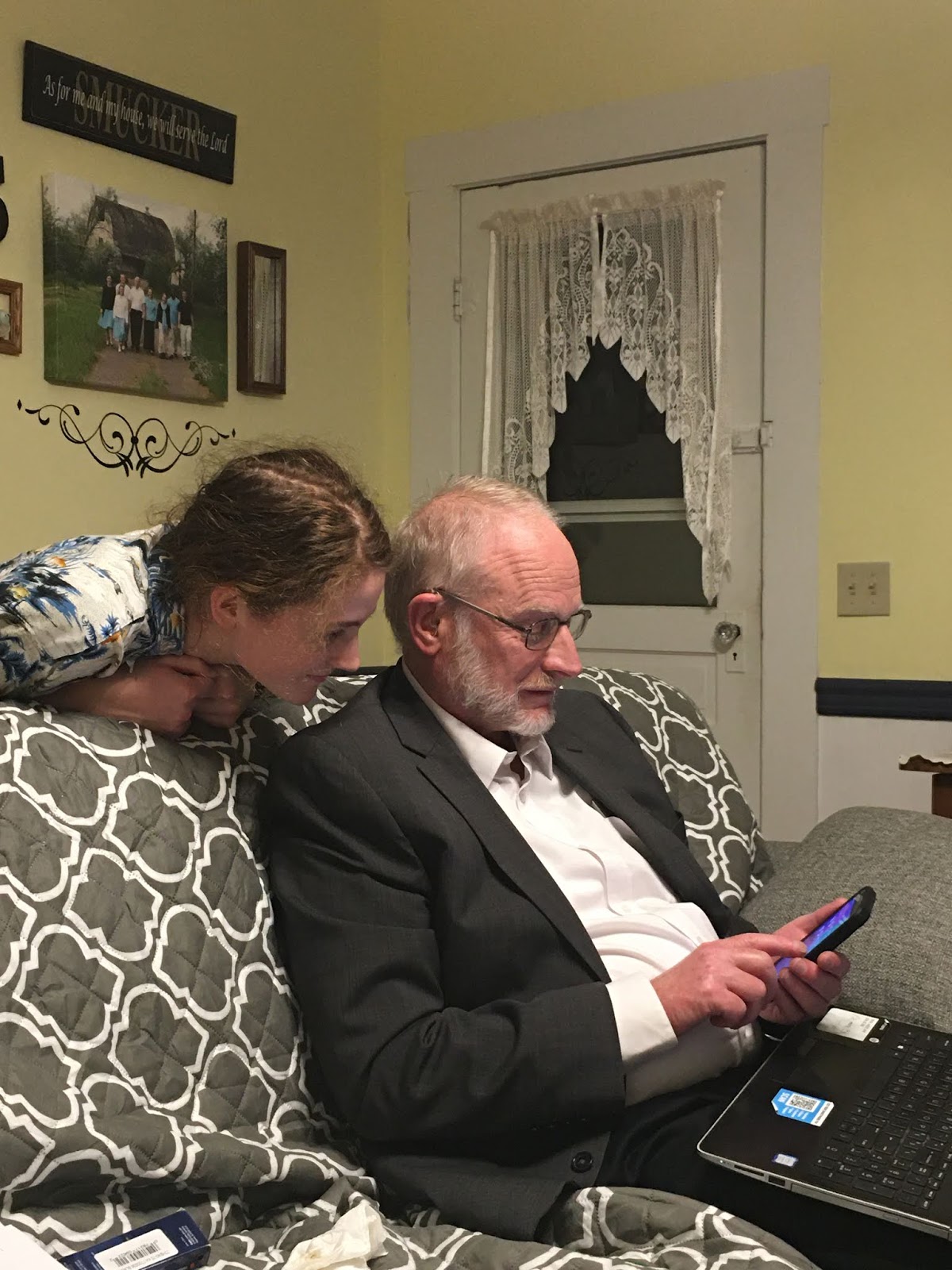
Jenny helps Paul figure out the technology.
I have been a homebody for years, so this isn't such a jolt for me. I've often wondered how long I could stay home without getting tired of it, but didn't think I'd ever get a chance to find out.

Now I know: About this long.

The Smucker sisters-in-law have learned to video-chat.
Anything is possible now.
I go walking a lot, inspecting the local lambs and cherry trees a lot more closely than in the past, simply because there's time.

Living in the country and getting out in it are astonishing gifts.


I'm also writing, sewing, cleaning out corners, and calling people I haven't called in a while.

Amy takes classes from OSU at home, tutors via Zoom, and whips up amazing food. "She and Jenny are living their best lives," said Emily.

Amy in one of her natural habitats
Emily, meanwhile, is perplexed by her own cabin fever, since she has been working from home for months already. Was it she who got the idea to take a basket of gifts to a neighbor with a birthday on Sunday? We stood a proper distance outside the door, sang Happy Birthday, and briefly chatted.

"You remind me of Little Women," the neighbor said. "You girls are all together and just having so much fun."

Emily's been mailing out postcards.
Jenny aka Amy March is video-teaching like her dad, video-learning like Amy, and taking walks by the creek in her rubber boots, watching birds and collecting creek-water ecospheres in quart jars.

Here's Jenny, disinfecting groceries.
Steven works as an ambulance guy and is working on his paramedic internship. He left his room yesterday all crisp and handsome in his uniform. "Hey!" said his sisters, "We should send him off like they do to medical workers on all the videos online!" So we stood and applauded while he went out the back door, grinning.

Steven on a Sunday night, listening to Jenny talking about math.
I try not to worry about him. Of course he doesn't necessarily know if a patient has Covid-19, so he and the others take extra safety precautions. Oregon, and Lane County in particular, have been affected, but not overwhelmed like New York.

When Steven's home, he takes care of things around here.


These are bizarre times. We are having fun despite the challenges.

But we remember the suffering.

Jenny baked a lemon blueberry cake.
  
We built a bonfire one Sunday evening.

A new diversion: putting puzzles together.
This season gives us a fresh view of the normal and everyday.
My hens haven't caught on that there's anything to worry about.
We'll keep it that way.

Monday, April 06, 2020

ABC 2020--Post 2--A Tour of the Sparrow Nest


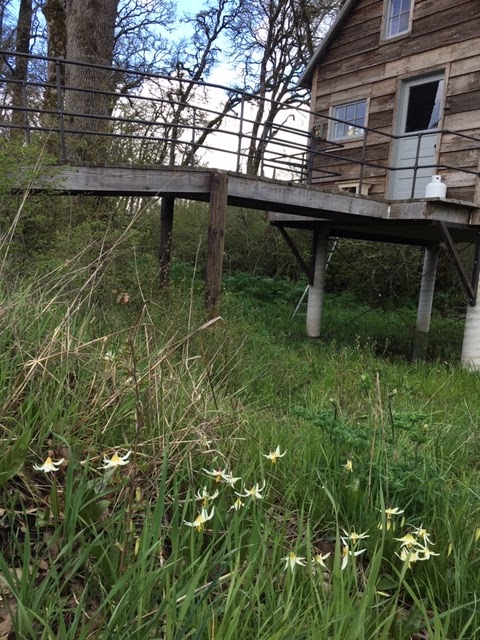
The Nest is surrounded by very large trees.
We note that one window on the side is lower than the other.
That's where my desk is.

I have a writing cabin called The Sparrow Nest.

This is about how it came to be, how it turned out, and why we built it as we did, should you embark on such a project yourself someday.

Every writer dreams of a quiet, secluded spot, I think. One danger of such a place, says Stephen King, is that you might begin to think that your life serves your writing, rather than the other way around.

But it can't be argued that I, being easily distracted, needed quiet in order to write, I needed to write because I had a monthly deadline, and such quiet was hard to find in this populous household living in an old house with porous walls.

At one point, we had considered carving out a little second-story enclave for me at our seed warehouse, and had actually sketched out plans. Then Paul started dismantling the machine shed by the creek that his grandpa, Orval, had built 70 years before, and we got the idea to build a little writing shed with the lumber.

The logical spot for such a building was across Powerline Road, in that narrow slice of swamp and oaks between the road and Muddy Creek. Of course it was too flood-prone there to build on the ground, so Paul decided to put it on concrete posts, level with the road, up above the 500-year flood plain.

We sketched ideas and drew up plans. If we kept it off-grid and 200 or fewer square feet, we shouldn't need a permit, we were told.

We had no idea what we were in for, and how hideously difficult it would turn out to make such a simple project a reality. Would we even have begun, had we known?

I've often felt, in this process, like Nehemiah building the wall of Jerusalem, beset by relentless harassment and opposition.

The Sanballats and Tobiahs of our lives mostly included the following:

1. The county pencil-pushers who regulate such things. All was going well with the process until one guy with the road department saw that Paul was pouring concrete out there and made a great and noisy protest, all the way up the county ladder. As a result, we needed a permit, and the process dragged out for a full year. We had to get signatures, blueprints from an engineer, permissions, stamps, forms, and other frustrating, detailed requirements.

Just recently, we had the final inspection done. Paul told the county inspector the whole story. The inspector apologized for how hard it was and told him that, just between you and me, that should never have happened to us. It ought to have been a straightforward, perfectly permissible shed. 

2. Life. I knew going into it that work on the cabin would come after Paul had taken care of pastoring at church, principalling at school, and officiating at the warehouse, and other duties.
Neither of us had any idea how many crises those jobs would entail, how exhausted he would be, or how discouraging that half-finished cabin would be for both of us.
One small example that is typical of a hundred: Paul had great plans to work on a back deck for the cabin over spring break last week. Once again he drew diagrams on graph paper and picked out lumber. He had a nephew double check his plans for anchoring the corners.
Then the corona virus hit, and there was a run on animal feed. In the one week of spring break, the warehouse processed and shipped over twice as much as normal: 269 tons of two-grain chicken scratch, organic oats, beet pulp, 5-grain scratch, and more. Paul's employees were working around the clock.
Of course we were grateful for the extra business, but both of us were sad that it meant the one little window of opportunity to build the deck was closed. When spring break was over, Paul spent up to 8 hours a day figuring out the technology for teaching online, in addition to cleaning an extra 500 bags of mousy grass seed, taking care of church stuff from a social distance, and shipping the normal 120 tons of feed.

Were we simply too visionary and unrealistic, starting out? Paul and I both regularly come up with great ideas that bog down in the actual materializing.

Or were we beset by spiritual enemies who didn't want the cabin to fulfil its purposes? Because it often seemed like we were pushing up against something unseen but determinedly oppositional.

I worried that the cabin would be irrelevant by the time it was finally finished, that all the kids would be gone and I'd have a whole quiet 2-story house to write in.

The cabin has now been usable for almost three years, ever since it was built off-site, mostly by my nephew Austin Koehn, and lifted into place. It evolved so gradually since then that I can't really say when it was considered finished by others looking on. To me it has felt like my place of peace and concentration from the day the crane lifted it onto the concrete stilts, even when there was still plastic over the windows and I had to climb an 8-foot stepladder to get inside.

In some ways it may never be finished, because we will always have great ideas for improving it, such as that deck that isn't yet.

Meanwhile, it is truly my sparrow nest in the same way that a little brown bird fluffs her feathers and settles into a warm nest shaped exactly right for her.

I write there, of course. "Writing" includes typing out an article for Vibrant Girl magazine or a chapter of fiction, as you would expect. But I also critique submissions from my writing group, research printing companies, organize my stacks of random notes before they slide sideways onto the floor, prepare talks, coax my stubborn printer, write to young writers who ask me for advice, and answer emails.

In the quiet, ideas bubble up. Distractions are minimal. I show up and associate the space with work, so I work.

Except when I take a nap or watch the ducks in the creek.

The Sparrow Nest has proved equally valuable as a place to talk with people. As mentioned, I was afraid I would no longer need privacy by the time the cabin was finished. As it turns out, we have six adults living here. They are in and out all day long, plus, also as mentioned, our house has porous walls.

But I can have someone over for a private conversation in my cabin. We drink tea and no one can hear what we say. The conversation stays within those old wood walls. I've had sisters-in-law over, neighbors, friends, and my own adult children. I've had guests who needed me to listen and others who listened to me. In the laughter and tears as the sun slants through those old-fashioned windows and across the table, I sense that something good is happening here, valuable enough that it's no wonder we faced such strange and relentless opposition.

During this time of isolation, my vigilant children and Kate Brown the governor won't let me have anyone over. I am so looking forward to more afternoons with tea in the yellow pot and interesting people around the table.

Sometimes, the Sparrow Nest is also a guest room. When our son Matt comes home to visit, he sleeps in the loft.


In many ways, the Sparrow Nest feels like it belongs to everyone. Many have followed the story of its coming to be. It's right by the road, so anyone can see it.

Perhaps that was what made people feel they had the right to show up and see it for themselves. The day I looked up from my computer to see an old man with his face up against the window in the door, peering inside and scaring me half to death, that was the day I realized I had to draw some boundaries.

Naturally, this coincided with a year of finally learning to set boundaries in many other areas of my life. These things always come from all directions, it seems, when it's time for me to learn the next life lesson. Boundaries are what you need as a human person with limited resources. They make you sad, sometimes, and they might upset others, but they are healthy and good.

So now there's a gate across the walkway. Any of you could climb right over it, but it still sends a message.

The gate, like the rail, is made of pipes.

Also, you can come inside for tea only if I invite you, because I've learned, painfully, that that is the best way. A place of peace and rest and imagination requires a degree of protection.

Today, though, I'm inviting you inside, via photos, for a virtual tour while you're staying at home.

Thank you for your interest, and I wish you a similar space of your own, when the time is right.

--
A few facts and specs, as requested by my friend Miriam Iwashige.

The cabin is 12.5 by 16 feet, which keeps it at 200 square feet, the county's limit for a basic shed. That is easily big enough for what we use it for, with the exception of a few Thai dinners for 8 or 10 that Amy served.

The posts are 8 feet high. So far we've had floods that came four or five feet up the posts, but I don't expect a floor-level flood in my lifetime.

Paul put four pieces of rebar into each post, and the engineer said that wasn't enough. So Paul added bracing underneath to compensate. We assume this will keep it safe and standing during the predicted Cascadia earthquake.


The sturdy bracing underneath.
Most of the lumber came from the old shed at the warehouse. All of the corrugated metal on the roof and inside came from the same source.

Certain components in the walls and roof, such as plywood, were purchased new.

It was a lot of work restoring all that wood, but the results are lovely.

We bought the windows at garage sales. If we did it over, we would buy new windows. It was far too much work to redo the glass, the glazing, and the painting. Although I love the results.

The view of Muddy Creek out the back door. We've talked about taming this wilderness,
and last summer our son Ben hacked a path to the creek, but
I'm fond of the overgrown, natural look too.

The back door, which will lead to a little deck, when God wills.

As you can see in the above photo, we heat the cabin with a propane heater. It works quite well, except the heat tends to whisk up to the loft. It helps if I run a small fan.

The plan is to have a propane tank underneath the cabin, with a hose coming inside. 

Sometimes a small electric heater is sufficient.

Which brings us to: electricity. Technically, the cabin is off-grid, but we have found ways to bring electricity to it for lights, my computer, and the electric kettle.

If our system doesn't work long-term, we do have a generator we can hook up.

At least one engineer son has ideas for using the creek to generate power.

Half of the cabin has a loft.
Half does not.
This half has an old light I found, where else?
At a garage sale.
As you can see, I never put curtains over the windows. I love all the natural light, but it also looks bare and doesn't offer privacy if someone sleeps there.

I may decide to hang lace curtains or blinds, someday. Or not.

Ann Lamott says to keep a 1" picture frame in front of you when you're writing.
Tell yourself to write only enough to fill that frame.
Do it again.

The ladder--with pipe rails--leads to the loft.

The ladder slides back and forth on that pipe.
The rails extend on up to make it less treacherous to find your footing,
climbing down.

One of the best decisions I made was to insist on the window above my desk being lower than the others so I could see out while I was working. Paul protested about this, since it wouldn't look right to his carpenter eye.

But I insisted, and I'm so glad I did.

I have a big screen, keyboard, and mouse that all sprout from my laptop. You could come up with more efficient methods, but this works for me.


My desk, which is made of--what else?--reclaimed wood and pipes. The two drawer pieces slide underneath,
or I can pull them out if I need more flat space.


These are the little animals that inspire characters in my stories.


My living room.
The corrugated-metal wainscoting is the same stuff that's on the roof.


 I really like to use heirlooms and items with connection to the past. In the picture above:
My mom crocheted the rugs and made the quilted wall hanging.
Paul's aunt Allene crocheted the afghan that's on the couch, for a wedding gift.
The folded quilt also came from Aunt Allene, more recently, when she had to move to assisted living.
The white blanket on the round chair came from my goodie bag at the ladies' retreat in Texas last October.
The green chair is one of a set of three that belonged to Paul's great-grandmother.
Imagine, all those people and times coming together in one place.

Despite all the things we repurposed or bought used, the whole project cost alarmingly much more than we had expected. I tell Paul periodically that I really feel I need to write a bestseller, just to break even.

He insists that it was worth the price. I needed it for me, and the fact that ministry happens there makes it even more of a good investment.


So I honestly don't know how much it cost, exactly, because I don't want to ask and Paul doesn't want to tell me. I am grateful for Paul's attitude about it, but I'd still feel better, overall, if I wrote a bestseller.

  
Here's my "kitchen."
I haul water from the house to make tea or coffee.
The countertop is an old metal "worktable" top that used to be my mom's.
Paul built the island underneath it 25 years ago when we lived in an old house by
the freeway.
I want to make a nicer curtain for it someday.
With the cabin being by the creek and in a flood zone, there was no way we could meet the requirements for plumbing of any kind. So I haul water out as necessary.

Lacking a bathroom limits overnight guests to the young, adaptable types like Matt.

Once the back deck is built, we might build a little enclosure at one corner with a camping toilet inside. It could be carried to the house to be cleaned.


Here's where we have tea. The table is a wonderful find that I bought
from a woman who used to read my newspaper column.
It can go from very small to very large and seat people comfortably at every stage.
My friend Sharon Coblentz gave me the teacup rack on the wall.
 It is a lovely thing to have a nest, a warm and welcoming space. I wish you one of your own.

Special thanks to everyone who played a part in the Sparrow Nest coming to be:
Paul, first and most
Keith Birky
Kevin Baker
Austin Koehn
Our sons--Matt, Ben, and Steven
Emily, who painted, cleaned, and spackled
Everyone who followed along and encouraged us.


Thursday, April 02, 2020

April Blogging Challenge 2020--Post 1--These Hazy Days

My daughter Emily and I are doing the ABC [April Blogging Challenge] again this year. We’ll be posting on alternating weekdays. I plan to post family updates, book reviews, current projects, and random thoughts on Coronavirus--that tsunami that has swept over all of our lives--and we’ll examine bits of debris the wave has washed onto our shores.

In a recent Patreon post, Emily wrote:

The world is strange, and scary, and sometimes I feel like I’m not living in the present at all, but rather a memory. 

I thought that was the best description I’ve heard yet.

Six of us are living in our house right now. Some, working essential jobs, leave the house more than others, but we all distance and isolate. Paul and the kids are especially protective of me, since I have asthma.

So I stay home, and non-family members don’t come into the house.

I’m starting to feel like an elderly person with dementia. I move through the day in a bit of a haze, not  sure what day it is and not quite certain what is now and what is past and future.

The day’s little milestones take on great significance. I believe I will go on a walk now, between rain showers. The mail lady has come! Oh, wonderful--it is time for dinner! And now I must tuck the chickens in for the night.

Yesterday, after two weeks of isolation, I felt vague emotions stirring up mud long settled at the back of my mind. It was like smelling a scent you hadn’t smelled for twenty years, and then you got a whiff and it immediately brought back a memory.

Our first two years in Canada, from 1986 to 1988, were spent at a boarding school way out in the bush. It’s hard to describe the experience of coming from Oregon, with its thousands of people, miles of interconnected highways, and endless places to go, to Stirland Lake.

True, it had a road, so one could drive in and potentially out. But the nearest town was over a hundred miles away.

When you were at Stirland Lake, you were very much THERE. You saw the people in the compound. The same people were your neighbors, co-workers, students, Bible study group, and friends. You played volleyball with them on activity nights, worshipped with them on Sunday, and met them in the lane when you went on a walk.

You couldn’t escape.

If one of them had, say, a whiny voice or maybe a bushy beard growing from the horizontal area under his jaw that everyone knows ought to be shaved, and you found this irritating, you couldn’t conveniently avoid that person and their whiny voice or beard. Especially in the dead of winter, with the cold and the miles all around, pressing you hard into this little pocket of community in the middle of the wilderness, you were very much there to stay and so were they.

I wasn’t particularly irritated at anyone yesterday, although I do at times get provoked at the people I live with, especially when they talk too loudly too early in the day, but I had that same suffocating sense of being very much HERE, in this place, with no place to go, as though the rest of the world were a thousand miles away, and these people in this house were the only people left.

That brought with it another sensation that was both current and memory—a vague longing to go secondhand shopping.

I remember this not only at Stirland Lake but also at Weagamow Lake a few years later and even in Kenya in 2003.  It was like a pregnancy craving for acorn squash—suddenly I longed to poke around a good dusty thrift store like I hadn’t wanted anything in a long time. The knowledge that I couldn't do this made the longing much more intense.

The reservation of Weagamow had over 800 people, and I marveled often at what a blessing it was to live somewhere where there were always new people to get to know. But it was even further north than Stirland, and fly-in only for most of the year, so the sense of isolation was still huge.

I used to dream about trains. Trains symbolized connection. They had come from one place and in my dreams they were going past me to another and yet another, honking their beautiful horns.

I would wake up and, of course, we were still at what felt like the far fringes of the universe, tethered only by the thinnest of threads, and the nearest train was hundreds of miles away.

We live in a farmhouse in Oregon today. I would love to go to garage sales and secondhand shopping, those vague longings in my memory that stir to life in isolation. Even more, I want to have friends over for tea in my cabin. I want to go camping at the coast, hike to a waterfall, visit Aunt Allene at the nursing home, and have a big table full for Sunday dinner. I want to hug the friend who is grieving and hold my friend and neighbor Kayla’s baby.

When those gifts return, I don't think I'll ever forget to appreciate them.

Meanwhile, I deliberately appreciate the gifts of here and now.

We live out in the country, so the landscape is mine to wander across and through, unhindered by snow, cold, or potentially contagious people. I’ve been taking more walks than normal and taking time to really look at sheep in a green field and acorns sprouting in the ditches under the oaks, near the cabin.


The insides of these acorns are a bright red when they split open. How have I never noticed this before?

There are neighborhood pigs and goats to visit.

Cars and trucks still drive by. Sometimes the drivers wave.

And the trains are still running. They sound their beautiful horns in the night as they rumble by on the tracks a quarter mile away. They are coming from somewhere and going somewhere else. The world is still connected.

We are not isolated at the edge of the universe.

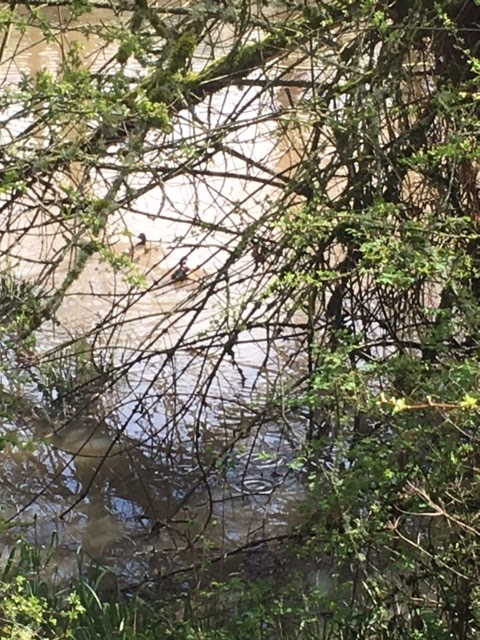
Someday this time will be a memory stirred up like the mud at the bottom of Muddy Creek when a gently swimming duck suddenly flaps into flight.

My view of Muddy Creek from a cabin window.
There are two ducks in this picture who inspired the analogy.
But now, right in the hazy middle of it, I want to live it fully, with every possible grace.

The lambs' tongues are blooming.


Tuesday, March 17, 2020

Blizzard Syndrome and the Current Social Distancing

This morning our daughter Emily said we should make Prune Loaf.

I said, "Yes. We should."

We have a malady known as Blizzard Syndrome, and Blizzard Syndrome calls for Prune Loaf.

Back in 1975, we lived in Minnesota in an older house that didn't have any running water or indoor plumbing. The water came from a pump about a hundred feet from the house. We had an outhouse and also strategic buckets indoors when the weather was nasty.

That January a blizzard blew in. Even for Minnesota, it was extreme-- a storm for the history books. It brought tons of snow, bitter cold, and days of wild wind that, they said, lifted the topsoil off the Dakotas and blew it our way, piling huge drifts of gritty gray snow. We'd wake up in the morning to little drifts of snow on the windowsills that had blown through tiny cracks and crevices. If there was any opening at all, the wind found it.

Mom and us three girls, aged 13 (Rebecca), 12, (me), and 6 (Margaret),  were home alone for most of the blizzard. To stay warm, we curtained off the living room and cranked up the oil stove until the metal cylinder inside glowed red hot. We must have hauled enough water before the storm hit, because there would have been no pumping in that weather. We also had propane for the kitchen stove.

Blizzard Syndrome is a peculiar fidgety agitation that takes possession of the soul when you're stuck inside in a blizzard.

First there's a sense of excitement as you check supplies, watch the gathering storm, and make sure everyone is at a safe place to wait it out. Then, once the storm locks you inside, you pace the floor, look out the window, and call people to see how they're doing, such as your brother Fred who is over at his co-worker's house because he couldn't make it home.

You can't go anywhere. You are stuck here until the danger passes.

None of the normal recreations appeal. You don't feel like reading or playing games or painting your paint-by-number kit, all the things you'd love to do, normally, when there are dishes to wash.

We had a bad case of Blizzard Syndrome.

Finally, I believe it was Mom who suggested we bake something, so Rebecca and I poked around in our cold kitchen , looking for ingredients and leafing through a cookbook.
This isn't the actual recipe, but it was a cookbook from this era.
We didn't have a lot of ingredients to work with, and certainly nothing fancy, because we were poor and also because we were in the process of moving to another house, but we found a recipe for something we could make:Prune Loaf.

Dad liked to eat prunes, so they were kind of a mockable food. But this recipe lifted those humble fruits into something slightly exotic.

We steamed the prunes and mixed a sweet dough, then rolled out the dough and wrapped a circle of it around each prune. We rolled these balls in sugar and stacked them in a baking pan.

And baked the resulting loaf, of course, and proudly served it.

Blizzard Syndrome was staved off for an hour or so, at least.


I look back and think I would have been paralyzed with fear if I'd been Mom. Home alone with three daughters in a cold house, short on supplies and clean water, far from neighbors, and utterly unreachable in an emergency.

Later, she said she'd been most afraid that red-hot oil stove would burn the house down, but she didn't let us know. Instead, she gathered us around on Sunday morning, the third day of the storm, to hold a little church service in the sort-of-warm living room. And, of course, she encouraged us to keep busy.

When the storm passed, we found a door that wasn't drifted shut and went out into a bizarre world where we could walk on top of the hard-packed snow over drifts that were like swirling mountain ranges over the fields and up to the top of the chicken house.

A day or so later, the snow plow pushed through, backing up to take a run at the section in front of our house and piling up snowbanks that turned out to be as high as the school bus, when the school bus finally came again and we scrambled up and over to meet it.

We compared stories with everyone we knew and rejoiced that we had all survived.

And "making Prune Loaf" entered the family lore as a code for doing something about that strange and unique restlessness that hits when danger keeps you at home.

Today our world is restricted by coronavirus. The girls are home from college. Events are cancelled. Restaurants and coffee shops are closed. Paul and Jenny teach via the internet, because there are no children at school. All sorts of plans are indefinitely postponed.

Mostly, we stay home.

We are all feeling a mix of that peculiar fidgety excitement, apprehension, and agitation that takes possession of the soul at such times.

We have Blizzard Syndrome.

It's time for our own COVID-19-Quarantine version of Prune Loaf.