Monday, April 26, 2021

The Bathroom Remodel, Part Two--The Messy Middle

When you start tearing into an old house, you never know what you'll find.

Here are a few stories I posted on Facebook as they happened:


I was called into the bathroom to approve a few particulars about the tub and shower arrangement. Paul and the Carpenters frowned, pointed, measured, and looked to me for approval. But I was distracted by something else. "Why can I see daylight through that gap in the corner?" I said.

They all looked. "What?" "Wait." "You're right."

It appeared that the bathroom, which used to be the back porch, was falling off the rest of the house.

Much more measuring was done, and crawling under the house, and trying to jack up a wall.

Apparently it happened when Paul's dad moved the house here 40 years ago. The foundation is solid, so we are unlikely to keep tilting further every time we fill the bathtub. That was the band's conclusion. I hope they're right.


They braced the one wall, just in case, so if there was any more shifting the tile wouldn't be cracking in every direction.
I'm learning it's good to speak up with what I think and see, even if I officially don't know anything about remodeling.

Then there was the episode where we decided to restore the ceiling to its original glory.


“That ceiling is a bit of a surprise,” said the carpenter.

He said it quietly, like it was no big deal.

First he had pried off just a bit of drywall around the light and exposed the old beadboard underneath, and we had decided to return to the original ceiling. Then he hacked off big chunks of drywall. After that, he made his calm observation, like you might say, "We need to pick up another bag of grout." Or like Daniel Kropf, Paul's great-grandpa, probably said to Anna in 1911, "Yah, we had just enough boards to finish the back porch ceiling, and we didn't have to make another trip to town for more."

Anna, I'm guessing, nodded and smiled like a good wife fully confident in her husband's skills and judgment. The next day she walked through the house, admiring the progress. Her husband was obviously all about practicality and efficiency, hence the steep stairs and the utterly utilitarian floor plan--a square house divided into square quarters. At least he had indulged her with that bay window in the living room.

Then Anna bustled into the back porch where she would put her wash machine. Good, good. Plenty of room for the washer, the galvanized schwank tub for rinsing, and all the baskets.

She looked up.

"Daniel! Wass in die Welt?!"

A third of the ceiling was covered in bead board like the kitchen, a third in plain boards like the bathroom, and the final third in leftover siding boards from the outside of the house.

"Ach, Anna, it doesn't matter, does it? Look, this way we could use up all the leftovers and they all came out even!”

Anna sighed. It was only the back porch, after all. Visitors would never come out there. And she really was grateful for her efficient husband and her new house.

Maybe, a long way into the future, her great-grandson's wife would think it was just the latest and greatest thing, after the back porch had been a bathroom for many years.

Well, no, probably not. But Anna had bigger fish to fry than worrying about mismatched ceilings. So she bustled off to peel potatoes for supper for Daniel and their ten children.

--

I decided I have a limit to my quest for authenticity in this house. The ceiling will get covered in reproduction beadboard after we clean up 50 years of bug droppings. It will run crosswise to maximize efficiency and avoid waste, since Paul carries the practical genes of his great-grandfather.

Meanwhile, the bathroom progresses bit by bit. Everything is a terrible mess, but the new shower area gives me hope. It looks like a line from Edelweiss--"small and white, clean and bright."

The quiet carpenter does excellent work.


The mess of the whole project was overwhelming at times, as was the stress of having extra people in the house day after day. Sometimes Jenny and I escaped into the pantry for a bit of privacy, sipping tea and whispering among brooms and Crock Pots.


When we finally reached the point where we could start painting, it felt like we might actually reach the end of this project, and we had a hand in its outcome.


Dozens of details--faucets, latches, light switch covers, and more still needed to be worked on, but the end was in sight.

Next post: the results.


Sunday, April 25, 2021

The Bathroom Remodel, Part One

 Twenty years ago, when we moved into this house, we felt something had to be done. The only way into the tiny downstairs bathroom was through Paul's parents' bedroom. Anne had curtained off a little passage with chenille bedspreads, but it still made us uncomfortable.

At that time, the bathroom was at one end of the back porch. The rest of the porch was a laundry area. We decided to turn the whole thing into a bathroom.

We took out the clawfoot tub and replaced it with a fiberglass tub and shower combo. We now realize this was stupid. The smartest thing we added was a pocket door to separate the tub and toilet area from the sinks and mirror area that we added in the former laundry area.

Before: looking reasonably good if you're not up close

It served us well. On many many school mornings the bathroom buzzed with activity as I braided the girls' hair, everyone brushed their teeth, and people pounded on the pocket door, waiting for their turn. I changed diapers on the long counter between the sinks and washed and bandaged wounds. Water balloons were filled there, and cats got baths. 

The bathroom was exhausted. Mold crept across the corners, and we suspected the floor was rotting under the linoleum near the shower. Worst, one side of the room had settled just enough to make it impossible to latch or lock the doors. Our family trusted each other to knock and holler, but it was disconcerting for guests.

As with our office redo, it was good that we plunged in without knowing how much work it was going to be. And it still isn't 100% finished.

My friend Twila, who is married to Paul's cousin Brian, said she's not posting pictures of her new kitchen until it's completely done. I decided not to follow her example, since there might be hard water spots on the new tile by the time the last towel bar is up.

Before

Before
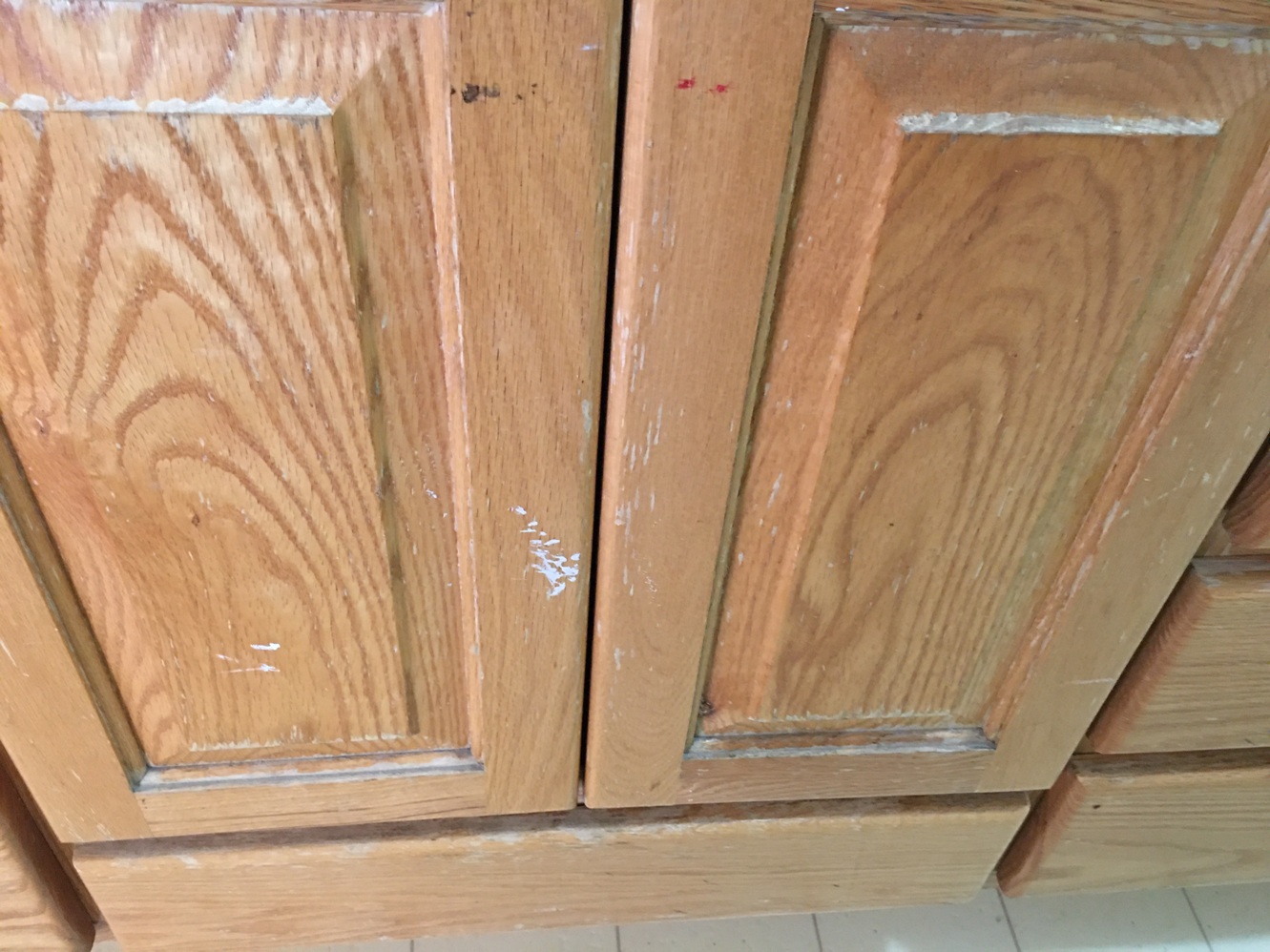
We decided to keep the layout of the bathroom and also the cabinets. They had been custom built and had good solid bones. However, the varnish was wearing off, leaving dull areas, especially on the doors.

"Why don't we keep them just like they are but make them darker?" I suggested.

Paul didn't think that could be done without sanding off all the original finish, a very complicated undertaking.

I was dubious.

He asked the carpenter, who agreed with him. It really wasn't possible. It wouldn't work to paint them, either, because the grain would show through.

I called a professional cabinet refurbisher in Eugene. He also said the original finish would need to be sanded down completely and quoted me a price that would have paid for a whole new custom-built arrangement.

"Humph," I said.

I contacted my friend JoAnne from Texas, who sent me to Pinterest. "I know it's been done," she said.

Yessssss. Paul was willing to try. I think that since his accident and learning to do all the things he "shouldn't" be able to do, he's more willing to find a way around obstacles.

We bought cans of stain at Jerry's, the home-improvement store where an employee had the audacity to tell me he doesn't like Pinterest.

I thought but did not say: Too bad for you.

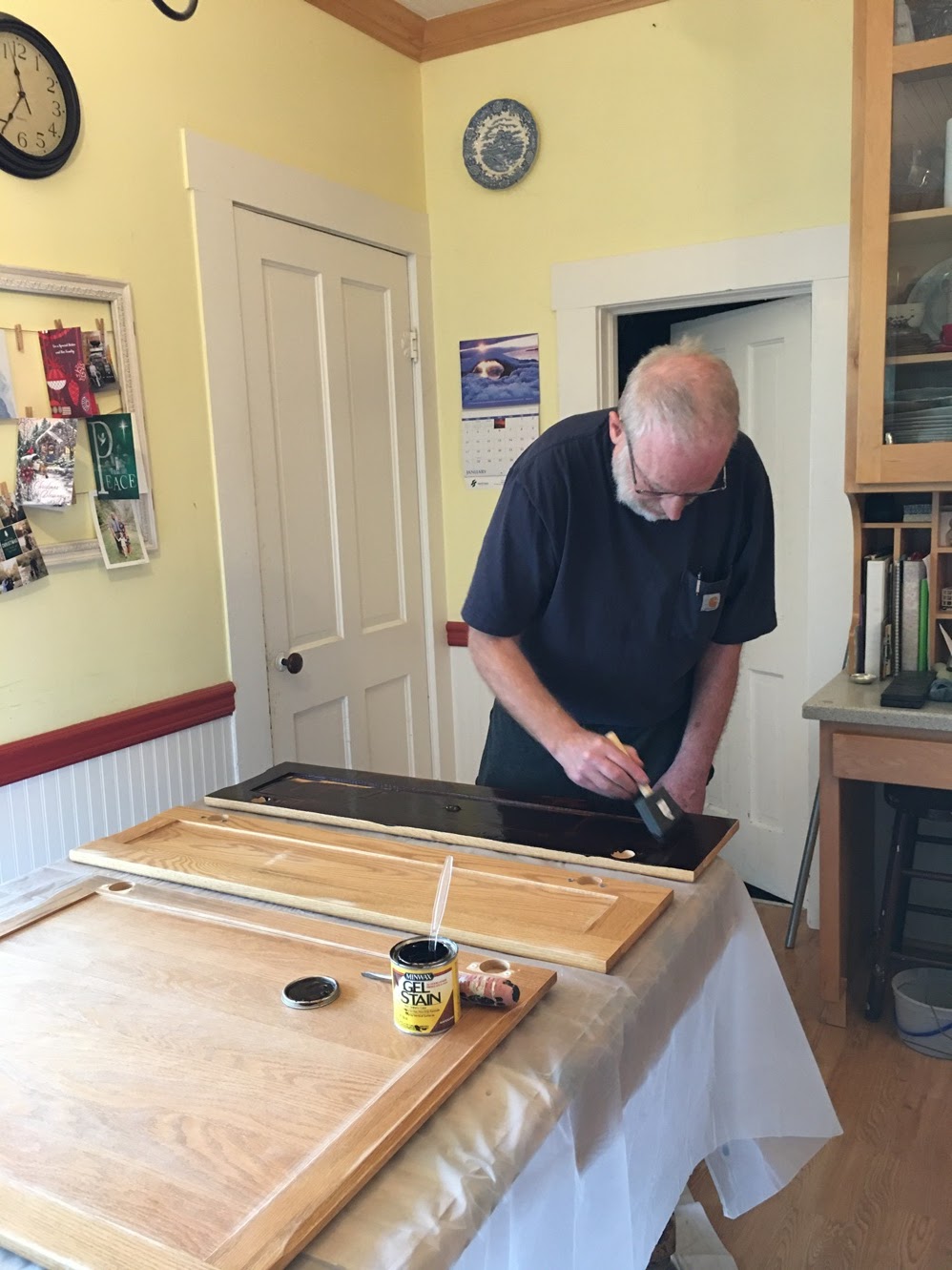
Paul decided to experiment on the inside of the doors. He took off the doors and the drawer fronts despite his bum arm and began to slather stain on the back of a door as per instructions.

The website had told us to put on multi layers of stain, which created a dark, opaque finish with the wood grain showing through. It looked ok but not beautiful.


Paul tried a different stain on the back of a different door, and I saw that a single layer, spread on and then wiped off after a few minutes, was exactly the look I wanted.

He perfected the process on the back of some drawers, then administered the same treatment to all the drawers, doors, and frames. 

First, he or Steven sanded them lightly.

Then, he brushed on the stain. He tried to follow the grain of the wood. Then he wiped it off.

We found that he had to be really careful with the initial application, because any attempt to touch it up soaked and peeled off some of the first application.

Also, the doors didn't stain as nicely as the drawers, because of all the areas where the varnish had worn off. We decided we would say they look "distressed."

Kevin the carpenter added the final clear coat.

Overall, we're really pleased with the result. I am very happy that I kept believing it could be done despite all the knowledgeable men who insisted it couldn't.


The end result, with exactly the dark shade I wanted.
This was before the new counter was on and after the new floor was in,
which is kind of jumping to the end of the chapter.

To avoid overloading subscribers' email feeds with photos, I'll do a second post with the rest of the bathroom.

Sunday, April 11, 2021

Ask Aunt Dorcas: The Opposite of Bad Parenting

Probably fifteen people have asked Aunt Dorcas to write a parenting book. She keeps saying "No, I don't think so," but she got going on this post and admits that this is almost book-length. She doesn't want you to feel any obligation to read it all.

Aunt Dorcas in San Diego

 
Dear Aunt Dorcas,

I read your article on parenting and while I mostly agree, it gives me unpleasant images of peers of mine, shrugging weakly while their belligerent children boldly defy them, unhindered. Can you round out your last article with some helpful viewpoints or include some direction regarding this?

You said that so much of what parents react to is simply children being children. Agreed. But to what extent? I realize that much of that is for the parent to discern. Could you help us? I’ve read enough of your writings to know your not on level with the mom that smiled wanly at her son as he hammered on mine, explaining that he was tired. Or explaining during utter mutiny about their house,  that knowing the family needed to move in a month was ‘wearing on them and feeling that they didn’t have their own space’.

I know, there’s always context. Probably I’ve been unjust in my conclusions. However, it doesn’t take long in my household for me to see that my children have an uncanny ability to capitalize on excuses I make for them. I don’t want to be like the suit-coated, pinching father you mentioned or the weak willed woman I mentioned. Please help us stay out of ditches. A lot of people I know read your writings and are greatly influenced- I appreciate that and I’m asking for more influence on this regard.

--Sherri

Dear Sherri--

Here’s a summary of raising children, in case you don't have time to read the whole post:

1. Children need guidance and involvement to become functional adults.

2. This is a lot of work.

3. If you’re the mom or dad, it’s your job to do the parenting.

4. You have to be the grownup.

5. You have what it takes.

What is the opposite of a dog?

As the principal’s wife for over 30 years, I gave the ACE Reading Readiness Test to lots of little preschoolers.

One task involved finding opposites, and it featured a picture of a dog. All right, little Braxton, what is the opposite of a dog? Two of the options were things like a tree and a cup. The third was a cat. That was the “right” answer. The child was supposed to circle the picture of the cat.

I would tell the kids to skip that one because, let’s be clear, a cat is not the opposite of a dog. They are two different kinds of domesticated mammals.

A surprising number of people wrote to me after my post on March 21, concerned that if I was speaking out against spank-to-break-the-will parenting, then I was promoting its “opposite,” lax and lazy parenting.

As with cats and dogs, harsh parenting and lax parenting are not opposites. They are two different kinds of bad parenting. Both choose the parent’s convenience over actually teaching the child.

The opposite of both is strong, committed, active, involved, loving parenting.

I understand the concern, though. Most of us don’t witness the sort of abusive parents who traffic their kids or the neglectful parents who essentially hire someone to raise their kids for them. Many of us, praise God, don’t witness will-breaking parenting either.

But we all see inadequate parenting, where parents seem helpless before their children. I'll focus more on the aggressive child in this post, but this also applies to the parent who acts helpless before defiance and chaos.

So what does this lax parenting look like?

I mentioned in my previous post that often a child needs food or sleep rather than another lecture or a spanking, because he is a child, and this is what children do. A number of people took issue with that and felt I was promoting the sort of parenting that accepts any kind of behavior because the child is a child.

We’ve all been there. This is the mom who sips her coffee while her son attacks yours with a pair of scissors. As you levitate from your chair in horrified wrath, the other mom laughs. “Oh, calm down. He’s fine. They’ll figure it out on their own. Kids will be kids.”

Um, yeah. That’s the problem. This is what kids do, and your job is to teach them not to. My son is about to lose an eyeball, you think.

The will-breaking mom is likely to snatch up her toddler, haul him into the next room, and give him 25 smacks you can hear from where you’re sitting. That’s not helpful either.

In many years of parenting and observing, this is what I’ve found: The overly-spanked child and the un-parented child are equally likely to hit your child over the head with the Fisher-Price telephone. The only difference is, the will-broken child will wait until his mom isn’t looking.

Despite appearances, these methods are the same sort of neglect. They fail to teach the child basic life skills of empathy, manners, kindness, respect, and boundaries.

The aggressive child has a lot to lose when, as he gets older, no one likes him or wants to play with him. He won’t understand why, or how to change things.

Sternly parented kids are often dishonest, manipulative, and devious.

Unparented kids are often aggressive, selfish, and destructive.

A good mom, in this case, will get involved. She won’t let other kids suffer at her child’s hands. Ideally, she’ll take away the scissors or toy, make sure the other child is ok, and instruct her child on what to do and not do.

If her kid is tired, thirsty, or hungry, she’ll make sure that need is met. If he can’t handle playing with other kids, she’ll take him out of the situation.

This—sorry to break it to you—involves actually doing something.

I know it’s hard. You are lonely and exhausted as a full-time mom, and you finally get to spend time with a few friends. There you are, around the table, sipping coffee while the kids play, and at long long last you get to talk with other adults. Someone asks you what was the deal with Joe and Martha—they’ve been hearing rumors--and everyone turns and looks at you.

Oh my word. You have been living for this moment. All eyes on you, no one interrupting, and you’re holding the juiciest gossip in your hand, like a ripe plum. You lean forward. “Well! So Joe was doing some concrete work for my husband last week, on that new storage building, and they got to talking, and oh, goodness, I hope it’s ok for me to share this. He said they need to make a trip to Wisconsin next week…”

“WAAAAAHHHHHH!!”

You all turn around. Your toddler is whacking Sandra’s with a heavy little John Deere tractor.

This is the crucial parenting moment.

I am so sorry to tell you this, but here we go: This is your child, acting like a child. But you can’t let him continue this behavior. You have to be the grownup. You have to stop your story, raise your weary self from the chair, walk across the room, settle the fight, make sure the other kid is ok, and figure out how to make sure it doesn’t happen again.

By the time you get back, Sandra with her loud voice will have taken the opportunity to start in on vaccines, and how you know there’s that misguided neighboring church where they all give their kids shots, and when you visit there and the children turn around and stare at you in church, it seems like they all have kind of a blank stare, with those odd close-set eyes and pointed noses? WELL! there’s a new study out showing that a whole generation of children is looking suspiciously like chickens, because they culture the MMR vaccine in egg whites!*

*I made that up.

Everyone will gasp. The conversation will go from vaccines on to Kathy’s kids getting the flu to the Christmas program at school. You won’t get back to your story until you’re about to go home, and your children are crying, and the hostess says, Oh yeah, what was that you were saying, about Joe and Martha?

Arrrrggghhh.

But you are the grownup, and you will do the necessary thing for the sake of your child.

Children are naturally adorable but utterly ignorant and uncivilized. They aren’t born knowing the rules. Unless taught otherwise, they will touch all the cupcakes on the plate before choosing one, steal from the convenience store, and paint graffiti on bridges.

Children don’t naturally trim their fingernails, take turns, cover their mouth to cough, or eat with a fork. They have to be taught to finish a task, tell the truth, and say thank you.

They might pick up some of these life lessons from watching other people or from teachers and aunts, but it would be a big favor to all of us if you, the parents, would tie your apron and take on this job.

This is your child. It is your job to teach them. Yes, it’s a big job and you don’t feel up to it. Do it anyhow.

It’s not about punishing them every time they turn around or excusing bad behavior. It’s about carefully cultivating a relationship, meeting their needs, getting to know them as people, coaching, guiding, and teaching them the life skills they need to make it on their own.

Remember the story of the dad pinching the little girl in church because she played with her braids? The kids in that family could sit like statues in church. But. Two of the children attended the school where I taught. At all-school assemblies, those two were the worst behaved of anyone. Moving, talking, turning, distracting. The dad’s tight control wasn’t teaching them anything except to sit still in his presence. Away from him, they didn’t know how to be quiet and respectful, or why.

A better method would have been to sit on the couch at home and practice sitting still for half an hour while Dad reads a Bible story. It could be fun, with lots of praise for learning this self-discipline, and instructive--we sit still so others can worship. "You guys are amazing. Have some M&Ms."

Parenting involves finding the delicate balance between individualism and collectivism.

Your child is a unique individual. You need to get to know him or her, understand them, give them grace to be kids, and encourage their gifts.

But they are also part of a big world full of people. Their actions will almost always affect others. It’s crucial that they learn to value others, respect boundaries, practice kindness, and treat others like they want to be treated, both at home and away.

It’s your job to make sure your child doesn’t hurt other people, destroy their possessions, or generally create misery wherever they go.

I met a nice Christian mom who told a group of us how her little boy won’t have a bowel movement unless he takes all his clothes off first. Then he sits on the toilet for twenty minutes, swinging his feet and talking to himself. So, if they’re shopping and he has to poop, she grabs a magazine and takes him into the handicapped stall for this lengthy process. All the clothes come off, he sits there doing his business, and she sits on the floor in front of him and reads her magazine. If someone comes in and wants to use the stall, she shrugs and says, “Sorry.” 

She laughed. I didn’t.

This story bothered me for these reasons:

1. The mom takes no initiative to improve this situation. She is helpless before the child’s preferences.

2. She takes up the handicapped stall for this operation. Her son learns that his wishes are important enough to supersede the needs of a disabled person in their designated stall, no less.

3. I’m afraid she puts that magazine back on the rack after she’s been reading it on the bathroom floor.

The main thing that needs to happen here is not a big discipline session with the child. The problem is the mom. She’s not being the grownup. She’s not caring how her and her son’s behavior affects other people.

So that comes first. They need to use the smaller stall, even if it’s cramped.

And she needs to bring her own reading material.

Then she needs to realize that she isn’t without capacity and volition. If she enjoys the break from shopping, fine. She could also practice changing the routine at home. "This week you’re going to be a big boy and leave your shirt on when you poop." The next week, he gets a reward if he finishes in under 15 minutes.

Even if the child genuinely needs his 20 minutes, they can meet that need but still be considerate.

The mom and dad are the adults. They need to figure it out. The more aware they are of how their own behavior affects others, the easier it will be to teach the child to be considerate.

All of our six children have lived at home for at least part of their college years. One of the many advantages of this is that I get to hear their stories about other students.

College is often the first time that kids are on their own and away from home, making their way as adults. I’ve determined that it’s a JumboTron screen where their parents’ parenting is displayed in living color. 

Some have obviously learned to work hard, get along with people, make good decisions, plan ahead, behave graciously, communicate, and take social cues.

Others have not.

Jenny, a senior at Oregon State, has been going off recently about a classmate we’ll call Jordan. “He is SO full of himself and acts like he knows EVERYTHING. He goes off about RINGS! You don’t talk about RINGS* in an advanced calculus class! And he sits there and picks his nose and eats it RIGHT in my line of sight! We were supposed to read this article and share something we’d learned, and he spoke up right away and said, ‘Oh, I knew all that information already,’ so it made everyone else feel stupid, but then I spoke up anyway and shared something I’d learned, then I think that made other people feel ok about talking too.”

*a complicated math concept, not a band around your finger

Jordan might be autistic, I’ll grant that. But a more likely guess is that he was taught to value his own conclusions but not to interact graciously in a group. So he gets to live with being disliked in all his classes but probably never knowing why.

The most specific test for how people were parented is college group projects.

It might be a class on English literature, fluid dynamics, or teaching reading. The professor, feeling vindictive toward the world, decides to divide everyone into groups of four. Each group needs to work together to research a situation and write a summary.

Group projects can be helpful and interesting when everyone contributes. They can be torture when they don’t, and I’ve had grownup kids in tears over group projects.

I asked Emily what kinds of people are the worst to work with. She said, “Most people do ok, actually.  But others don’t communicate. They don’t pull their weight.  Or there are people who are SO CONFIDENT that their way is the right way and are completely unwilling to give an inch.”

Your goal is to raise a child to be welcome in group projects in college, construction crews, youth groups, and church committees.

You don’t have to whip your child into abject submission, let them terrorize the other toddlers because kids will be kids, or any number of bad ways to parent.

You do, however, need to be a healthy and whole person yourself. You need to pursue inner health and Jesus, and parent out of that good place.

Then, you need to invest yourself deeply into this precious little life and be the loving adult, guiding and leading.

God gave you this child. He’ll give you what it takes.

You are the adult. You can do this. It will be worth it.

That’s what I think.

--Aunt Dorcas


Monday, April 05, 2021

Aunt Dorcas Vacations: Seeing Where People Are From

All ready to shop for fabric!
[I'm on the left, Simone on the right]

Aunt Dorcas went on vacation.

This not a Q&A advice column as the alternate-week schedule would call for, but a post on Aunt Dorcas's little trip to California. But, since she can't help but insert a bit of advice, here it is:

Get to know where your people are from.

--
The famous Portland carpet and a pair of practical shoes. With socks.

I hadn't flown anywhere for 17 months. The last trip was when I flew to Texas for a ladies' retreat in October of 2019. Covid dried up all the speaking invitations, and Paul's accident canceled any hopes of even slightly complicated travel for a long time.

Then my friend, neighbor, and cousin-in-law Simone, who grew up in Southern California, decided to visit there for a month's retreat and invited me to join her for as long as I liked.

In a stroke of wonderful timing, my sister Rebecca and her husband Rod moved to San Diego a few weeks ago.

So I flew to San Diego, spent a few days with Rebecca, met Simone, spent a few days with her, and drove home with Simone.

In winter, the light in Oregon is muted, like it's passing through filters, sheets clothespinned to the mountains on both sides, or the scroll in the song, that can't contain the whole though stretched from sky to sky.

In southern California, all the filters and barriers are gone. The sunshine is clear and intense, blazing and bright. I had no idea how hungry I was for that kind of light until I was in it, turning my face to it, soaking it in.

I did a lot in a week. 

Rebecca and I strolled along the harbor and admired the ships, sat on her deck with tea, and talked a lot. I saw where her husband teaches and met some of his co-workers.
Incognito at Balboa Park.


You could see Tijuana and the ocean from Rebecca's patio.

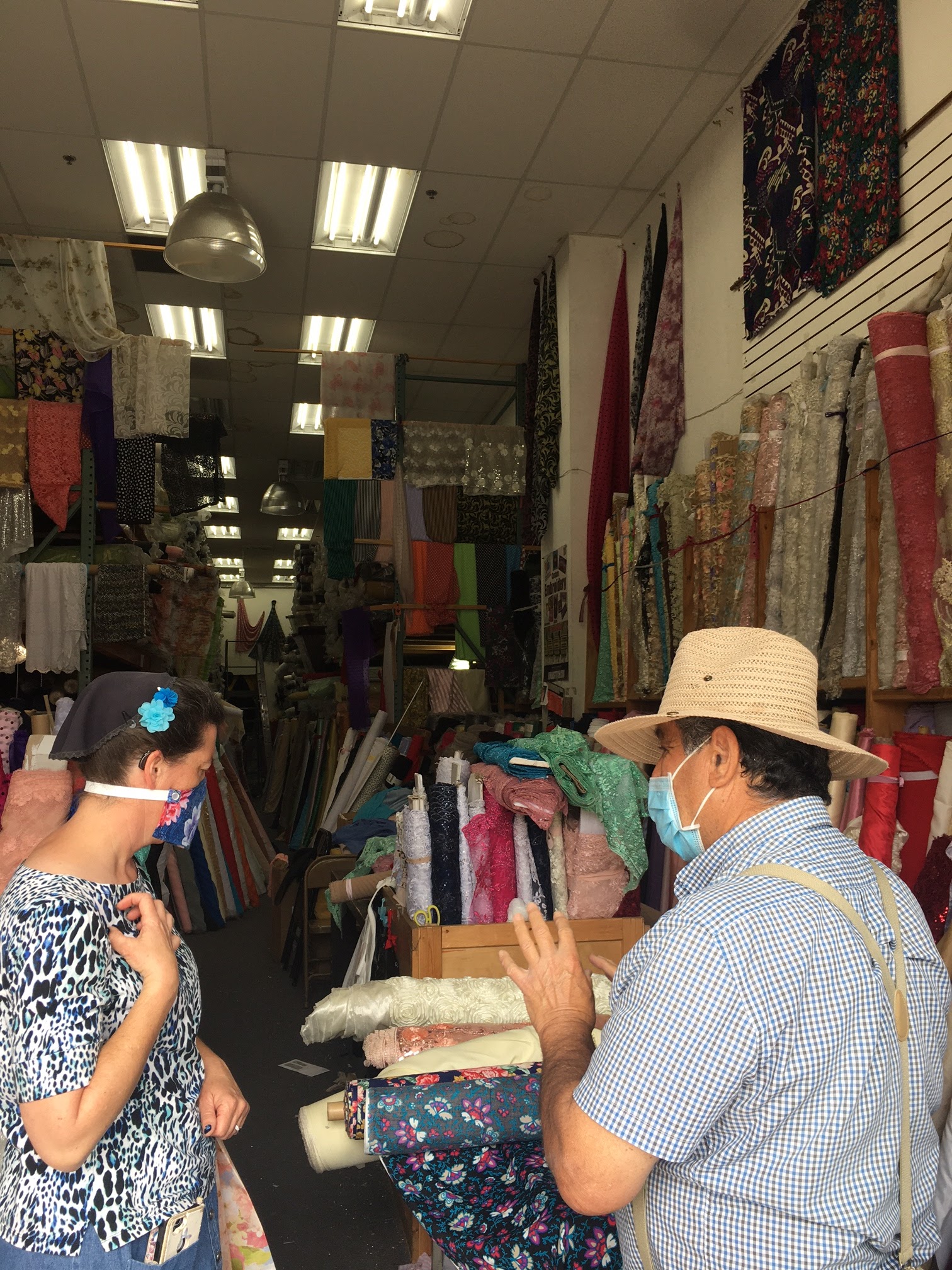
Simone and I went fabric shopping in the fashion district of LA, toured San Juan Capistrano, and attended an outdoor Easter service on Saturday evening at Mariners, a megachurch with a campus the size of your local community college.

San Juan Capistrano was lovely and historic, but it also made us sad.
The native people were persuaded to help build this large church. It took six years, then 
it was used for only nine years before being destroyed in an earthquake, killing 40 people.
Only the chancel and part of the transept remain.

The bells at San Juan Capistrano.
Sadly, the swallows no longer gather at the mission, but
they still return to the town.

The fabric shopping in particular had been a dream of ours for a long time. We backed into the tightest parking space I've ever seen and found our way through a dozen shops overflowing with rolls of fabric. It was like being overseas, without the jet lag. Clutter, variety, bargaining, open fronts, other languages, even the shopkeepers' grapevine messaging like I had noticed in Kenya. At one shop, we chatted with the Mexican owner and his son, who had been to college in Portland. Then we wandered across the street to another shop, where another older man greeted us with, "So, you're from Oregon?"


Many of the fabrics were brightly colored and shiny with lace and sequins, but we also found piles, stacks, and walls of pretty knits, natural fibers, and every variety of polyester you can imagine.


I'm down there by the ladder. The fabric I bought had
to be hauled for a long way in that green bag, which 
limited my purchases considerably.
Next time, I need to have Paul drive me down in a seed truck.

We loved it.

After the stresses of the past year, it was all healing medicine, spooned into my soul in hourly doses.

Simone and I had planned to start home on Sunday and take two days to get here. But, feeling anxious to get home, we impulsively decided to set out Saturday night and drive it all in one shot, if we could stay awake.

The 14-hour drive went amazingly well, we surprised our families, and I was able to be here for Easter dinner with the family and the guests they'd invited.

We have been through hard things, and it was unbelievably satisfying to know that even at this stage of our lives we could make a dream come true, turn ideas into reality, and make our way back home all on our own.

This morning, this is what strikes me most: it's good to find out where your people are from.

Paul, who grew up Mennonite and Wesleyan Methodist, knew almost nothing about the Amish of my past. It felt important to me that he not only hear my stories but see it for himself, so when my grandma died in Kansas in 1988, I made sure we went to the funeral. Rebecca did the same with her husband. We sat on those benches in that crowded house among hundreds of bearded men, white-kapped ladies, and wide-eyed silent children who stared curiously.

At the viewing, Paul nudged Rod, indicated the little girls in front of them in their white organdy coverings and black dresses, and marveled, "This is what our wives looked like."

I've always been grateful that we made the effort to attend that funeral. Now he knew, at least in a small part.

When we attended a Wesleyan Methodist camp meeting, I did the same for him. Despite the similarities to Mennonites, I sensed that they spoke a language I didn't quite understand. I was disturbed at the fiery sermon and the emotional prayers, both of which seemed contrived and overwrought to me, but I understood a part of my husband that I hadn't known before. He did his best to interpret it all for me. "They're not nearly as black-and-white about sanctification as they sound in their sermons." 

Whenever I visit Lancaster, Pennsylvania, I understand my mother-in-law better, and also my friends from that area. Speech patterns, foods, quirks, and preferences are all evident. There are right things to do, and right ways to do things. They may have been in Oregon for 50 years, but they'll still say the eggs are "all"--meaning "all gone."

I got to know Simone back when she and Paul's cousin Darrell were dating, well over 20 years ago. She was from some kind of "plain" background that seemed to be basically Mennonite. However, she had mannerisms that weren't typically Mennonite-woman, like a loud laugh. I heard parts of her story over the years, of course, but never understood the context.

In California, we stayed with her cousin and his wife. One day a fistful of relatives came for lunch.

Now I know much better where Simone is from.

This family line is Serbian, with some German and Slavic in-laws thrown in for good measure. Simone's generation were either immigrants from Europe or the children of immigrants. They all came from a strict religious background, and their dads did hard time in Communist prisons.

The conversation was constant, loud, and intense. People fearlessly injected their opinions, laughed loudly, and gestured with such vigor that they hit me in the arm if I was beside them. Any subject merited deep intensity and fervor, from getting a visa to the homeless in America to being enslaved by the Turks for 400 years.

Not only was it a fascinating experience, it provided context for who Simone is now.

My sister, who has been uprooted into new communities multiple times in the last ten years, says one of the hardest things is the struggle to make new friends who don't know your history. Where do you begin to explain? The Amish part, the overseas parts, the children, the medical work, the Midwest? 

We are so much more than what we show on the surface. We are history, cultures, events, and places, all swirled together. We are decisions, disappointments, conquests, and defeat. We are all the people who nurtured us, damaged us, or gave us their genes.

It is a gift to a spouse or friend or parent--anyone you care for--to see for yourself where they are from. If you can't go see their history for yourself, you can listen to their stories with interest and intent. We all want to be known, and to be loved for who we really are.

Sunday, March 28, 2021

The Office Remodel


An old house like ours is like the Ship of Theseus. If you replace all the pieces of it, little by little, is it still the same house?

This is from Wikipedia: 

It is supposed that the famous ship sailed by the hero Theseus in a great battle was kept in a harbor as a museum piece, and as the years went by some of the wooden parts began to rot and were replaced by new ones; then, after a century or so, every part had been replaced. The question then is whether the "restored" ship is still the same object as the original.

The most recent parts of this ship to be changed were the downstairs bathroom and office. The bathroom was the more extensive remodel, but that update will come later. Most of the work was finished weeks ago, but an entirely different company was doing the counter and sinks, and we had to wait an extra two weeks on them.

Then the carpenter crew came back to put in the last bits of wainscoting, only to find that those pieces had accidentally been thrown away when they did the final cleanup. So now we keep waiting. Is it a new bathroom if 97% of it is new, but two 6-inch sections of bare wall still have carpenter-pencil scribbling and sploshes of paint?

This house is laid out like a 4-square game. The northeast square is off the living room and served as the master bedroom back when Vernon and Elsie Knox lived here, and what is now our bedroom was the nursery for each new little Knox Brother. We use the northeast room as our office. Over the last 20 years it has served as a slow, giant vacuum cleaner for papers, books, office supplies, and random cords that we will need a week later if we ever throw them out.

I don't have "before" pictures of the office, because it wasn't a room I was proud of.

Emptying out this accumulation was a huge but necessary job, and it rendered the living room unusable for a few weeks.

This is getting ahead of the story, but in the process of moving back in, we got rid of boxes full of books and hundreds of old files and accumulated papers. We found missions committee notes from years ago, zillions of warehouse papers, and even Paul's research paper from high school.


I had plenty of papers of my own filed away. Honestly, why did I keep some of this stuff? Did I really think I would use this craft idea I tore out of a magazine? Appliqued bunnies! And that child's expression--Jenny said that's how she feels when I make her pose with things I make.

But we didn't toss many cords, unfortunately. I didn't have the nerve.

It really is refreshing to get rid of accumulated papers.

I had torn up the carpet last year, exposing the old wood floor, but we couldn’t complete the job until the built-in bookshelves were out. 

If you knew how big these projects would turn out to be, you’d never start.

We wanted to make the floor look like the bedroom floor that Paul refinished about four years ago. Our builder guy, Kevin Baker, sanded it for us, a task that Paul would have done in his healthier days. But then Paul was able to stain and varnish the floor. If you have the skills in your head, it’s amazing how you can find ways to get them done with one arm.

In case you're interested, he used Dura Seal quick coat 2 hour penetrating finish for wood floors 110 Neutral stain and DuraSeal polyurethane for wood floors.

Meanwhile, Paul did warehouse paperwork on the little
table where my grandpa did his farm paperwork
a hundred years ago.


 When he was finished with the first coat of polyurethane, a section by the door looked flat and dull, while the rest of the room looked shiny. 


Paul redid it, with the same result. He couldn’t figure out what he was doing wrong. Did he get a bit of water mixed in from a washed-out brush? Did he fail to stir enough? We still don’t know.

Finally, he bought a new can of varnish and a new brush, and this time it worked.


We painted like crazy.

That basket contains the internet router and stuff, which had to remain usable while the remodel happened.


Yes, I let Paul get back on a ladder.

The carpenters put up wainscoting on the walls, restoring it to our best guess of what it looked like long ago.

The bookcases got wrestled back into place.

We were deliberate and intentional about what went back in.


I set up my new computer that Paul got me for Christmas.
My family has figured out this is the best way to drag me
into the 21st century. My old desktop was 11 years old.


We love how it looks. Sometimes you just have to plunge in so you’re forced to finish the task.

Sunday, March 21, 2021

Ask Aunt Dorcas: Breaking Their Wills


 Dear Aunt Dorcas,

 Do you have any thoughts or advice to share on the concept of breaking your child’s will? I am referring specifically to Michael and Debbie Pearl’s suggested parenting plan.

                                                     -Erin

Dear Erin--

I’m told that Ali Abdullah Saleh, the former president of Yemen, once said that leading Yemen was like dancing on the heads of snakes.

That’s how I feel addressing this question. But I feel it’s important, so let’s poke it with a stick and see what happens.

Let’s establish a few basics about raising children that we agree on:

1. Human babies are the most helpless of any animal newborns. Baby chicks peck their way out of the egg and pretty soon they’re running to the food dish on their little scratchy feet. Baby sea turtles head for the ocean on their own determined little flippers.

But baby humans will lie there and die without constant and long-term care.

2. It takes a long time to raise a human. We are born not knowing language, survival skills, or how to function in a community. Each of us needs to be nurtured, protected, and taught. Children with minimal care might survive physically, if they’re lucky, but if they aren’t taught the complex rules of interacting in a family, culture, and community, they will not thrive or be healthy members of society.

3. It’s the parents’ job to raise the child into a fully-functioning adult. They might feel that they can’t possibly be grownup enough to be in charge, but if God sends them a baby, then they’re the ones responsible for it. It is their job now. 

4. Raising a child is a big task, and it’s not easy, but we’ve made it more complicated than it ought to be.

We’ve all seen what happens when a child doesn’t get what they need. From the sad barefoot child in the grocery cart ahead of you on a cold day to the untamed wildcat that tears through your house and bounces on the couches to the kids who bullied you at school to the little girl in front of you at church who sat perfectly still until she happened to play with her braids a little bit and her dad reached over and gave her a vicious pinch on the arm that made her sit perfectly still again and filled her love-hungry eyes with tears.

[That last example is pulled from real life, and 25 years later I still want to reach forward and show that black-suited dad what a real pinch feels like.]

So we know what’s at stake if we don’t parent well, and we want desperately to get it right. I think this is why the subject is so fraught with controversy—it matters that much. Despite Scripture, our own childhoods, watching others, and a million books on parenting, there are no simple equations, and the math doesn’t always come out the same for everyone.

We want to get it right. Sometimes it’s because we love our children so much, and other times it’s because we fear the shame if they go wrong.

The first line of the book Anna Karenina by Leo Tolstoy is famous and wise: "Happy families are all alike; every unhappy family is unhappy in its own way."

We could all, right now, number our notebook paper from one to ten and list ten kinds of unhappy families, but I prefer to look at what the happy and healthy families have in common.

Off the top of my head, here are eight traits.

Basic stability--Dad isn’t going to walk off. Mom isn’t going to be drunk at breakfast.

Safety--Children don’t live under a cloud of fear and uncertainty.

Nurture—Children are cared for physically and emotionally.

Cohesion—family members are for and not against each other.

Grace—Children are allowed and expected to be children. Behavior is addressed without destroying the worth of the child.

Clarity—children have a good idea of what’s expected of them

Competence—children know they have what it takes to do and contribute what’s expected

Decency--people treat each other with basic respect and kindness

Within those parameters, there’s room for enormous variation. In his book Walking His Trail: Signs of God Along the Way, Steve Saint, son of the martyred missionary Nate Saint, mentions the differences in the childhood homes of his father and aunt, Rachel Saint, and her eventual missionary partner, Elisabeth Elliot.

The Saints were a laidback West Coast family. Schedules and proper manners didn’t matter too much. They valued creativity, fun, and discovery. One weekend, as I recall, the boys wanted to take the family car apart, and their dad shrugged and said it was fine as long as they had it back together to take to work Monday morning.

Elisabeth, on the other hand, was a Howard from the East Coast, and the Howards did things right. Schedules, manners, meals, tidiness, disciplines, all kinds of things. 

I also read The Making of a Christian Family, Elisabeth Elliot’s story of her family, and the properness of it all nearly gave me hives. Interestingly, though, her family loved to laugh, and she relates how some were wonderful storytellers or mimics, and they would shriek and laugh at the dinner table.

Rachel and Elisabeth didn’t work out so well together on the mission field, as one might expect, but the point here is that despite their wildly different upbringing, both women were effective missionaries and good people.

As long as the basics are in place, there’s lots of room for variation.

However, I don’t think there’s room for the Pearl method of “breaking the child’s will.”

This is why: It presumes a basic enmity between parent and child. It puts them against each other.

[Edit: Just to be clear, this "spank until the will is broken" idea was around when my husband was a child, he says, long before the Pearls started their teaching, and it came from multiple sources. So I'm referring more to the general principle than the Pearls' specific methods.]

This is painful for me to address, because it’s too much like the approach I used with my older children.

Somehow, between my birth family, preachers, other parents, and books, I had picked up this idea that my children had a huge and terrifying entity inside that was going to swell up like mutant bread dough and destroy both them and us if we didn’t keep it punched down.

The primary method to accomplish this was punishment, either spanking or some other unpleasant consequence. The general idea was that if it didn’t work, you weren’t doing it enough, kind of like multi-level marketing nutrient supplements.

Well, we had very spirited children, and I loved them to pieces. But I was also terrified of them ending up in prison or Hell, or both, if I let that bread dough ooze over the edge of the bowl.

I was also afraid of what other people thought. This whole era was complicated by my own unresolved issues.

I remember asking other moms for advice, and how utterly unhelpful it was. “Sounds to me like he has an anger problem! You need to deal with that.” “You just have to spank until their crying changes to a submissive cry.” “I think he has a demon. He’s just so crazy wild.”

We didn’t have a lot of time or resources for therapy, or even the initiative to seek it out. Paul was a much better parent than I was, but I was the one with the children all the time.

Thankfully, things slowly got better, and by the time the last of the six came along, parenting was different. I had let go of some of the shame and terror, and was better able to relax and enjoy my children.

The “breaking their will” idea presumes the complete dominion of the parent, like a slave master over a slave, or a conquering king over his defeated subjects.

In the Pride and Prejudice series from the 1990s, the best version ever made, Mrs. Long is talking to Mrs. Bennett about everything Mr. Wickham had been up to. Since I don’t want to watch all five hours to get the quote right*, here’s what I recall: “Intrigues! Seductions! Drunken routs, in which more things were broken than pots and heads!”

*I mean, I do, but you know what I mean.

When you go about breaking the will, more things are broken than pots, heads, and wills. Worthiness, hope, relationships, a sense of safety, love.

How much better for parents and children to have a sense of being with and for each other. Yes, the parents are the responsible adults, and this isn’t to say they need to be the buddies, watching indulgently as a toddler pokes at your cat’s eyes or endlessly playing whatever the 4-year-old demands. But they can convey a sense of being in the same family and on the same team. “We all want to make this work. We want good things for each other.”

With my younger children, I realized that much of what I thought was that ominous bread dough rising (the Sinful Nature!) was just kids being kids. This is what children do. Usually they need a hug, a peanut butter sandwich, and a nap instead of another lecture or spanking.

Most kids want to do what’s right and appropriate, if only because they want people to like them. You can give them basic information about behavior and consequences without shaming them down to their souls.

“It’s not ok to kick the dog. It hurts him.”

--Kick—

“Let’s go inside. Unfortunately, if you kick the dog you can’t play outside today. We’ll try again tomorrow.”

Once I realized how ridiculous, fear-based, and even abusive my methods had been, everything improved. I liked my children. They liked me. We cared for each other. They wanted to please me. Things were never perfect, but perfect isn't the goal. Caring for each other is the goal, and safety, competence, and all that.

My grownup kids have forgiven me and given the refreshing drink of grace. I am so grateful. I still pray for God to heal whatever I damaged.

You don’t have to freak out, dominate, and control. You can be the parent and guide them to adulthood with the loving authority of Jesus.

Your family will have its own personality, flavor, and priorities, and that’s ok. If you hear or read parenting advice that smells of shame, abuse, and fear, you are allowed to ignore it.

Pursue your own healing and being like Jesus, because your children are going to be a lot like you.

That’s what I think. I wish you well.

Aunt Dorcas

----
Photo by Sophie Carlson. [Designed and sent of her own volition--how sweet of her!]
Check out my books at Muddy Creek Press.

Sunday, March 07, 2021

Eight Months--On Being Weak

 Here's what I posted on Caring Bridge today:

Today it's eight months since Paul fell.

"He will recover, but it will be a marathon, not a sprint," they told me at the hospital, still in the emergency room. They were right.

I would imagine the only way to run a marathon is one step at a time, and that's how we ran ours. Today, Paul drove us to church, then we ate dinner with our whole family. Later, he and I went on a 2-mile walk.

We got here one step at a time.

At the post-surgery visits, the doctors again expressed amazement at his recovery not only from the accident, but also from the surgery on his neck. The word "miraculous" came up.

Some of the muscles in his left arm and shoulder have recovered completely, some partially, and a few not at all, including the deltoid in the shoulder.

"Don't give up hope," the neurosurgeon said. "Keep doing therapy on that shoulder, just in case."

So, while Paul continues to build up his strength, and we hope for full restoration, where we are is probably where we will be for the foreseeable future. So we adapt to what is.

A large recent project has been remodeling our bathroom and office. We hired someone to do most of the work, but Paul has made numerous trips to Jerry's, the huge local home-improvement store, to pick up supplies. One day he said, "I think people offer to help me a lot more than before my accident."

Most of us age gradually, so slowly we barely notice.

Paul aged about ten years in a moment. Before, he was tall, strong, and confident, with a straight back and a commanding presence.

He lost about an inch of height thanks to the crushed vertebrae, he is more stooped, and his shoulders are uneven. Also, his left arm dangles.

So people offer to reach things for him, to lift and carry them, to help load them in the car.

It's a strange thing to go from strong to weak in an instant. You realize, suddenly, that you've always seen the world from the perspective of the strong. Paul was not only physically strong, he also had influence. He was an employer, teacher, and pastor. He was decisive, and he made things happen.

The world looks different when you're weak.

The strong make the decisions. Sometimes they consider how their decisions will affect the weak, and sometimes not. You can tell a lot about a person by how they treat people with less strength and power.

Romans 15 says, "We who are strong ought to bear with the failings of the weak and not to please ourselves." That may be talking about spiritual weakness, but the principle applies. Other verses repeat the idea that considering the weak is an important Christian principle:

Acts 20:35--I have shewed you all things, how that so labouring ye ought to support the weak, and to remember the words of the Lord Jesus, how he said, It is more blessed to give than to receive.

I Thessalonians 5:14--Now we exhort you, brethren, warn them that are unruly, comfort the feebleminded, support the weak, be patient toward all men.

Probably where we noticed this dynamic the most was with Covid. Across the board, the people with the most to lose were not making the decisions. From churches deciding policies, to nursing homes isolating their residents, to governments creating mandates, it was usually the healthy and strong who decided.

While he recovered from his accident, it was important that Paul didn't catch Covid. We also had to be very careful leading up to his surgery at the end of the year because they were testing him often, and a positive test would have derailed all the schedules and plans.

It was fascinating how people treated him and his needs.

Most visitors, even those who never wore masks otherwise, asked if we'd prefer that they wear one. The question communicated care and respect to us.

Some made efforts to accommodate us away from our home, through meeting outside, for example, or substituting Zoom meetings until things were safer. Others were not willing to alter any functions for our sake, so the only option for us was not to attend. That was their privilege, of course, but it communicated information about them, and about our relative value. Some said, "You can wear a mask if you like," not realizing, apparently, that we were still at their mercy, since masks are better at keeping you from giving Covid than from getting it.

When you're suddenly weak, you view the world like you never did before.

Probably the most interesting episode happened on a hike near Tillamook on the northern coast. Paul and I ate our lunch in the parking lot at the head of the trail. One group returned from the hike while we were there, otherwise very few people or cars were around.

We got our water and jackets, read the information signs where the trail began, and started out. The first leg of the hike was up a long, steep hill which we ascended with difficulty, like old people, to be honest--puffing and slow.

Near the top of the hill we met two hikers coming our way. They were both wearing masks as they passed us. Paul and I looked at each other. We have been careful to mask whenever required and appropriate, but it had never crossed our minds to take masks along on this hike. None of the signs had mentioned it, and we were outside in the wilderness.

However, if the current hiking protocol was masking, we wanted to be respectful. We had no way of knowing if masks were expected or if this group was unusual.

We looked down that long, steep hill. Did we have the energy to hike back to the car, get masks, and come back? No. We didn't.

So we plodded on.

We met probably ten people on that 3-mile hike, and their response to us was fascinating. Without exception, they either stepped way off the trail to let us by, or they nodded politely and then popped masks, t-shirt neckbands, or scarves over their nose and mouth as they passed.

None of them berated us, even though we were the "negligent" ones. Their eyes smiled in a friendly fashion.

It was like being in Thailand and having younger people bow and press their fingertips together in a respectful Wei. All the hikers conveyed an attitude of, "We know this is kind of silly to yank up these masks, out here in the woods, but we are going to make you feel protected, you sweet old people out here bravely trying to hike!"

It's hard to explain how blessed we felt. Something valuable was communicated even if, technically, their gestures may not have been necessary.

I started popping the top of my shirt up over my nose as well, which felt awkward. But, as with knowing when and how to return the Wei in Thailand, I like to do what's appropriate in the local culture.

Our son Ben, who hiked 500 miles in Oregon last year, informed me later that most hikers have something to easily pop over their nose and mouth if they meet someone on a narrow trail. He prefers a bandana around his neck. Others use a mask or their shirt. 

One of these years, Covid and Paul's accident will only be awful memories. But for the rest of our lives, all of us who are strong and influential will have opportunities to make decisions that affect the weak. I hope we do it with consideration and honor. Eventually, most of us will be weak, and then, belatedly, we will truly understand what it's like to have others make choices on our behalf.

In John 21, Jesus says, "when you were younger you dressed yourself and went where you wanted; but when you are old you will stretch out your hands, and someone else will dress you and lead you where you do not want to go."

Whether that change happens gradually or in an instant, you will look at life from a new perspective and  learn new things about yourself and the people around you.